Changelog
Version 2.2 - December 4, 2025
- Added Offensive, Defensive and Goalkeeping as new defined terms
- Updated Figures V-1 and V-3 to clarify intent
- Updated the red box of <SC3> for clarity
- Expanded the red box of <G4> to clarify rule enforcement
- Added a new bullet to <GG1> to clarify that anyone who is not a Drive Team Member cannot coach or affect the Match, and to specify that Drivers can only operate their own Team’s Robot
- Updated <GG9> to clarify intent
- Added a red box to <GG15> to address judgement calls to decide who is “more” Defensive
- Revised <SG7> for clarity and intent
- Revised <SG9> to provide clarity regarding Loading multiple Blocks at one time
- Added a new figure to <SG10> to show “inside the Goal”
- Updated <SG10> and added a new Violation note to use the new “Goalkeeping” term
- Updated <R3> and added a bullet point for clarity and intent
- Added a new bullet to <R8> to limit the use of V5 Robot Brain accessories
- Updated <R19> to prohibit speakers and other devices that create sound
- Expanded <R20i> to reflect that zip tie measurements are nominal
- Revised <R25d> to include all legal plastics
- Added a new bullet to <R28> to prohibit modification of V5 Robot Brain accesssories
- Revised <RSC2bii> to include edge cases
- Updated <VUR2> and added a red box to address the end of the VEXpro product line
- Added significant Q&A boxes throughout the manual
- Minor typo / formatting fixes
- Updated the definition of Team to provide clarity
- Updated the definition of Major Violation to clarify that Minor Violations carry over into Elimination Matches, unless otherwise specified
- Added CoC-related Violation as a defined term
- Added additional flowcharts under the definition of Violation to provide guidance
- Added a new bullet to <SC1> to reflect that the Match score should not be changed based on Violations during the Match
- Revised <SC5d> for clarity
- Added a bullet to <G1>, stating that event attendees are not allowed to record audio or video of Teams’ discussions with Head Referees or other event staff/volunteers
- Split <G4> into two rules and rewrote it, to clarify intent
- Added rule <G5>
- Updated <GG2a> to clarify that Teams that participate in zero Qualification Matches cannot be considered for judged awards
- Added two bullets to <GG7> to clarify intent
- Added a new paragraph and Violation notes to <GG9> to address reaching inside a Goal, and anchoring
- Updated the Violation note in <GG16> to clarify intent
- Revised <GG17> to clarify that a Holding count should begin immediately once the Head Referee observes a suspected Holding interaction
- Added <SG4a> to provide guidance on handling Blocks that should have left the Field, but were deflected back into it
- Revised <SG9> and added a Violation note to specify that Match Loads must be introduced one at a time
- Added a new paragraph to <SG10>; to clarify when “reaching inside a Goal” becomes anchoring.
- Updated <SG11> to include Match Affecting Violations
- Updated <RSC2b> to specify the number of Blocks for a filled Control Zone
- Clarified that that standard gameplay Violations that occur in Practice Matches should not be tracked
- Updated <T5> to clarify intent and add a tolerance for the Control Zone tape lines
- Added “anchoring the metal plates to the underlying surface with tape or hardware” as a permissible field modification in <T6>
- Updated <T7> to clarify that all Robot Skills Challenge Fields must be consistent with each other
- Revised <T20a> for clarity
- Added significant Q&A boxes throughout the manual
- Minor typo / formatting fixes
- Updated the definition of Loader to provide clarity
- Updated the definition of Park Zone to include the portion of the Floor tiles bordered by the Field Perimeter and the plastic extrusions
- Revised <SC2a> to clarify inside surfaces, and updated Figure SC2-2 to show an applicable example
- Updated the Autonomous Win Point criteria for Worlds-qualifying events and revised the red box in <SC6>
- Revised <GG1> to clarify that only three Drive Team Members can attend a Match
- Revised <GG2> to clarify that the Robot must remain at the Field for the entire duration of the Match
- Revised <GG3> to address Smart Field Control connections and errors
- Revised <GG4> and added a red box to remove penalties for reaching over the Field in ways that are safe and don’t impact the Match
- Updated <GG17> to reduce Holding to a 3-Count, and standardize when Head Referees should begin and end Holding counts
- Updated <SG4> to remove “intentionally or strategically”, to remove the need for referee judgement calls
- Revised <SG9>, and added Violation notes and a new figure to clarify when a Block can be added to a Loader during a Match
- Updated <SG11> to protect any Robot that is at least partially within the vertical projection of its Alliance-colored Park Zone
- Revised <R3> to add a red box that addresses inspection markers
- Updated <R9> to clarify intent
- Added a bullet to <RSC1> to clarify that removing Blocks from the Field in Robot Skills Matches is not a Violation
- Updated <RSC2> to require Robots to move to receive points for a Parked Robot in Robot Skills Matches
- Updated <RSC3> to clarify intent
- Updated <VUG2> to clarify intent
- Updated <VUR1> to allow unmodified legal Raw Stock
- Added “Sphere” as a legal form of Raw Stock in <VUR4>
- Updated <VAIT2b> to clarify intent
- Added significant Q&A boxes throughout the manual
- Minor typo / formatting fixes
- Revised the Violation note in <SG4> to include strategic and intentional removal of Blocks from the Field
- Updated <SG7e> to clarify intent
- Updated <SG8b> to clarify that incidental Violations of <SG7> will not be penalized
- Revised <SG9> to clarify that Drive Team Members are allowed to use both hands when introducing Blocks into a Loader
- Updated <SG9d> to note that Blocks bouncing out through the bottom opening of a Loader after being properly introduced should not be considered a Violation
- Added a new bullet to <SG9> to state that Blocks can only be added to a Loader containing 5 or fewer Blocks
- Updated <VUR4> to include tapped/threaded-hexagonal stock
- Added Section 7, VEX AI Robotics Competition
- Added a new drawing for Control Zone tape specifications to Appendix A
- Added significant Q&A boxes throughout the manual
- Minor typo / formatting fixes
- Revised the definition of Major Violation to differentiate between intentional actions and intentional Violations
- Updated <SG7eii> to include all Blocks on the other side of the Autonomous Line
- Revised <R5> to give Event Partners more freedom in measuring Robot starting sizes
- Added a new subclause to <RSC2a> to clarify that Blocks contacting a Robot at the end of a Robot Skills Match should not be considered as Scored
- Added a bullet to <RSC3> to clarify that Robot Skills Matches do not include Match Load Blocks
- Updated <T1e> to clarify that Head Referees must follow the rules in the game manual
- Updated <VUR4> to include hexagonal and rounded stock
- Updated <VUR12d> to allow Sensors to be powered by External Processors
- Removed through-bore encoder housings from <VUR13b>
- Added significant Q&A boxes throughout the manual
- Minor typo / formatting fixes
- Added a link to the obsoleted game manual version in the “Updates” section, to use as a reference during update grace periods
- Clarified that the most current version of the English language PDF of the manual (this document) takes precedence over any other supplemental or translated material
- Updated the definition of Lifting to clarify intent
- Updated the definition of Control Zone to clarify boundaries
- Revised <SC2> to clarify that Blocks must be in contact with the inside surface(s) of the plastic trough to be considered as Scored
- Updated <GG1a> to clarify that devices are allowed in the Alliance Station, but communication features may not be used for any reason during a Match. Using devices for translation purposes post-Match is allowed
- Updated <GG13> to clarify that an Alliance will be ineligible to receive an Autonomous Win Point if they commit a Violation during the Autonomous Period
- Updated <SG2> and <SG3> to clarify vertical and horizontal expansion limits
- Revised <SG7> and added a new figure to clarify intent regarding Blocks starting on the Autonomous Line
- Added a bullet to <SG9> to clarify that Blocks that bounce out of a Loader while being Loaded into the Field should not be considered a Violation
- Updated <SG10> to clarify intent
- Revised wording of <R6ai> and <R6b> to clarify intent
- Added VEX Smart Field Controller Brains to the list of prohibited items in <R19>
- Updated <R20i> to include metric equivalents
- Added a bullet to <RSC2b> to clarify intent
- Updated the list of acceptable Field modifications to <T6>, and added them to the end of Appendix A
- Revised <VUG3> to clarify that Match Load Blocks may be entered into the Field during the Driver Controlled Period
- Minor typo / formatting fixes
- Initial Release
Quick Reference Guide
|
Scoring Rules |
|
All Scoring statuses are evaluated after the Match ends |
|
Controlled criteria |
|
Scoring of the Autonomous Bonus is immediately after the Autonomous Period ends |
|
|
Safety Rules |
|
Be safe out there |
|
Stay inside the Field |
|
Wear safety glasses |
|
Each Student Team member must have a completed participant release form on file |
|
|
General Rules |
|
Treat everyone with respect |
|
V5RC is a Student-centered program |
|
Use common sense |
|
All work must represent the skill level of the Students on the Team. |
|
|
General Game Rules |
|
Only Drive Team Members, and only in the Alliance Station |
|
Hands out of the Field |
|
Match replays are allowed, but rare |
|
Time Outs |
|
Keep your Robot together |
|
Don't hook your Robot to the Field, and don't get Entangled. |
|
The red Alliance places last |
|
Controllers must stay connected to the Field |
|
Autonomous means “no humans” |
|
All rules still apply in the Autonomous Period |
|
Don’t destroy other Robots |
|
Offensive Robots get the “benefit of the doubt” when judgment calls are required |
|
You can’t force an opponent into a penalty |
|
No Holding for more than a 3-count |
|
Use Blocks to play the game |
|
|
Specific Game Rules |
|
Starting a Match |
|
Horizontal expansion is limited |
|
Vertical expansion is limited |
|
Each Robot gets one Block as a Preload |
|
A Robot may carry, push, or plow an unlimited number of Blocks |
|
Don’t cross the Autonomous Line, and don’t interfere with your opponents’ actions |
|
Engage with the Autonomous Line at your own risk |
|
Match Loads may be introduced during the Match under certain conditions |
|
Don’t reach inside enclosed sections of Goals, and no Goalkeeping |
|
Park Zones are protected during the endgame |
|
|
Robot Rules |
|
One Robot per Team |
|
Robots must pass inspection |
|
There is a difference between accidentally and willfully violating a Robot rule |
|
Robots must fit within an 18” x 18” x 18” volume |
|
Officially registered Team numbers must be displayed on Robot license plates |
|
Robots have one Brain |
|
Keep the power button accessible |
|
Firmware |
|
Use a “Competition Template” for programming |
|
Motors are limited |
|
Electrical power comes from VEX batteries only |
|
Robots use VEXnet |
|
Give the radio some space |
|
One or two Controllers per Robot |
|
Robots are built from the VEX V5 system |
|
New VEX parts are legal |
|
Prohibited Items |
|
Certain non-VEX components are allowed |
|
Custom V5 Smart Cables are allowed |
|
A limited amount of tape is allowed |
|
Certain non-VEX fasteners are allowed |
|
Visual decorations are allowed |
|
A limited amount of custom plastic is allowed |
|
Pneumatics are limited |
|
Most modifications to non-electrical components are allowed |
|
No modifications to electronic or pneumatic components are allowed |
|
|
Robot Skills Challenge Rules |
|
Standard rules apply in most cases |
|
Scoring Robot Skills Matches |
|
Robot and Field setup for Robot Skills Matches |
|
|
Tournament Rules |
|
Head Referees have final authority on all gameplay and Robot ruling decisions |
|
Head Referees must be qualified |
|
Drive Team Members are permitted to immediately appeal a Head Referee’s ruling |
|
The Event Partner has ultimate authority regarding all non-gameplay decisions |
|
Be prepared for minor Field variance |
|
Fields may be repaired at the Event Partner’s discretion |
|
Fields at an event must be consistent with each other |
|
There are three types of field control that may be used |
|
There are two types of Field Perimeter that may be used |
|
Qualification Matches follow the Match Schedule |
|
Each Team will have at least six Qualification Matches |
|
Qualification Matches contribute to a Team’s ranking for Alliance Selection |
|
Qualification Match tiebreakers |
|
Small tournaments have fewer Alliances |
|
Send a Student representative to Alliance Selection |
|
Elimination Matches follow the Elimination Bracket |
|
Elimination Matches are a blend of “Best of 1” and “Best of 3” |
|
Ties in Elimination Matches lead to limited rematches |
|
Skills Match Schedule |
|
Skills Challenge Fields do not require the same modifications as the Head-to-Head Fields |
|
Skills rankings at events |
|
Skills rankings globally |
|
Robot Skills at league events |
|
|
VURC Game Rules |
|
Different Robot placement than rule <GG10> |
|
Different expansion |
|
Different availability of Loaders |
|
Different Autonomous Win Point criteria |
|
Don’t cross the Autonomous Line, and don’t interfere with your opponents’ actions |
|
Engage with the Autonomous Line and Neutral Zone at your own risk |
|
Some electronic devices may be in motion or moving at the beginning of the Match. |
|
|
VURC Robot Rules |
|
Teams may use any official VEX Robotics products, other than the listed exceptions |
|
The following material types are not considered Raw Stock |
|
Fabricated Parts may not be made from Raw Stock which poses a safety or damage risk |
|
Fabricated Parts must be made by Team members |
|
Springs |
|
Fasteners |
|
One (1) V5 Robot Brain and up to two (2) V5 Robot Radios |
|
No motor restrictions |
|
No Sensor and other Additional Electronics restrictions |
|
Commercially available Electromechanical Assemblies are not legal |
|
Unlimited amount of the following commercially available pneumatic components |
|
Teams may use commercially available bearings on their Robot |
|
|
VURC Tournament Rules |
|
Qualification Matches are conducted in a revised 1v1 format |
|
Elimination Matches will be conducted without an Alliance Selection |
|
The Autonomous Period at the beginning of each Head-to-Head Match will be 30 seconds |
|
The Driver Controlled Period is shortened to 90 seconds |
|
VEX U Student eligibility |
|
VURC tournaments have fewer Teams in Eliminations |
|
|
VURC Robot Skills Rules |
|
VURC Robot Skills Matches use the same Field layout as VURC Head-to-Head Matches |
|
Both Robots must start the Robot Skills Match in starting positions for the red Alliance |
|
Teams are permitted to use both Robots in VEX U Robot Skills Matches |
|
|
VEX AI Rule Modifications: Scoring |
|
Control Bonus criteria |
|
Isolation Bonus scoring |
|
Isolation Win Point criteria |
|
|
VEX AI Rule Modifications: Game |
|
Standard game rules apply |
|
Autonomous means “no humans.” |
|
Different expansion |
|
Different availability of Loaders |
|
|
VEX AI Rule Modifications: Skills |
|
Standard rules from V5RC and VURC apply |
|
Rule <VURS3> applies as written |
|
VAIRC Robot Skills Matches use the same tape lines as V5RC, with a different Field layout |
|
VAIRC Robot Skills Match starting positions |
|
Blocks can be added to Loaders by Robots, not by Drive Team Members |
|
VAIRC Robot Skills Match scoring |
|
|
VEX AI Rule Modifications: Tournament |
|
The following VURC rules apply as written |
|
VEX AI Robotics Competition Team makeup |
|
Students may only participate on one VAIRC Team |
|
|
VEX AI Rule Modifications: Robot |
|
Most VEX U Robot rules apply as written |
|
Any components used for AI vision processing are considered Additional Electronics |
|
VAIRC Teams may also participate in V5RC or VURC |
|
Section 1 - Introduction
Overview
This section provides an introduction to the VEX V5 Robotics Competition (V5RC) and V5RC Push Back.
The VEX V5 Robotics Competition
The world around us is constantly changing, and so are the ways we learn. Traditional classroom methods don’t always capture the hands-on problem solving and collaboration that are essential in STEM fields. Competitive robotics provides an alternative approach—one that engages students in real-world applications of engineering, coding, and design. Instead of just reading about these concepts, you get to experience them firsthand as you test ideas, refine solutions, and work as part of a team to overcome challenges. By combining creativity with technical skills, the VEX V5 Robotics Competition helps make STEM learning more dynamic, practical, and inspiring.
Competitive robotics isn’t just about building a robot—it’s about learning to approach challenges with confidence, resilience, and teamwork. The same problem-solving mindset that helps you design and refine a VEX robot is the foundation for tackling real-world engineering problems, scientific breakthroughs, and technological innovations. Push Back is more than just a game—it’s an opportunity to develop skills that will shape the problem solvers and innovators of tomorrow.
Working together with other people—whether it be your own teammates or someone from another organization—can be challenging, but it’s just as much a part of the VEX V5 Robotics Competition as building a robot.
Within this manual, you’ll find the rules that define Push Back. These rules are designed to create a competitive yet fair environment that rewards creativity, strategy, and collaboration. Just like in the real world, constraints exist to challenge you—not to limit your potential, but to inspire innovative solutions.
As you embark on this season, remember that every challenge is an opportunity to grow. Whether you’re fine-tuning your design, refining your strategy, or working through unexpected setbacks, the lessons you learn here will stay with you far beyond the competition field.
Good luck, and we look forward to seeing your creativity and innovation in action!
Sincerely,
The VEX Robotics Game Design Committee, composed of members from VEX Robotics, the Robotics Education & Competition Foundation, and DWAB Technology
V5RC Push Back: A Primer
VEX V5 Robotics Competition Push Back is played on a 12’x12’ square Field, set up as illustrated in the figures throughout.
In Head-to-Head Matches, two (2) Alliances—one (1) “red” and one (1) “blue”—composed of two (2) Teams each, compete in Matches consisting of a fifteen (15) second Autonomous Period followed by a one minute and forty-five second (1:45) Driver Controlled Period.
The object of the game is to attain a higher score than the opposing Alliance by Scoring Blocks in Goals, Controlling zones within Goals, clearing Loaders, and Parking in defined zones at the end of the Match.
An Autonomous Win Point is awarded to any Alliance that completes a set of assigned tasks by the end of the Autonomous Period.
An Autonomous Bonus is awarded to the Alliance that has the most points at the end of the Autonomous Period.
Teams may also compete in Robot Skills Matches, where one (1) Robot tries to score as many points as possible. See Section 4 for more information.
At the VEX U collegiate level, Teams play in a modified tournament with a 30-second Autonomous Period and additional Robot build challenges. See Section 6.
About the Game Manual - A Note from the GDC
This Game Manual contains everything there is to know about this season’s game, V5RC Push Back. It is intended to be a resource for all Teams, Head Referees, Event Partners, and other members of the V5RC community.
The rules contained in the following pages can be thought of as “constraints” that define this game, just as engineers begin any design project by defining their constraints. At the beginning of a season, “constraints” are all we have. We don’t know what the winning Robot, best strategy, or most-frequently violated rule will be any more than you do. Isn’t that exciting?
When exploring a new game, please approach this Game Manual with that mentality of looking at rules as constraints. The Game Manual and its appendices—and the official Q&A on RobotEvents.com— contain the full and complete list of constraints that are available for competitors to strategize, design, and build their Robots.
Obviously, all Teams must adhere to these rules, and any stated intents of these rules. However, beyond that, there is no “right” way to play. There are no hidden restrictions, assumptions, or intended interpretations beyond what is written here. So, it is up to you, the competitor, to find the path through these constraints that best suits your Team’s goals and ambitions.
Our Intent - How We Want the Game Played
The Game Design Committee (GDC) carefully designs each VEX Robotics Competition game with a clear vision of how we believe it should be played. The GDC envisions Push Back as a fast-paced game driven by constant back-and-forth action, where Teams must balance strategies to maintain control of Goals around the Field. Teams are encouraged to actively manipulate both their own and their opponents’ game pieces, creating dynamic shifts in scoring opportunities throughout the Match. Due to this continuous interaction, Offensive strategies should naturally be more effective than purely Defensive ones. At all times, there should be an open lane for a Robot to score into a Goal, ensuring that gameplay remains fluid and engaging. With a large quantity of Blocks available in both colors, no Team should ever be without access to their own game pieces. This design ensures that Teams remain focused on strategic decision-making, adaptability, and active gameplay rather than passive blocking or hoarding.
As the season progresses and Teams develop new strategies, certain aspects of gameplay may evolve in ways that were not initially anticipated. To ensure that the game remains fair, competitive, and aligned with its original intent, the GDC has identified key areas that may be subject to clarification or adjustment throughout the season. While updates are not limited to these areas, the GDC believes these are some of the most critical for maintaining the integrity of gameplay:
- No Possession Limit: The GDC has intentionally designed this game without a possession limit, as we believe such a restriction would hinder strategic play. However, we are mindful of potential exploitation, such as excessive hoarding of game objects. If it becomes clear that this is negatively impacting gameplay, we will consider implementing a possession limit. If a possession limit is implemented, the limited quantity could also be subject to future updates. Any updates to this quantity should not be more than 3-5 Blocks per update.
- Size of the Control Zone for Long Goals: The GDC may adjust the size of this zone if it is determined to be disproportionate to the flow of gameplay. Any change to this zone should be limited to no more than one Block size per update to ensure gradual, controlled adjustments.
- Goal Defense: The GDC intends for Matches to remain dynamic and offense-driven. While Defensive strategies are a natural part of gameplay, excessive Goal-tending or prolonged stalemates are not in the spirit of the game. If Defensive play becomes too dominant, the GDC will consider rule adjustments to incentivize more Offensive engagement.
Any potential adjustments would be made with the goal of ensuring that the game plays as intended for the duration of the season. While we will try our best to adhere to the self-imposed limits on change per update, we may make larger/broader changes if it is deemed absolutely necessary. Any updates will be communicated through official rule updates.
Updates
This manual will have a series of “major” and “minor” updates over the course of the season. Each version is official and must be used in official V5RC events until the release of the next version, upon which the previous version becomes void.
The latest version of the Game Manual can always be found at https://link.vex.com/docs/25-26/v5rc-pushback-manual.
Known major release dates are as follows:
Release Date |
Effective Date |
Version # |
Details |
May 11, 2025 |
May 11, 2025 |
Version 0.1 |
Initial game release |
May 27, 2025 |
May 27, 2025 |
N/A |
Official Q&A system opens |
June 5, 2025 |
June 12, 2025 |
Version 0.2 |
Minor typographical errors or formatting issues found in the initial release. Very few rule changes are expected. |
June 26, 2025 |
July 3, 2025 |
Version 1.0 |
May include gameplay or rule changes inspired by input from the official Q&A system and the VEX community. |
August 7, 2025 |
August 14, 2025 |
Version 1.1 |
Clarification / minor update |
September 4, 2025 |
September 11, 2025 |
Version 2.0 |
May include gameplay or rule changes inspired by early-season events. |
October 9, 2025 |
October 16, 2025 |
Version 2.1 |
Clarification / minor update |
December 4, 2025 |
December 11, 2025 |
Version 2.2 |
Clarification / minor update |
January 29, 2026 |
February 5, 2026 |
Version 3.0 |
May include gameplay or rule changes inspired by mid-season events. |
April 2, 2026 |
April 9, 2026 |
Version 4.0 |
May include gameplay or rule changes pertaining specifically to the VEX Robotics World Championship. |
In addition to these known major updates, there may also be unscheduled updates released throughout the season if deemed critical by the GDC.
Any scheduled or unscheduled updates will always be released on a Thursday, no later than 5:00 PM CST (11:00 PM GMT). These updates will be announced via the VEX Forum, automatically pushed to the V5RC Hub app, and shared via VEX Robotics / REC Foundation social media & email marketing channels. Once announced, the new version of the Game Manual will be immediately available at the link above.
Generally, Push Back Game Manual updates, scheduled or unscheduled, will include a grace period before the updated rules go into effect for competitions. See the Release Table above for specific dates. This grace period does not apply to the Version 0.1 Release, which serves as the initial rule set for the season. Any events that begin before the 7-day grace period has ended should continue using the rules from the previous Game Manual Release. This policy ensures fairness and consistency, allowing Teams to adapt their strategies and gameplay accordingly before the changes are enforced in official competitions.
During the 7-day grace period, the previous manual version will be available at https://link.vex.com/docs/25-26/v5rc-pushback-manual-obsolete. This link will be only be active during the grace period following each manual update, and will be disabled once it ends.
The GDC reserves the right to enforce critical updates to the Game Manual as effective immediately upon release, if we feel that the changes are critical for competitive integrity, safety, and/or other extenuating circumstances.
Multi-week league events (or similar) that cross over a grace period should use the version of the Game Manual that is in effect at the beginning of each league session. Leagues should update to new versions of the Game Manual between sessions as appropriate.
The Q&A System
When first reviewing a new robotics game, it is natural to have questions about situations which may not be immediately clear. Navigating the Game Manual and seeking out answers to these questions is an important part of learning a new game. In many cases, the answer may just be in a different place than you first thought—or, if there is no rule explicitly prohibiting a gameplay strategy, then that usually means it is legal!
However, if a Team is still unable to find an answer to their question after closely reviewing the relevant rules, then every Team has the opportunity to ask for official rules interpretations and clarifications in the VEX Robotics Question & Answer System. These questions may be posted by a Team’s Adult representative via the RobotEvents account that is associated with that Team.
All responses in this Q&A system should be treated as official rulings from the VEX Robotics Game Design Committee, and they represent the correct and official interpretation of the VEX V5 Robotics Competition rules. The Q&A system is the only source besides the Game Manual for official rulings and clarifications, and is functionally an extension of the Game Manual. Unlike Game Manual updates, Q&A rulings are effective immediately upon release.
The VEX V5 Robotics Competition Question & Answer System will open May 27th.
Before posting on the Q&A system, be sure to review the Q&A Usage Guidelines.
- Read and search the manual before posting.
- Read and search existing Q&As before posting.
- Quote the applicable rule from the latest version of the manual in your question.
- Make a separate post for each question.
- Use specific and appropriate question titles.
- Questions will (mostly) be answered in the order they were received.
- This system is the only source for official rules clarifications.
If there are any conflicts between the English-language PDF of the Game Manual and other supplemental or translated materials (e.g., referee training materials, the V5RC Hub app, the game reveal video, a translated game manual, etc.), the most current version of the English-language PDF of the Game Manual takes precedence.
Similarly, it can never be assumed that definitions, rules, or other materials from previous seasons apply to the current game. Q&A responses from previous seasons are not considered official rulings for the current game. Any relevant clarifications that are needed should always be re-asked in the current season’s Q&A.
Additional Policies
The rules and guidelines in these official documents and policies apply to Teams and events in the VEX Robotics Competitions alongside the rules in this Game Manual.
- Code of Conduct - Outlines the expectations of behavior and ethical standards for all attendees at REC Foundation-sanctioned events.
- Student-Centered Policy - Communicates the REC Foundation’s goal of maximizing learning opportunities for Students, and the mandate that Students use designs, code, and game strategies that are consistent with their abilities and knowledge. The related Important Behavior Guidelines for Team Adults provides guidelines for Adults to promote Student-centeredness when interacting with Teams.
- Commitment to Coach Excellence - Communicates the partnership and expectations between the REC Foundation and Coaches. Must be agreed to during Team registration.
- Commitment to Event Excellence - Communicates the partnership and expectations between the REC Foundation and Event Partners, with the goal of providing Teams with quality and uniform competition experiences throughout our programs.
- Guide to Judging - Provides policies and procedures for the judging process, and guidelines for Teams’ engineering notebooks.
- Organizational Policy - Provides guidelines for organization and Team numbers that are assigned during Team registration.
- Qualifying Criteria - Provides the criteria that Teams and events must meet to qualify for Event Region Championships and the VEX Robotics World Championship.
- Youth Protection Policy - Provides information, guidelines, and procedures to create safe environments for participants in our range of programs.
Section 2 - The Game
Field Overview
The V5RC Push Back Field consists of the following:
- 88 Blocks
- Four Loaders, two adjacent to each Alliance Station
- Four Goals
- 2 Long Goals
- 2 Center Goals, one Upper and one Lower
- 2 Park Zones, one blue and one red
Note: The illustrations in this section of the Game Manual are intended to provide a general visual understanding of the game. Some figures may highlight or change the appearance of certain Field and Scoring Elements to emphasize or clarify intent.
Teams should refer to official Field specifications, found in Appendix A, for exact Field dimensions, a full Field bill of materials, and exact details of Field construction.
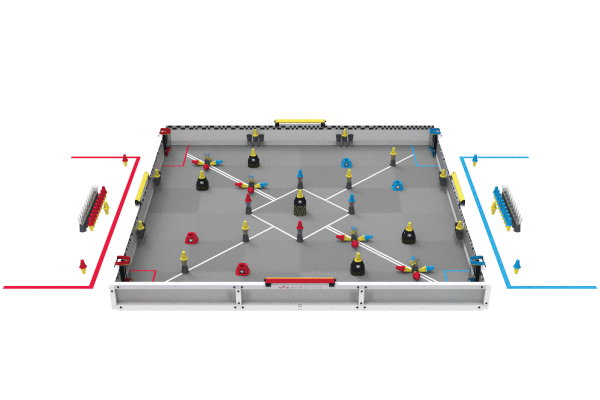
Figure FO-1: An overhead view of the V5RC Push Back Field, with Alliance Stations (orange), Loaders (yellow), Park Zones (pink), and Goals (green) highlighted.
Figure FO-2: An overhead view of the V5RC Push Back Field in its starting configuration, with highlighted Blocks (Red / Blue).
Figure FO-3: The recommended locations of the Field Monitor (green), Head Referee (black & white stripes), and Scorekeeper Referees (black & white checkerboard).
General Definitions
Adult - Anyone who is not a Student or another defined term (e.g., Head Referee).
Alliance - A pre-assigned grouping of two (2) Robots that are paired together during a given Match.
Alliance Station - The designated regions where the Drive Team Members must remain for the duration of the Match.
Autonomous Bonus - A point bonus awarded to the Alliance that has earned the most points at the end of the Autonomous Period. See <SC5> for more information.
Autonomous Win Point (AWP) - An additional Win Point awarded to any Alliance that has completed a defined set of tasks at the end of the Autonomous Period of a Qualification Match. Both Alliances can earn an Autonomous Win Point if both Alliances accomplish these tasks. See <SC6> for more information.
Defensive - A category of strategies, Robot actions, and/or Robot statuses that can be employed by a Team during a Match; see rules <GG14> and <GG15> for more information. A Robot is Defensive while it is engaged in actions that cannot increase its Alliance's score for the current Match, and instead limits an opponent’s ability to score or play the game. A Robot can be in possession of a scoring object and capable of scoring, but still be Defensive based on its actions. Examples include, but are not limited to:
- De-scoring in a way that doesn't increase points for the Robot's own Alliance
- Limiting access to a portion of the Field while not attempting to score
- Holding, blocking, impeding, or otherwise restricting or controlling an opponent’s movements
- Goalkeeping
Disablement - A penalty applied to a Team for a safety Violation. A Team that receives a Disablement is not allowed to operate their Robot for the remainder of the Match, and the Drive Team Member(s) will be asked to place their controller(s) on the ground or another safe location outside of the Field, as directed by the Head Referee.
Disqualification - A penalty applied to a Team for a Major Violation. A Team that receives a Disqualification in a Qualification Match receives zero (0) Win Points, (0) Autonomous Win Points, (0) Autonomous Points, and (0) Strength of Schedule Points. When a Team receives a Disqualification in an Elimination Match, the entire Alliance is Disqualified and they receive a loss for the Match. At the Head Referee’s discretion, repeated Violations and/or Disqualifications for a single Team may lead to its Disqualification for the entire tournament (see <GG6>). A Team that receives a Disqualification in a Driving Skills Match or Autonomous Coding Skills Match receives a score of zero (0) for that Robot Skills Match.
Drive Team Member - A Student who stands in the Alliance Station during a Match. Adults are not allowed to be Drive Team Members. See rule <GG1>.
Entanglement - A Robot status. A Robot is Entangled if it has grabbed, hooked, or attached to an opposing Robot or a Field Element. See rule <GG14>.
Field - The entire playing Field, comprising of the Floor and the Field Perimeter.
Field Element - The Field, white tape, Loaders, Goals, Park Zones, and all supporting structures and accessories (such as field monitors, etc.).
Field Perimeter - The outer part of the Field, made up of 12 straight sections.
Floor - The interior flat part of the playing Field, made up of an array of six (6) gray foam field tiles wide by six (6) gray foam field tiles long (totaling 36 field tiles) that are within the Field Perimeter.
Game Design Committee (GDC) - The creators of Push Back, and authors of this Game Manual. The GDC is the only official source for rules clarifications and Q&A responses; see Section 1.
Holding - A Robot status; see rule <GG17> for more information. Holding is legal until it exceeds the limits in <GG17>. A Robot is considered to be Holding if it meets any of the following criteria during a Match:
- Trapping - Limiting the movement of an opponent Robot to a small or confined area of the Field, approximately the size of one foam field tile or less, without an avenue for escape. Note that if a Robot is not attempting to escape, it is not considered Trapped.
- Pinning - Preventing the movement of an opponent Robot through contact with the Field Perimeter, a Field Element, or another Robot.
- Lifting - Controlling an opponent’s movements by raising or tilting the opponent’s Robot off of the foam tiles. Preventing a Robot that is already off of the Floor from returning to the Floor may also be considered Lifting or Trapping.
Match - A set time period, consisting of a Autonomous Period and/or Driver Controlled Periods, during which Teams play a defined version of Push Back to earn points.
- Autonomous Period - A time period during which Robots operate and react only to sensor inputs and pre-programmed commands.
- Driver Controlled Period - A time period during which Drive Team Members operate their Robot via remote control.
Match Type |
Participants |
Specific Rules |
Autonomous Period (m:ss) |
Driver Controlled Period (m:ss) |
|---|---|---|---|---|
Head-to-Head |
Two Alliances (red/blue), each composed of two Teams, with one Robot each |
Scoring (“SC”), General Game (“GG”) and Specific Game (“SG”) sections |
0:15 |
1:45 |
One Team, with one Robot |
Section 4 |
None |
1:00 |
|
One Team, with one Robot |
Section 4 |
1:00 |
None |
|
VEX U Robotics Competition Head-to-Head |
Section 6 |
0:30 |
1:30 |
|
VEX U Robotics Competition Driving Skills Match |
Section 6 |
None |
1:00 |
|
VEX U Robotics Competition Autonomous Coding Skills Match |
Section 6 |
1:00 |
None |
|
VEX AI Robotics Competition Head-to-Head |
Section 7* |
0:15 |
1:45 |
|
VEX AI Robotics Competition Autonomous Coding Skills Match |
Section 7* |
1:00 |
None |
*Note: The time periods in VAIRC are referred to as the Isolation Period and the Interaction Period.
Offensive - A category of strategies, Robot actions, and/or Robot statuses that can be employed by a Team during a Match; see rules <GG14> and <GG15> for more information. A Robot is Offensive while it is engaged in actions that could directly increase its Alliance's score for the current Match. Examples include, but are not limited to:
- Adding an object to a Goal to score points
- Moving toward a Goal with an object that could earn points for their Alliance
- Changing the status of a Field Element or scoring object that acts as a multiplier or scoring bonus for their Alliance
- Achieving (or attempting to achieve) any Robot status that adds points to their Alliance's score
- Obtaining (or attempting to obtain) scoring objects
Robot - A machine that has passed inspection, designed by Student Team members to execute one or more tasks autonomously and/or by remote control from a Drive Team Member.
Student - A person is considered a Student if they meet both of the following criteria:
- Anyone who is earning or has earned credit toward a secondary school (i.e., high school) diploma, certificate, or other equivalent during the six (6) months preceding the VEX Robotics World Championship. Courses earning credits leading up to high school would satisfy this requirement.
- Anyone born after May 1, 2006 (i.e., who will be 19 or younger at VEX Worlds 2026). Eligibility may also be granted based on a disability that has delayed education by at least one year.
- Middle School Student - A Student born after May 1, 2010 (i.e., who will be 15 or younger at VEX Worlds 2026). Any Students who meet this criteria may also compete as High School Students.
- High School Student - Any eligible Student that is not a Middle School Student.
Team - One or more Students make up a Team. To participate in an official VEX V5 Robotics Competition event, a Team must first register on RobotEvents.com and receive a VEX V5 Robotics Competition Team number. A Team's unique number identifies their organization and their Team within that organization. Each Team must build their own Robot, create their own code, and maintain their own Engineering Notebook if they choose to use one.
- A Team is classified as a Middle School Team if all members are Middle School Students.
- A Team is classified as a High School Team if any of its members are High School Students, or if the Team is made up of Middle School Students who declare themselves “playing up” as High School Students by registering their Team as a High School Team.
- Once a Team has competed in an event as a High School Team, that Team may not change back to a Middle School Team for the remainder of the season. If a Team mistakenly registers as a Middle School Team but is ineligible for that age group, their registration may be revised mid-season with RSM assistance; all prior qualifications for the season will be lost.
- Teams may be associated with schools, community/youth organizations, or groups of neighborhood Students.
In the context of this Game Manual, Teams include three types of Student roles related to Robot build, design, and coding. See <G2> and <G5> for more information. Adults may not fulfill any of these roles.
- Builder - The Student(s) on the Team who assemble(s) and repair(s) the Robot. Adults are permitted to teach the Builder(s) how to use concepts or tools associated with Robot construction, but should never work on the Robot.
- Coder - The Student(s) on the Team who write(s) the computer code that is downloaded onto the Robot. Adults are permitted to teach the Coder(s) how to use concepts or tools associated with programming, but should never work on the code that goes on the Robot.
- Designer - The Student(s) on the Team who design(s) the Robot. Adults are permitted to teach the Designer(s) how to use concepts or tools associated with design, but should never work on the design of the Robot.
Time Out - A single break period no greater than three minutes (3:00) allotted for each Alliance during the Elimination Bracket. See <GG7>.
Violation - The act of breaking a rule in the Game Manual.
- Minor Violation - A Violation which does not result in a Disqualification.
- Accidental, momentary, or otherwise non Match Affecting Violations are usually Minor Violations.
- Minor Violations usually result in a verbal notification from the Head Referee during the Match, which should serve to inform the Team that a rule is being Violated before it escalates to a Major Violation.
- Major Violation - A Violation which results in a Disqualification.
- Unless otherwise noted in a rule, all Match Affecting Violations are Major Violations.
- If noted in the rule, egregious or strategic Violations or intentional actions that result in Violations may also be Major Violations.
- Multiple Minor Violations within a Match or tournament may escalate to a Major Violation at the Head Referee’s discretion or as specified in a rule. Minor Violations carry over into Eliminations unless otherwise specified within a rule.
- Match Affecting - A Violation which changes the winning and losing Alliance in the Match.
- Multiple Violations within a Match can cumulatively become Match Affecting.
- When evaluating if a Violation was Match Affecting, Head Referees will focus primarily on any Robot actions that were directly related to the Violation.
- Determining whether a Violation was Match Affecting can only be done once the Match is complete and the scores have been calculated.
- CoC-related Violation - A Violation of a rule that relates to the RECF Code of Conduct and related processes. For V5RC, VURC, and VAIRC, the included rules are: <S2>, <G1>,<G2>, <G4>, <G5>, <R1> through <R4>, and Major Violations of <S1>.
- Potential CoC-related Violations should be brought to the attention of the Event Partner, and resolved through the Code of Conduct Reporting Process in coordination with the Head Referee, Judge Advisor, and RECF Regional Support Manager. Follow-up investigations are conducted by the RECF Rules & Conduct Committee (RCC). Penalties for confirmed CoC-related Violations can range from single-Match Disqualifications to removal from the program.
Some rules include Violation Notes in red italicized text to denote special circumstances or provide additional clarifications. If no Violation Notes are found in a given rule, then it should be assumed that the above “default” definitions apply.
To determine whether a Violation may have been Match Affecting, check whether the Team who committed the Violation won or lost the Match. If they did not win the Match, then the Violation could not have been Match Affecting, and it was very likely a Minor Violation.
See the flowcharts in figures V-1, V-2, and V-3 for more information, and this article for full details of the event CoC process.
Figure V-1: The process for determining Violations during Robot inspection.
Figure V-2: The process for determining whether or not an infraction should result in a Major Violation or Minor Violation
Figure V-3: The process for determining CoC-related Violations
Game-Specific Definitions
Autonomous Line - The pair of white tape lines that run across the Field, and the space between those lines. See <SG7> for more information.
Block - A blue or red 18-sided hollow plastic polygonal object with flat faces and a weight of approximately 40 grams. Each cross-section measures approximately 3.25” (82mm) between pairs of opposing flat faces, and 3.85” (98mm) between pairs of opposing corners.
Figure B-1: A Block
Control Zone - A defined section of a Goal that can be Controlled by an Alliance at the end of a Match.
- Long Goal - The Control Zone for a Long Goal consists of the space between (but not including) the white tape lines (highlighted in green in Figure CZ-1), and holds up to three (3) Blocks.
- Center Goal, Upper and Lower - The Control Zone for a Center Goal includes the entire Goal.
Figure CZ-1: The Control Zone (highlighted green) of a Long Goal consists of the volume between the white tape lines, as shown.
Controlled - A Control Zone status that is assessed at the end of the Autonomous Period and the end of the Match. A Control Zone is Controlled by an Alliance if a majority of the Blocks in that Control Zone are that Alliance’s color. See rule <SC3> for details.
Goal - A Field Element that is constructed out of plastic and metal components into which Blocks can be Scored. Each Long Goal has a completely enclosed center section between two open sections. Each Goal includes a defined Control Zone.
- Long Goal - Each Long Goal is 48.8” (1239mm) in length, with a 13.33” (339mm) enclosed center section.
- Center Goal, Upper and Lower – Each Center Goal is 22.6” (574mm) in length.
Figure G-1: A Long Goal
Figure G-2: A Center Goal
Goalkeeping - A Robot status and/or Robot action. In Push Back, a Robot is Goalkeeping while it is reaching into any open portion of a Goal while not attempting to change the score of the Match through legal means. A Robot can be in possession of a Block and capable of scoring, but still be Goalkeeping based on its actions. See <SG10> for more information.
Loader - One of four 21.34” (542mm) tall plastic and rubber structures that are attached to the Field Perimeter. Robots may remove Blocks from Loaders during a Match, and Drive Team Members may add Match Load Blocks to Loaders during the Match (see <SG9> for details). Each Loader begins the Match containing (6) Blocks.
Figure L-1:A Loader
Match Load - One of the 24 Blocks, 12 per Alliance, that begin the Match in an Alliance Station and which may be introduced during the Match. See <SG9> for more information.
Parked - A Robot status at the end of the Match. See <SC4>.
Park Zone - A Field Element and enclosed section of the Floor that mark a location where Blocks begin a Match and Robots can be Parked at the end of the Match. Park Zones are made of red or blue plastic extrusions and black plastic connectors, and include the enclosed portions of the Field Tiles. Each Park Zone is 18.87“ (479mm) wide x 16.86” (428mm) deep.
Figure PZ-1:A Park Zone
Scored - A Block status. See <SC2>.
Scoring
10 Points |
|
3 Points |
|
Each Controlled Zone in a Long Goal |
10 Points |
Controlled Center Goal - Upper |
8 Points |
Controlled Center Goal - Lower |
6 Points |
8 Points |
|
30 Points |
<SC1> All Scoring statuses are evaluated after the Match ends. Scores are calculated five (5) seconds after the Match ends, or once all Blocks, Field Elements, and Robots on the Field come to rest, whichever comes first.
- This 5-second delay is intended to be the only permitted “benefit of the doubt” for last-second scoring actions. If an object or Robot is still in motion and “too close to call” between two states at the 5-second mark, then the less advantageous of the two states should be awarded to the Robot(s) in question. For example:
- At the end of the Match, the on-screen timer displayed by Tournament Manager will hold the current Match information and “0:00” for five (5) seconds before moving to queue the next Match. This should be the primary 5-second visual cue used by Teams and Head Referees.
- This 5-second delay is only intended to be a “benefit of the doubt” grace period, not an extra five (5) seconds of Match time. Robots which are designed to strategically exploit this grace period will receive a Minor Violation, and any post-Match movement will not be included in score calculation (i.e., the Match will be scored as it was at 0:00).
- Referees should avoid contacting or moving Robots and/or Blocks as much as possible while evaluating Scoring statuses. If an object must be moved to evaluate the status of another object, its status must be agreed upon by all Teams and the Head Referee, and noted or recorded, before it is moved.
- Referees must record counts based on verified scoring statuses evaluated after the Match, using final positions of Blocks, Field Elements, and Robots. Point considerations used to determine whether a Violation is Match Affecting (e.g., specified in Violation Notes) should NOT be added to or deducted from the actual score, and points scored during a Violation should not be deducted from a score.
<SC2> A Block is considered Scored if it meets all of the following criteria:
- The Block is in contact with the inside surface(s) of the clear plastic part of a Goal.
- The edge faces of the clear plastic parts are not considered inside surfaces.
- The Block is not in contact with a Robot of the same color as that Block.
- The Block is not in contact with the Floor.
Significant Q&As:
- 2737 - Edge-case examples of scored and not scored Blocks
<SC3> A Control Zone is considered Controlled by an Alliance if a majority of the Blocks Scored in that Control Zone are the same color as the Alliance.
- For Long Goals, a Scored Block is considered Scored in the Control Zone if it is entirely contained within that Control Zone.
- A Block must be considered Scored in a Goal (see <SC2>) to also be considered Scored in a Control Zone.
In most cases, if you can’t see a little bit of the next Block on the “inside” of the tape line (see figure SC3-2), the Block on that side of the Control Zone probably isn’t entirely contained within the Control Zone.
It’s not practical to examine every Block at a detailed level to decide whether it’s “entirely within” or not. If a Head Referee can’t definitively tell whether a Block is entirely contained within a Control Zone or not, that Block should be considered Scored in the Control Zone. Teams should not be invited into the Field to contribute opinions; this decision is up to the Head Referee.
Figure SC3-1: The left-most (red) Block is not fully within the tape lines marking the boundaries of the Control Zone, and therefore would not be considered in determining which Alliance is in control of the Goal. The three other (green) Blocks are fully within the tape lines, and would be considered.
Figure SC3-2:The (green) Block on the right is fully within the tape boundaries, and would be considered as scored.
Significant Q&As:
- 2789 -The top surface of the Goal is the “tiebreaker” if there’s slight variance in the tape lines
<SC4> A Robot is considered Parked if it meets all of the following criteria:
- The Robot is not contacting the Floor outside of its Alliance-colored Park Zone.
- The Robot is not contacting any Field Elements other than the inside face of the Field Perimeter, the Floor inside of its Alliance-colored Park Zone, and/or the plastic extrusions and connectors that are part of the Park Zone. Contact with these allowed elements is not required.
- The Robot is at least partially within the vertical projection of its Alliance-colored Park Zone.
Significant Q&As:
- 2672 - Contact with Blocks doesn’t affect a Parked status
<SC5> Scoring of the Autonomous Bonus is evaluated immediately after the Autonomous Period ends (i.e., once all Blocks, Field Elements, and Robots on the Field come to rest).
- Points for Parked Robots are not included in the calculation of an Alliance’s score for the purposes of determining the Autonomous Bonus.
- If the Autonomous Period ends in a tie, including a zero-to-zero tie, each Alliance will receive an Autonomous Bonus of five (5) points.
- Any Violations, Major or Minor, committed during the Autonomous Period will result in the Autonomous Bonus being automatically awarded to the opposing Alliance. See <GG13>.
- Per rule <GG13>, if both Alliances commit Violations during the Autonomous Period, then no Autonomous Bonus will be awarded.
<SC6> An Autonomous Win Point is awarded to any Alliance that ends the Autonomous Period with all of the following tasks completed, and that has committed no Violations during the Autonomous Period:
- At least seven (7) Blocks of the Alliance’s color are Scored.
- At least three (3) different Goals include at least one (1) Scored Block of the Alliance’s color.
- At least three (3) Blocks of the Alliance’s color have been removed from Loaders adjacent to the Alliance’s Alliance Station.
- Neither Robot is contacting the Park Zone barrier.
For events which qualify directly to the World Championship (e.g., Event Region Championships and Signature Events), the following tasks must be completed for an Alliance to receive an Autonomous Win Point. The standard criteria above still apply to all other events.
- At least ten (10) Blocks of the Alliance’s color are Scored.
- At least three (3) different Goals include at least two (2) Scored Blocks of the Alliance’s color.
- At least three (3) Blocks of the Alliance’s color have been removed from Loaders adjacent to the Alliance’s Alliance Station.
- Neither Robot is contacting the Park Zone barrier.
Autonomous Win Point criteria may be further modified for the World Championship if needed, with details to be released in a future Game Manual update.
Autonomous Win Point criteria for World Championship-qualifying events will be used as a baseline to determine criteria for the World Championship. Any potential modifications will be minor, and will provide an increased challenge over the criteria listed above. For example, one possibility could be ”At least twelve (12) Blocks Scored,” instead of ten (10).
This rule is applied differently for VEX U. See Rule <VUG4>.
Safety Rules
<S1> Be safe out there. If at any time the Robot operation or Team actions are deemed unsafe or have damaged a Field Element, Block, or the Field, the offending Team may receive a Disablement and/or Disqualification at the discretion of the Head Referee. The Robot will require re-inspection as described in rule <R3> before it may take the Field again.
Violation Notes: Major Violations should be reported to and/or discussed with the Event Partner during the event, and should be reported to the REC Foundation Rules and Conduct Committee following the event.
<S2> Students must be accompanied by an Adult. No Student may attend a V5RC event without a responsible Adult supervising them. The Adult must obey all rules and be careful to not violate Student-centered policies, but must be present for the full duration of the event in the case of an emergency. Violations of this rule may result in removal from the event.
Violation Notes: Violations should be reported to the Event Partner during the event, and should be reported to the REC Foundation Rules and Conduct Committee following the event.
<S3> Stay inside the Field. If a Robot is completely outside of the Field during a match, it will receive a Disablement for the remainder of the Match.
Note: The intent of this rule is not to penalize Robots for having mechanisms that inadvertently cross the Field Perimeter during normal game play.
<S4> Wear safety glasses. All Drive Team Members must wear safety glasses or glasses with side shields while at the Field for Matches. While in the pit and queuing areas, it is highly recommended that all Team members wear safety glasses.
<S5> Each Student Team member must have a completed participant release form on file for the event and season. A Student Team member cannot participate in an event without a completed release form on file.
General Rules
<G1> Treat everyone with respect. All Teams are expected to conduct themselves in a respectful and professional manner while competing in VEX V5 Robotics Competition events. If a Team or any of its members (Students or any Adults associated with the Team) are disrespectful or uncivil to event staff, volunteers, or fellow competitors, they may receive a Disqualification from a current or upcoming Match. Team conduct pertaining to <G1> may also impact a Team’s eligibility for judged awards. Repeated or extreme Violations of <G1> could result in a Team being Disqualified from an entire event, depending on the severity of the situation.
We all can contribute to creating a fun and inclusive event experience for all event attendees. Some examples include:
When dealing with difficult and stressful situations, it is…
- Okay for Teams to be gracious and supportive when your Alliance partner makes a mistake.
- Not okay for Teams to harass, tease, or be disrespectful to your Alliance partner when a Match does not go your way.
When a Team does not understand a Match ruling or score, it is…
- Okay for Drive Team Members to consult with a Head Referee to discuss a ruling per the process outlined in <T3> in a calm and respectful manner.
- Not okay for Drive Team Members to continue arguing with the Head Referees after a decision has been finalized, or for Adults to approach a Head Referee with ruling/scoring concerns.
This rule exists alongside the REC Foundation Code of Conduct. Violation of the Code of Conduct can be considered a Major Violation of <G1> and can result in Disqualification from a current Match, an upcoming Match, an entire event, or (in extreme cases) an entire competition season. The Code of Conduct can be found here.
More information regarding the event Code of Conduct process can be found here.
- Event attendees are not allowed to record audio or video of Teams’ discussions with Head Referees or other event staff/volunteers.
Violation Notes: Any Violations of <G1> may be considered Major Violations and should be addressed on a case-by-case basis. Teams at risk of a Major Violation of <G1> due to multiple disrespectful or uncivil behaviors will usually receive a “final warning,” although the Head Referee is not required to provide one. All Major <G1> Violations/Disqualifications should be reported to and/or discussed with the Event Partner during the event, and should be reported to the REC Foundation Rules and Conduct Committee following the event.
Significant Q&As:
- Q&A 2871 - Manipulating Match results by playing beneath your abilities can be a G1 Violation, but isn’t in all cases
<G2> V5RC is a student-centered program. Adults should not make decisions about the Robot’s build, design, or gameplay, and should not provide an unfair advantage by providing ‘help’ that is beyond the Student’s independent abilities. Students must be prepared to demonstrate an active understanding of their Robot’s design, construction, and programming to judges or event staff. Students should build, design, and code the Robot with minimal Adult involvement.
Some amount of Adult mentorship, teaching, and/or guidance is an expected and encouraged facet of VEX competitions. No one is born an expert in robotics! However, obstacles should always be viewed as teaching opportunities, not problems for an Adult to solve for the Team.
When building or designing the Robot, it is…
- Okay for an Adult to help a Student consider why something failed, so it can be improved.
- Not okay for an Adult to provide step-by-step instructions or photos for the Student to copy.
When a mechanism falls off, it is…
- Okay for an Adult to help a Student consider why it failed, so it can be improved.
- Not okay for an Adult to investigate or put the Robot back together.
When a Team encounters a complex programming concept, it is…
- Okay for an Adult to guide a Student through a flowchart to understand its logic.
- Not okay for an Adult to write a premade command for that Student to copy/paste.
During Match play, it is…
This rule operates in tandem with the REC Foundation Student Centered Policy, which is available in the REC Library for Teams to reference throughout the season.
Significant Q&As:
- 2676 - Adults should not provide an unfair advantage by helping Students create custom plastic parts
Violation Notes: Potential Violations of this rule will be reviewed on a case-by-case basis. By definition, all Violations of this rule become Match Affecting as soon as a Robot which was built or coded by an Adult wins a Match. All reported and/or suspected <G2> Violations should be reported to the Event Partner during the event, and should be reported to the REC Foundation Rules and Conduct Committee following the event.
<G3> Use common sense. When reading and applying the various rules in this document, please remember that common sense always applies in the VEX V5 Robotics Competition.
For example…
- If there is an obvious typographical error (such as “per <T5>” instead of “per <GG5>”), this does not mean that the error should be taken literally until corrected in a future update.
- Understand the realities of the VEX V5 Robot construction system. For example, if a Robot could hover above the Field for a whole Match, that would create loopholes in many of the rules. But... they can’t. So don’t worry about it.
- When in doubt, if there is no rule prohibiting an action, it is generally legal. However, if you have to ask whether a given action would violate <S1>, <G1>, or <T1>, then that’s probably a good indication that it is outside the spirit of the competition.
- In general, Teams will be given the “benefit of the doubt” in the case of accidental or edge-case rules infractions. However, there is a limit to this allowance, and repeated or strategic infractions will still be penalized.
- This rule also applies to Robot rules. If a component’s legality cannot be easily/intuitively discerned by the Robot rules as written, then Teams should expect additional scrutiny during inspection. This especially applies to those rules which govern non-VEX components (e.g. <R19>, <R20>, <R23>, etc). There is a difference between “creativity” and “lawyering.” Basically, if there’s not a rule that makes a Robot part legal, it’s not allowed.
<G4> All work must represent the skill level of the Students on the Team. The Team’s design, Robot, coding, strategy, and ongoing work must represent the skill level of the Students currently on the Team.
- Teams must avoid academic dishonesty and should not copy a Robot or mechanism that has been provided for them. This includes, but is not limited to, the use of instructions, pictures & videos, notebooks, CAD designs, and/or any other documentation useful to the design process provided by anyone that is not a Student on the Team (including Students on another Team).
- Teams may be inspired by designs by other Teams, and use an idea from someone else to spark innovation, but are expected to document and demonstrate this in their engineering notebook alongside evidence of iteration. Teams are required to present this evidence if asked to do so by a Robot inspector, Head Referee, Event Partner, or Judge.
- Using elements of another design as a starting point is acceptable if the Team is capable of demonstrating evidence of iteration, innovation, and/or modification that makes the design uniquely their own. Documentation should clearly demonstrate the idea that was used for inspiration, and how it was changed for the final implementation on the Team’s Robot. It should be clear that this final implementation is not an exact copy of ANY other original design.
- Failure to demonstrate evidence of iteration, innovation, and/or modification will result in a Violation.
- Teams may use Robot plans and code (e.g., the annual Hero Bot, VEXcode configurations, etc.) provided by VEX Robotics or the RECF, but are encouraged to use these Robots, mechanisms, and code only as a starting point that Students modify, improve, or replace as their skills increase. Plans provided by VEX Robotics or the RECF are the only legal plans available for use in competition.
- This rule still applies to Teams within the same school, organization, or club. Robots and/or code sets that are identical or substantially similar to one another across Teams within the same school/organization/club will be considered in Violation of this rule, regardless of whether they compete in the same or different events.
- 2677 - Teams may only use custom parts that were designed and created by the Students on that Team
- 2823 - Excerpts from the Student-Centered Policy about code, templates, and libraries
- 2834 - Specific G4 scenarios and clarifications
- 2843 - Ownership of ideas when students legally change teams
- 2850 - Holecounting a design is not the same as being inspired by it
- Teams believed to be in Violation of this rule should be reported to the Judge Advisor, Head Referee, or Event Partner for further investigation in coordination with the RSM. Based on the investigation the Team may be removed from further Matches, have their Robot Skills Challenge scores removed, and/or be removed from consideration from judged awards.
- Violations of this rule will be evaluated on a case-by-case basis, in tandem with the RECF Student Centered Policy as noted in <G2>, and the REC Foundation Code of Conduct as noted in <G1>. All reported and/or suspected <G4> Violations should be reported to the Event Partner during the event, and should be reported to the RECF Rules and Conduct Committee following the event.
- Team members may only move from one Team to another for non-strategic reasons outside of the Team's control.
- Examples of permissible moves may include, but are not limited to, changing schools, conflicts within a Team, or combining/splitting Teams.
- Examples of strategic moves in Violation of this rule may include, but are not limited to, one Coder “switching” Teams in order to program multiple Robots, one Student designing multiple teams’ Robots, or one Student writing the Engineering Notebook for multiple Teams.
- If a Student leaves a Team to join another Team, <G4> still applies to the Students remaining on the previous Team. For example, if a Coder leaves a Team, then that Team’s Robots must still represent the skill level of the Team without that Coder. One way to accomplish this would be to ensure that the Coder teaches or trains a “replacement” Coder in their absence.
- Points ii and iii are intended to represent real-world situations that are found in industry engineering. If a vital member of a professional engineering team were to suddenly leave, the remaining members of the team should still be capable of working on / maintaining their project.
- When a Team qualifies for a Championship event (e.g., States, Nationals, Worlds, etc.) the Students on the Team attending the Championship event are expected to be the same Students on the Team that was awarded the spot. Students can be added as support to the Team, but may not be added as Drive Team Members or Coders for the Team.
- An exception is allowed if only one (1) member of the Team is able to attend the event. The Team can make a single substitution of a Drive Team Member or Coder for the Championship event with another Student, even if that Student has competed on a different Team. This Student will now be a member of this new Team and may not substitute back to the original Team during the season.
For more information, including acceptable and unacceptable examples of mechanical design, construction, coding, and strategy solutions, please refer to the Student Centered Policy in the RECF Library.
The VEX Robotics Competition and the Robotics Education & Competition Foundation (RECF) recognize that many third-party individuals and organizations produce and distribute Robot designs, instructions, and/or other materials that are not under our direct control. We cannot legally regulate or restrict the activities of these external entities. However, when Teams use these resources in ways that violate the spirit and letter of the VEX Robotics Game Manual—particularly Rules <G2> and <G4>—they undermine the core mission of the program: to provide Students with hands-on opportunities to learn, design, and innovate.
While it is never our intent to punish Students, we can legally regulate and restrict the activities of the Teams in our competitions, and we must preserve the fairness, educational value, and integrity of the competition. Therefore, Teams found to be in Violation of these rules will be held accountable to the strictest interpretations of <G2> and <G4>.
It is the responsibility of each Team to be able to explain and defend the design, construction, and programming of their Robot if questioned by referees, inspectors, Event Partners, or judges. Teams should be prepared to describe their design process, justify design decisions, and demonstrate a full understanding of how their Robot and code function.
If a Team is unable, for any reason, to provide reasonable evidence (when requested by event staff) that their Robot and code are the result of their own work, it is appropriate to assume that the Team is in Violation of <G2> and/or <G4>.
Event organizers cannot reasonably know the origins of every design or independently verify whether a Robot was created from scratch, purchased online, or copied from pictures of another Team’s design. When questions of authenticity arise, the only direct and fair approach is to require Students to explain and defend their work. This is not unlike academic honesty concerns in schools, and intellectual property concerns in business. By requiring Students to defend their designs, we ensure that they are developing not only technical skills, but effective communication skills and accountability, as well.
Consequences may include disqualification from matches, removal from events, and/or escalation of the investigation to VEX Robotics and the RECF for further disciplinary action, which may include sanctions up to and including removal from the program.
Event staff should bear in mind <G3>, and use common sense when enforcing this rule. It is not the intent to actively hunt for Violations of this rule, compare every Robot at an event to all other known Robot designs, or closely question every team at an event about their Robot's code. This rule is a set of tools for use if potential Violations are noted by or reported to event staff, and it is expected that most Teams will never be required to defend their Robot design or code.
Teams or individuals who deliberately weaponize, manipulate, or falsely report <G4> Violations for competitive gain or to harass another Team may be subject to a separate RECF Code of Conduct investigation. Misuse of this rule is considered a serious Violation.
Significant Q&As:
Violation Notes:
<G5> Each Student can only belong to one Team. Each Team must include Drive Team Members, Coder(s), Designer(s), and Builder(s). Many also include notebooker(s). No Student may fulfill any of these roles for more than one VEX V5 Robotics Competition Team in a given competition season. Students may have more than one role on the Team, e.g., the Designer may also be the Builder, the Coder, and a Drive Team Member.
Note: Teams cannot “borrow” Students from other Teams to serve as Drive Team Members, Coders, Designers and Builders or notebookers. However, Teams can add permanent members throughout the season under the guidelines of this rule.
Violation Notes: Teams believed to be in Violation of this rule should be reported to the Judge Advisor, Head Referee, or Event Partner for further investigation in coordination with the RSM.
Event Partners should bear in mind <G3>, and use common sense when enforcing this rule. It is not the intent to punish a Team who may change Team members over the course of a season due to illness, changing schools, conflicts within a Team, etc.
Event Partners and referees are not expected to keep a roster of any Student who has ever been a Drive Team Member for one day. This rule is intended to block any instance of loaning or sharing Team members for the sole purpose of gaining a competitive advantage.
General Game Rules
<GG1> Only Drive Team Members, and only in the Alliance Station. During a Match, Robots may be operated only by the Drive Team Members and/or by software running on the Robot’s control system in accordance with <R11> and <GG11>. A Team may send up to three (3) Drive Team Members to their Alliance Station for each Robot, and those Drive Team Members must remain in their Alliance Station for the duration of the Match.
Drive Team Members are the only Team members that are allowed to be in the Alliance Station during a Match. Adults (other than event staff) are not permitted to be in the Alliance Station during a Match.
- Drive Team Members are prohibited from any of the following actions during a Match:
- Using any sort of communication device in the Alliance Station. Non-headphone devices with communication features turned off (e.g. a phone in airplane mode or a walkie talkie turned off) are allowed. If communication features are needed for translation apps during post-Match discussions, it should not be considered a Violation.
- Standing or sitting on any sort of object during a Match, regardless of whether the Field is on the floor or elevated, except as required by an official accommodation request that has been approved by the REC Foundation.
- Bringing/using additional materials to simplify the game challenge during a Match.
- To ensure that Drive Team Members are aware of verbal calls during a Match (as an application of rules <T1>, <G1>, <S1>, and <G3>), powered headphones, earbuds, and/or passive earpieces connected to electronic devices cannot be worn/used in the Alliance Station except as required by an official accommodation request that has been approved by the REC Foundation.
- Individuals who are not Drive Team Members for a Match cannot provide directions, commands, or advice to the Drive Team Members during that Match. They're welcome to provide cheerful, positive encouragement, but should not affect Match play or strategy.
Point iii is intended to refer to non-Robot-related items that directly influence gameplay, such as a speaker that plays a buzzer sound to distract your opponent. Provided no other rules are violated, and the items do not pose any safety or Field damage risks, the following examples are not considered Violations of <GG1>:
Violation Notes: Major Violations of this rule are not required to be Match Affecting, and could invoke Violations of other rules, such as <G1>, <G2>, or <G4>.
<GG2> A Team’s Robot should attend every Match. The Team’s Robot must report to the Field for the Team’s assigned Match, even if the Robot is not functional. If the Robot is not at the Field for the entire duration of the Match, the Team will be considered a “no-show” and receive zero (0) Win Points, Autonomous Win Points, Autonomous Points, and Strength of Schedule Points.
- Teams are expected to participate in all scheduled Qualification Matches, Alliance Selection, and Elimination Matches(if they’re an Alliance Captain or were selected to join an Alliance for Elimination Matches). Failure to attend scheduled Matches or Alliance Selection may be considered a Violation of <G1> and the Code of Conduct. Teams that participate in zero Qualification Matches cannot be considered for Judged Awards.
Significant Q&As:
- 2733 - A Robot has to be at least in the Alliance Station to avoid a no-show
<GG3> Robots on the Field must be ready to play. When a Team puts their Robot on the Field, it must be prepared to play (e.g., batteries charged, sized within the starting size constraint, includes only the correct Alliance-color license plates, etc.).
- Teams who use VEX pneumatics must have their systems charged before they place the Robot on the Field.
- Robots must be placed on the Field promptly. Repeated failure to do so could result in a Violation of <G1>. The exact definition of the term “promptly” is at the discretion of the Head Referee and Event Partner, who will consider event schedule, previous Violations or delays, etc.
- If a Robot is delaying the scheduled start of a Match, it may be removed from the Field at the discretion of the Head Referee and Event Partner. The Robot may remain at the Field so that the Team does not get assessed a “no-show” (per <GG2>).
- If a Robot is not placed on the Field prior to the start of a Match, it cannot be placed on the Field during that Match.
- If an event is using Smart Field Control and a Robot is unable to successfully connect to Smart Field Control prior to the scheduled start of a Match, the Head Referee may ask the Team to remove their Robot from the Field in accordance with clause C.
<GG4> Hands out of the Field. Drive Team Members are prohibited from making intentional contact with any Blocks, Field Elements, or Robots during a Match, apart from the contact specified in <GG4a> or while introducing Match Loads as described in rule <SG9>.
- During the Driver Controlled Period, Drive Team Members may only touch their own Robot if the Robot has not moved at all during the Match. Touching the Robot in this case is permitted only for the following reasons:
- Turning the Robot on or off.
- Plugging in a battery.
- Plugging in a V5 Robot Radio.
- Touching the V5 Robot Brain screen, such as to start a program.
Note: Movement caused by an external force, such as another Robot, should not prevent a Drive Team Member from interacting with their Robot under this rule.
- Drive Team Members are not permitted to reach into the 3-dimensional volume of the Field Perimeter at any time during the Match, apart from the actions described above. Rule <S1> applies.
- Transitive contact, such as contact with the Field Perimeter that causes the Field Perimeter to contact Field Elements or Blocks inside of the Field, could be considered a Violation of this rule.
- Any concerns regarding Field Element or Block starting positions should be raised with the Head Referee prior to the Match. Team members may never adjust Blocks or Field Elements themselves.
If a Drive Team Member's hands extend over the Field and/or Field Perimeter in a way that is safe and doesn’t contact anything in the Field, it’s unlikely to be a Violation. However, Head Referees may still ask Drive Team Members to step back and remain completely outside the field when necessary (e.g., for safety reasons or to reduce the chances of gameplay interference).
<GG5> Match replays are allowed, but rare. Match replays (i.e., playing a Match over again from its start) must be agreed upon by both the Event Partner and Head Referee, and will only be issued in the most extreme circumstances. Some example situations that may warrant a Match replay are as follows (note that this is not an exhaustive list):
- Match Affecting “Field fault” issues.
- Field Elements starting in incorrect positions, and out of the allowed tolerances (see <T5>).
- Tape lines lifting.
- Field Elements detaching or moving beyond normal tolerances (not as a result of Robot interactions).
- The Autonomous Period or Driver Controlled Period ending early.
- Field control disconnecting or Disabling Robots. Note, this is sometimes confused with a Robot whose motors have overheated, or bent pins on a controller’s competition port causing intermittent drop-outs. In general, any true Field fault will impact both Alliances simultaneously, not one Robot at a time.
- Match Affecting game rule issues.
- Head Referee Disables a Robot for a misinterpretation of a rule Violation.
- Head Referee starts the Driver Controlled Period of the Match without determining the outcome of the Autonomous Period winner.
- The Field is reset before a score is determined.
- A Match is run before its scheduled time without a Team.
Note: As of the 2024-2025 season, the V5 white screen error is no longer a permitted cause for a guaranteed replay. More information about this error can be found here.
<GG6> Disqualifications. When a Team receives a Disqualification in a Qualification Match, they receive a score of zero (0) for the Match, as well as zero (0) Win Points, Autonomous Win Points, Autonomous Points, and Strength of Schedule Points.
- If the Team receiving the Disqualification is on the winning Alliance, then Teams on the opposing Alliance who are not also Disqualified will receive the win for the Match and two (2) Win Points.
- The Team’s non-Disqualified Alliance Partner is unaffected, i.e., they will also receive the win for the Match and two (2) Win Points.
- If the Match was a tie, then each Team on the opposing Alliance (the Alliance that did not receive the Disqualification) will receive the win for the Match and two (2) Win Points. If both Alliances have a Team receiving a Disqualification, then all non-Disqualified Teams will receive a tie for the Match and one (1) Win Point.
- Autonomous Win Points are not given to Teams that receive a Disqualification, and are not automatically awarded to the opposing Alliance.
When a Team is Disqualified in an Elimination Match, the entire Alliance is Disqualified; they receive a loss for the Match, and the opposing Alliance is awarded the win. If both Alliances receive a Disqualification in an Elimination Match, both Alliances receive a loss and will play another Match to determine a winner.
Note: If a Team is Disqualified in a Robot Skills Match, a score of zero (0) will be recorded for that Match.
<GG7> Time Outs. Each Elimination Alliance gets one three-minute Time Out, which they may request during the Elimination Bracket. The Time Out will be served at the time of the Alliance’s next upcoming Match. Alliances must request their Time Out between Elimination Matches; they may not use their Time Out during a Match, for another Alliance’s Match, or after they have been eliminated. There are no Time Outs during the Qualification Match schedule.
- A Time Out can be ended early, but only if agreed to by both Alliances and the Head Referee.
- An Alliance's Time Out request should never be denied if the Alliance legitimately needs extra time.
<GG8> Keep your Robots together. Robots may not intentionally detach parts during the Match or leave mechanisms on the Field.
Note: Parts which become detached unintentionally are a Minor Violation, are no longer considered “part of a Robot,” and should be ignored for the purpose of any rules which involve Robot contact or location (e.g., Scoring) or Robot size.
Violation Notes: Major Violations of this rule should be rare, as Robots should never be designed to intentionally violate it. Minor Violations are usually due to Robots being damaged during gameplay, such as a wheel falling off.
<GG9> Don't hook your Robot to the Field, and don't get Entangled. Robots may not intentionally grasp, grapple, hook, attach to or otherwise Entangle with any Field Elements. Strategies with mechanisms that react against multiple sides of a Field Element in an effort to latch or hook onto said Field Element are prohibited. The intent of this rule is to prevent Teams from unintentionally damaging the Field and/or from anchoring to or otherwise Entangling themselves with the Field.
Whenever possible, Head Referees should alert Teams to potential Violations before they happen to prevent actual Violations. If a Robot takes immediate action to avoid or resolve the issue, and if the Head Referee determines that the issue had no effect on the Match, no Violations should be recorded.
Violation Notes:
- If a Robot is reaching inside the open top portion of a Goal, it is that Team's responsibility to ensure that the Robot doesn't become Entangled with the Goal when approached by other Robots. <GG16> will not apply during related interactions, and a Robot that becomes Entangled while reaching into the open top of a Goal will receive a <GG9> Violation no matter how they became Entangled.
<GG10> The red Alliance places last. The red Alliance has the right to place its Robots on the Field last in Qualification Matches and Elimination Matches. Once a Team has placed its Robot on the Field, in order to avoid schedule delays its position should not be adjusted prior to the Match. <GG3> applies. If a Team chooses to reposition their Robot after it has already been placed, the opposing Alliance will also be given the opportunity to reposition their Robots promptly.
This rule is applied differently for VEX U. See Rule <VUG1>
<GG11> Controllers must stay connected to the Field. Prior to the beginning of each Match, Drive Team Members must plug their V5 Controller into the Field’s control system. This cable must remain plugged in for the duration of the Match, and may not be removed until the “all-clear” has been given for Drive Team Members to retrieve their Robots. See <T8> for more information regarding Field control system options.
Violation Notes: The intent of this rule is to ensure that Robots abide by commands sent by the tournament software. Temporarily removing the cable to assist with mid-Match troubleshooting, with an Event Partner or other event technical staff present and assisting, would not be considered a Violation.
<GG12> Autonomous means “no humans.” During the Autonomous Period, Drive Team Members are not permitted to interact with the Robots in any way, directly or indirectly. This could include, but is not limited to:
- Activating any controls on their V5 Controllers
- Unplugging or otherwise manually interfering with the Field connection in any way
- Manually triggering sensors (including the Vision Sensor) in any way, even without touching them
Note: In extreme cases, with permission from the Head Referee, Teams may Disable their Robot during the Autonomous Period by holding the power button on their V5 Controller. This exception is only intended for egregious safety- or damage-related circumstances; Disabling an autonomous routine for strategic purposes would still be considered a Violation of <GG12>.
Violation Notes: See <GG13>.
<GG13> All rules still apply in the Autonomous Period. Teams are responsible for the actions of their Robots at all times, including during the Autonomous Period. Any Violations, Major or Minor, committed during the Autonomous Period will result in the Autonomous Bonus being automatically awarded to the opposing Alliance and make the violating Team’s Alliance ineligible for the Autonomous Win Point.
If both Alliances commit Violations during the Autonomous Period, then no Autonomous Bonus will be awarded.
Violation Note: In general, Minor Violations of SG rules that occur during the Autonomous Period should only affect the outcome of the Autonomous Period (i.e., the Alliance can’t win the Autonomous Bonus or earn an Autonomous Win Point) and should not be considered when determining whether a Violation has been repeated during the event.
If a Head Referee determines that a Violation of an SG or GG rule during the Autonomous Period was intentional/strategic rather than accidental/situational, it should be recorded as a Minor or Major Violation and considered when determining whether a Violation has been repeated during the event.
Significant Q&As:
- 2694 - Any major or minor violation during the Autonomous Period makes you ineligible for the AWP or Autonomous Bonus (no exceptions)
<GG14> Don’t destroy other Robots. But, be prepared to encounter defense. Strategies aimed solely at the destruction, damage, tipping over, or Entanglement of opposing Robots are not part of the ethos of the VEX V5 Robotics Competition and are not allowed.
- V5RC Push Back is intended to be an Offensive game. Teams that partake in solely Defensive or destructive strategies will not have the protections implied by this rule (see <GG15>). However, Defensive play which does not involve destructive or illegal strategies is still within the spirit of this rule.
- V5RC Push Back is also intended to be an interactive game. Some incidental tipping, Entanglement, and damage may occur as a part of normal gameplay without Violation. It will be up to the Head Referee’s discretion whether the interaction was incidental or intentional.
- A Team is responsible for the actions of its Robot at all times, including the Autonomous Period. This applies both to Teams that are driving recklessly or potentially causing damage, and to Teams that drive around with a small wheel base. A Team should design its Robot such that it is not easily tipped over or damaged by minor contact.
Violation Notes:
- Major Violations of this rule are not required to be Match Affecting. Intentional and/or egregious tipping, Entanglement, or damage may be considered a Major Violation at the Head Referee’s discretion.
- Repeated Violations within a Match or tournament could be considered a Violation of <G1> and/or <S1> at the Head Referee’s discretion.
Significant Q&As:
<GG15> Offensive Robots get the “benefit of the doubt” when judgement calls are required. In a case where a Head Referee is forced to make a judgment call regarding a destructive interaction between a Defensive and Offensive Robot, or an interaction which results in a questionable Violation, referees will decide in favor of the Offensive Robot. This also applies during the Autonomous Period (see SG7a).
Head Referees must apply judgment when determining whether each Robot in a <GG15> interaction was Defensive or Offensive, and in some cases may need to consider which Robot was more Defensive or Offensive than another within the larger context of the Match. In these cases, the Head Referee should decide in favor of the less Defensive and/or more Offensive Robot based on the definitions and guidance in this game manual.
<GG16> You can’t force an opponent into a penalty. Intentional strategies that cause an opponent to break a rule are not permitted, and will not result in a Violation for the opposing Alliance.
Violation Notes: In most cases, if a Team causes their opponent to break a rule, the Head Referee will simply not enforce the penalty on that opponent, and it will be considered a Minor Violation for the Team that was forced into a Violation. However, if the forced situation becomes Match Affecting in favor of the Team that forced the Violation, it will be considered a Major Violation for the Team that forced the Violation.
Significant Q&As:
- 2776 - Example GG16 scenarios and suggested rulings
<GG17> No Holding for more than a 3-count. A Robot may not Hold an opposing Robot for more than a 3-count during the Driver Controlled Period.
For the purposes of this rule, a “count” is defined as an interval of time that is approximately one second in duration, and “counted out” by Head Referees verbally. A Holding count should begin immediately once the Head Referee observes a suspected Holding interaction.
A Holding count should pause when at least one of the following conditions is met:
- The two Robots are separated by at least two (2) feet (approximately one foam tile).
- Either Robot has moved at least two (2) feet away (approximately one tile) from the location where the Trapping or Pinning count began.
- The Holding Robot becomes Trapped or Pinned by a different Robot.
- In the case of Trapping, if an avenue of escape becomes available due to changing circumstances in the Match.
After a Holding count ends, a Robot may not resume Holding the same Robot again for a 5-count. If a Team resumes Holding the same Robot within that 5-count, the original Holding count will resume from where it ended. A Head Referee should use fingers to display the 5-count that occurs after the end of a Holding count, and “wave it off” after the Holding interaction has been cleared.
If the Head Referee determines that a Robot is not attempting to escape, then it is not considered Pinned or Trapped. This commonly occurs when the Robot has malfunctioned and lost the ability to move, or when the Robot is defending a Field Element.
This criteria is not required for Lifting; the Holding status begins as soon as the opponent becomes Lifted.
Holding is a standard and legal part of Head-to-Head game play, and only becomes a Violation if it exceeds the guidelines in this rule. By beginning a Holding count immediately after noticing a Holding interaction, and providing a visual signal when a Holding interaction has been cleared, Head Referees can help Teams avoid penalties.
Significant Q&As:
- 2743 - The Park Zone is not an avenue of escape from Pinning, but generally is an avenue of escape from Trapping
- 2744 - “Under the Long Goal” is not an avenue of escape from Pinning, but generally is an avenue of escape from Trapping
- 2744 - If two Robots are working together to Trap an opponent simultaneously, the Holding count can be applied to both Robots; it’s possible for them to legally take turns trapping, but it’s risky
- 2775 - More guidance on when and how to count Holding
- 2827 - Things to consider when deciding whether a Violation is Minor or Major
<GG18> Use Blocks to play the game. Blocks may not be used to accomplish actions that would be otherwise illegal if they were attempted by Robot mechanisms. If a rule is Violated through the use of a Block instead of a Robot mechanism, it should be evaluated as though the rule in question had been Violated by a Robot mechanism. Examples include, but are not limited to:
- Interfering with an opponent’s Autonomous routine per <SG7>
- Using a Block to intentionally tip or Entangle an opponent Robot
The intent of this rule is to prohibit Teams from using Blocks as “gloves” to loophole any rule that states “a Robot may not [do some action].” This rule is not intended to be taken in its most extreme literal interpretation, where any interaction between an Block and a Robot needs to be scrutinized with the same intensity as if it were a Robot.
Specific Game Rules
<SG1> Starting a Match. Prior to the start of each Match, the Robot must be placed such that it meets all of the following criteria:
- No larger than 18” (457.2 mm) long by 18” (457.2 mm) wide by 18” (457.2 mm) tall.
- Not contacting any Blocks other than a maximum of one (1) Preload. See rule <SG5>.
- Not contacting any Goals or Loaders.
- Not contacting any other Robots.
- Completely stationary (i.e., no motors or other mechanisms in motion).
- Contacting the barrier that defines their Alliance’s Park Zone.
Note: Using external influences, such as Preloads or the Field Perimeter, to maintain a Robot’s starting size is only acceptable if the Robot would still satisfy the constraints of <R5> and pass inspection without these influences.
Violation Notes: The Match will not begin with any conditions in this rule unmet. If a Robot cannot meet these conditions in a timely manner, the Robot will be removed from the Field and rules <R3d> and <GG2> will apply until the situation is corrected. They will not receive a Disqualification, but they will not be permitted to play in the Match.
This rule is applied differently for VEX U. See Rule <VUG7>
Figure SG-1: An overhead view of the Field, with four Robots in legal starting positions.
<SG2> Horizontal expansion is limited. Once the Match begins, Robots may expand horizontally beyond the 18” x 18” starting size limit within the following criteria:
- The Robot can never be larger than 22” wide or 22” long (must always be able to fit within a 22”x22” square horizontal footprint).
Violation Notes:
- The primary intent of this rule is to limit Defensive horizontal expansion. As such, Robots that expand horizontally in the vicinity of multiple Goals may be subject to rule <GG15>, and will not receive the “benefit of the doubt” in the case of any Head Referee judgment calls.
- Incidental/insignificant infractions that occur during a Match are only considered Minor Violations. Repeated Minor Violations should only escalate to a Major Violation in extreme circumstances. Examples of Minor Violations include, but are not limited to:
- Loose wires
- Broken zip ties / rubber bands
- Bent or broken mechanical components that are not used for strategic gain
This rule is applied differently for VEX U. See Rule <VUG2>
<SG3> Vertical expansion is limited. Once the Match begins, Robots may expand vertically beyond the 18” starting size limit within the following criteria:
- No part of the Robot may exceed an overall height of 22” at any point during the Match (must always be able to fit within a hypothetical 22”x22”x22” cubic sizing box).
This rule is applied differently for VEX U. See Rule <VUG2>
<SG4> Keep Blocks in the Field. Teams may not remove Blocks from the Field. A Block that leaves the field during Match play, will be given to a Drive Team Member from the same color Alliance as the Block and may be used as a Match Load in accordance with <SG9>.
- If a Block is leaving the Field (as determined by the Head Referee), but is deflected back into the field by a Drive Team Member, field monitor, ceiling/wall, or other external factor, it should still be considered “out of the field” and removed by a scorekeeper or Head Referee. If the redirection occurred due to contact with a Drive Team Member, it will be at the Head Referee’s discretion whether or not <GG4> (hands out of the field) should apply.
Violation Notes:
- After a Team’s third Match with any Violation of this rule (either Major or Minor), all subsequent Violations of this rule will immediately escalate to a Major Violation.
- Any Team that removes three (3) or more Blocks from the Field in a single Match will receive a Major Violation.
- If it is not clear which Robot was the last to contact the Block, all involved Teams with a color that is opposite to the Block will receive a Violation.
- Due to the difficulty of determining Match Affecting implications of this rule, most Violations should be considered Minor. However, blatantly intentional and/or Match Affecting Violations (especially during Elimination Matches) may still immediately escalate to a Major Violation at the Head Referee’s discretion.
Significant Q&As:
<SG5> Each Robot gets one Block as a Preload. Prior to the start of each Match, each Preload must be placed such that it meets all of the following criteria:
- Contacting one Robot of the same Alliance color as the Preload.
- Not contacting the same Robot as another Preload.
- Not contacting or within the volume of a Goal or Loader.
Note: If a Robot is not present for their Match, then that Robot’s Preload may be used as a Match Load in accordance with <SG9>.
Violation Notes: See <SG1>.
<SG6> A Robot may carry, push, or plow an unlimited number of Blocks. However, horizontal and vertical expansion limits apply to all parts of the Robot for the entire duration of the Match. See rules <SG2> and <SG3>.
<SG7> Don’t cross the Autonomous Line, and don’t interfere with your opponents’ actions. During the Autonomous Period, Robots may not contact foam tiles, Blocks, or Field Elements which are on the opposing Alliance’s side of the Autonomous Line.
- The Autonomous Period should be primarily Offensive, with Teams focusing on scoring and executing strategic maneuvers rather than Defensive disruption. Teams should avoid actions that are primarily Defensive in nature, including but not limited to:
- Intentionally disrupting Blocks or Field Elements on the opponent’s side of the Autonomous Line.
- Deliberately contacting an opponent’s Robot to interfere with their autonomous path.
- While some incidental contact or unintentional interactions may occur with Robots and/or Blocks on the other side of the Autonomous Line, Teams that employ deliberate Defensive autonomous strategies that impact their opponents’ autonomous routines may be subject to Minor or Major Violations at the discretion of the Head Referee.
- Teams may interact with the portions of each Goal that are on their Alliance’s side of the Autonomous Line, but may not reach across to interact with the “open” portion of a Goal on their opponents’ side of the Field.
- Blocks that begin the Match in contact with the Autonomous Line are not considered to be on either side, and may be utilized by either Alliance during the Autonomous Period. For the purpose of this rule, all eight Blocks that begin the Match in groups that cross the Autonomous Line are considered to be in contact with the Autonomous Line. See Figure SG-7.
- Direct contact with either of the following during the Autonomous Period will result in the Autonomous Bonus and an Autonomous Win Point being awarded to the opposing Alliance, unless the opposing Alliance also breaks rules in the Autonomous Period:
- An opponent Robot that isn’t interacting with either the Autonomous Line or objects that begin the Match positioned above or in contact with the Autonomous Line.
- Blocks on the other side of the Autonomous Line.
- Causing a Block to contact an opponent Robot that is driving at the moment of contact is a Violation; intentional Violations may be subject to Major Violations and Disqualifications at the discretion of the Head Referee.
- Causing a Block to contact a stationary Robot is not considered a Violation unless the Head Referee determines it was a deliberate Defensive action.
- Blocks that move across the Autonomous Line through Goals are not subject to <SG7>.
Figure SG-7: These Blocks (circled in red) would be considered to be in contact with the Autonomous Line.
Violation Notes:
- All Violations of this rule (Major or Minor) will result in the Autonomous Bonus being awarded to the opposing Alliance. See <SG8b> for a potential exception caused by Autonomous Line interactions and <SG7e> for specific examples that also award an automatic Autonomous Win Point.
- Intentional, strategic, or egregious Violations, such as intentional contact with an opposing Robot while contacting the foam tiles on the opposing side of the Autonomous Line, will be considered Major Violations and should result in a Disqualification for the Match.
- Deliberate Defensive Autonomous strategies, as described in clause <SG8a>, may also be recorded as <G1> Violations at the Head Referee’s discretion.
This rule is applied differently for VEX U. See Rule <VUG5>.
Significant Q&As:
- 2645 - Descoring Blocks from Goals during the Autonomous Period is not a Violation, regardless of what happens to those Blocks afterward
- 2647 - Intentionally placing Blocks on the opponent’s side of the Autonomous Line is a Violation
- 2924 - Scenarios and penalties for Robots and/or Blocks that cross the Autonomous Line
<SG8> Engage with the Autonomous Line at your own risk. Any Robot who engages with Blocks that begin the Match on the Autonomous Line should be aware that opponent Robots may also choose to do the same. Per <GG12> and <GG13>, Teams are responsible for the actions of their Robots at all times.
During the Autonomous Period, when Robots from opposing Alliances are both engaged with the same Block:
- If a possible <GG14> Violation occurs (e.g., damage, Entanglement, or tipping over), a judgment call will be made by the Head Referee within the context of <GG14> and <GG15> (just as it would if the interaction had occurred during the Driver Controlled Period).
- Incidental Violations of <SG7> will not be penalized and will not automatically award the Autonomous Bonus to the opponent as described by <GG13>. However, this allowance only applies when opposing Robots are interacting with the same element.
- Intentional, strategic, repeated, or egregious offenses, such as negatively impacting Robots that are not engaging with the Autonomous Line, may still be deemed a Violation of <GG13>, <GG14>, <GG15>, <SG7>, <G1>, and / or <S1> at the Head Referee’s discretion.
These gameplay elements are intended to be utilized by either Alliance during the Autonomous Period. This will inevitably result in Robot-on-Robot interactions, both incidental and intentional. The overarching intent of <SG8> is for the vast majority of these interactions to result in no rule Violations and/or penalties for either Alliance, just as no rules Violations occur in 99% of Driver-controlled interactions.
This rule is applied differently for VEX U. See Rule <VUG6>.
Violation Notes:
- For the purposes of Match Affecting calculations, each illegal Match Load should be considered worth a value of 3 points. These values are not added to the actual score. If subtracting 3 points per illegal Match Load from the the offending Alliance's final score would change the outcome of the Match, then the <SG9> Violation should be considered Match Affecting.
- For the purposes of this rule, the following guidelines should be used for escalating repeated Minor Violations to a Major Violation during Qualification Matches:
- Six or more illegal Match Loads in a single Qualification Match.
- Three or more Qualification Matches with at least one illegal Match Load (i.e., the third Match and all subsequent Matches with a Violation).
- For the purposes of this rule, only Match Affecting Violations should be considered during Elimination Matches (i.e., repeated Minor Violations in Elimination Matches do not compound to Major Violations).
- Point B-1 does not explicitly apply during Elimination Matches, although the risk of illegal Match Load becoming Match Affecting still inherently increases as the quantity of Match Loads increases.
- Point B-2 does not apply during Elimination Matches.
<SG9> Match Loads may be introduced during the Match under certain conditions. For the purpose of this rule, “introduce” refers to the moment when a Drive Team Member has released a Block into a Loader.
During this action, a Drive Team Members' hands may temporarily break the plane of the Field Perimeter. This momentary interaction is an exception to rule <GG4>. Excessive, unnecessary, or unsafe actions while introducing a Match Load may be considered a Violation of <S1> and/or <G1> at the Head Referee’s discretion.
Drive Team Members may introduce Match Load Blocks by placing them into either of the Loaders adjacent to their Alliance Station.
- Blocks may only be added to Loaders during the Driver Controlled Period of a Match.
- A Match Load Block may not be contacted by a Robot prior to being placed into a Loader.
- Match Load Blocks may only be removed from a Loader by a Robot, and only through the bottom opening of the Loader.
- Blocks that incidentally bounce out through the bottom opening of a Loader while being introduced should not be considered Violations.
- A Block can only be added to a Loader if there are no Blocks partially or entirely within the orange portion of that Loader.
Violation Notes:
- For the purposes of Match Affecting calculations, each illegal Match Load should be considered worth a value of 3 points. These values are not added to the actual score. If subtracting 3 points per illegal Match Load from the the offending Alliance's final score would change the outcome of the Match, then the <SG9> Violation should be considered Match Affecting.
- For the purposes of this rule, the following guidelines should be used for escalating repeated Minor Violations to a Major Violation during Qualification Matches:
- Six or more illegal Match Loads in a single Qualification Match.
- Three or more Qualification Matches with at least one illegal Match Load (i.e., the third Match and all subsequent Matches with a Violation).
- For the purposes of this rule, only Match Affecting Violations should be considered during Elimination Matches (i.e., repeated Minor Violations in Elimination Matches do not compound to Major Violations).
- Point B-1 does not explicitly apply during Elimination Matches, although the risk of illegal Match Load becoming Match Affecting still inherently increases as the quantity of Match Loads increases.
- Point B-2 does not apply during Elimination Matches.
The primary intent of clauses A & E are to prevent Match Load Blocks from being introduced in a way that overfills the Loaders (e.g., Blocks extending well above the top of the Loader), thereby reducing potential <SG4> and <SG9> Violations resulting from Blocks being removed/ejected from the top of the Loader. If a Head Referee is not certain whether or not a Violation of clause E occurred, they should give the Team the benefit of the doubt and not record it as a Violation. This benefit of the doubt must be applied equally to all Teams and Matches at that event. We don't intend this to be a rule that requires referees to closely watch every Loader. If there's brief overlap in the orange portion of a Goal as Blocks are rapidly added to a Loader, it probably shouldn't be considered a Violation.
This rule is applied differently for VEX U. See Rule <VUG3>.
<SG10> Don’t reach inside enclosed sections of Goals, and no Goalkeeping. Robots are not permitted to directly contact Blocks that are fully within enclosed sections of Long Goals, but may add or remove Blocks from open sections of Goals at any time during a Match.
A Robot can only reach into any open portion of a Goal to legally move Blocks (e.g., into or out of the Control Zone or the entire Goal). If a Head Referee sees a Robot that is Goalkeeping in the Driver Controlled Period of a Head-to-Head Match, that Robot should be verbally warned away and should receive an <SG10> Violation if it remains.
- Reaching inside the open top portion of a Goal to affect Blocks within that Goal is an inherently Defensive position, and will not get the benefit of the doubt (<GG15>) if judgment calls are required.
- If a Robot is reaching inside the open top portion of a Goal, it is that Team’s responsibility to ensure that the Robot doesn’t become Entangled with the Goal when approached by other Robots. <GG16> will not apply during related interactions, and a Robot that becomes Entangled while reaching into the open top of a Goal will receive a <GG9> Violation no matter how they became Entangled.
Violation Note: An <SG10> Violation should be considered Match Affecting if the Team responsible ties or wins the Match by 10 points or less.
Figure SG10-1: A diagram showing the portion at the end of the Goal (highlighted in green) that may pertain to Goalkeeping.
Significant Q&As:
- 2826 - Goalkeeping scenarios, including what should happen if two Goalkeeping Robots are pushing against each other
- 2837 - Clarifications on “inside a goal”
- 2845 - More clarification on “inside a goal”
- 2859 - One a Robot is outside of the Goal, they’re no longer Goalkeeping
- 2864 - Defensive actions around a Goal might be misinterpreted as Goalkeeping
- 2923 - If a Head Ref isn’t confident about a possible Violation for reaching into the closed part of a Goal, and it didn’t affect Blocks, they can probably ignore it
<SG11> Park Zones are protected during the endgame. During the last 20 seconds of a Match, Robots may not directly or indirectly contact the other Alliance’s Park Zone or opponent Robots that are partially or entirely within the vertical projection of that Park Zone.
Violation Notes: Intentional, strategic, egregious, or Match Affecting Violations will be considered Major Violations.
Significant Q&As:
Section 3 - The Robot
Overview
This section provides rules and requirements for the design and construction of your Robot. A VEX V5 Robotics Competition Robot is a remotely operated and/or autonomous vehicle designed and built by a registered VEX V5 Robotics Competition Team to perform specific tasks.
There are specific rules and limitations that apply to the design and construction of your Robot. Please ensure that you are familiar with these Robot rules before beginning your Robot design. These “inspection rules” are verified prior to the beginning of each event, in a formal Robot Inspection.
See Figure V-1 for more information on how to handle Violations of inspection rules and CoC-related rules during Robot Inspection.
Most of these rules are “hard limits,” such as the maximum number of motors permitted. However, some are “at inspector discretion,” such as determining a mechanism’s potential safety risk. At many events, the lead inspector and the Head Referee are the same person; if they are not, then the volunteer inspector should confirm any questionable judgment calls with the Head Referee. The Head Referee has final authority regarding all Robot rules, since it is ultimately their decision whether a Robot takes the Field for a Match after inspection has concluded (per <R3d> and <R3e>). See this REC Library article for more information and details on Robot inspection and legal parts.
Inspection Rules
<R1> One Robot per Team. Each Team can only bring one (1) Robot to a given event in the VEX V5 Robotics Competition. Though it is expected that Teams will make changes to their Robot at the competition, a Team is limited to only one (1) Robot at a given event, and a given Robot may only be used by one (1) Team. A VEX Robot, for the purposes of the VEX V5 Robotics Competition, has the following subsystems:
- Subsystem 1: Mobile robotic base including wheels, tracks, legs, or any other mechanism that allows the Robot to navigate the majority of the flat playing Field surface. For a stationary Robot, the robotic base without wheels would be considered Subsystem 1.
- Subsystem 2: Power and control system that includes a legal VEX battery, a legal VEX control system, and associated motors for the mobile robotic base.
- Subsystem 3: Subsystem 3: Additional mechanisms (and associated motors) that allow manipulation of Blocks and interactions with Field Elements and other Robots.
Given the above definitions, a minimum Robot for use in any VEX V5 Robotics Competition event (including Skills Challenges) must consist of subsystems 1 and 2 above. Thus, if you are swapping out an entire subsystem 1 or 2, you have now created a second Robot and have Violated this rule.
- Teams may not compete with one Robot while a second is being modified or assembled at a competition.
- Teams may not have an assembled second Robot on hand at a competition that is used to repair or swap parts with the first Robot.
- Teams may not switch back and forth between multiple Robots during a competition. This includes using different Robots for Robot Skills Matches, Qualification Matches, and/or Elimination Matches.
- Multiple Teams may not use the same Robot. Once a Robot has competed under a given Team number at an event, it is “their” Robot; no other Team may EVER compete with it.
The intent of <R1a>, <R1b>, and <R1c> is to ensure an unambiguous level playing Field for all Teams. Teams are welcome (and encouraged) to improve or modify their Robots between events, or to collaborate with other Teams to develop the best possible game solution.
However, a Team who brings and/or competes with two separate Robots at the same tournament has diminished the efforts of a Team who spent extra design time making sure that their one Robot can accomplish all of the game’s tasks. A multi-Team organization that shares a single Robot has diminished the efforts of a multi-Team organization who puts in the time, effort, and resources to undergo separate individual design processes and develop their own Robots.
To help determine if a Robot is a “separate Robot” or not, use the subsystem definitions found in <R1>. Above that, use common sense as referenced in <G3>. If you can place two Robots on a table next to each other, and they look like two separate legal/complete Robots (i.e., each has the 3 subsystems defined by <R1>), then they are two Robots. Trying to decide if changing a screw, a wheel, or a microcontroller constitutes a separate Robot is missing the intent and spirit of this rule.
This rule is applied differently for VEX U. See Rule <VUR1>.
<R2> Robots must represent the Team’s skill level. The Robot must be designed, built, and programmed by members of the Team. Adults are expected to mentor and teach design, building, and programming skills to the Students on the Team, but Adults may not design, build, or program that Team’s Robot. See rules <G2>, <G4>, and <G5>.
In V5RC, we expect Adults to teach fundamental Robot principles like linkages, drive-trains, and manipulators, then allow the Students to determine which designs to implement and build on their Robot.
Similarly, Adults are encouraged to teach the Students how to code various functions involving applicable sensors and mechanisms, then have the Students program the Robot from what they have learned.
<R3> Robots must pass inspection. Every Robot will be required to pass a full inspection before being cleared to compete. This inspection will ensure that all Robot rules and regulations are met. Initial inspections will take place during Team registration/practice time. Noncompliance with any Robot design or construction rule will result in removal from Matches or Disqualification of the Robot at an event until the Robot is brought back into compliance, as described in the following subclauses.
- Significant changes to a Robot, such as a partial or full swap of Subsystem 3, must be re-inspected before the Robot may compete again.
- All possible functional Robot configurations must be inspected before being used in competition. This especially pertains to modular or swappable mechanisms (per <R1>) and Match starting configurations/sizes (per <R5>).
- Teams may be requested to submit to spot inspections by Head Referees. Refusal to submit will result in Disqualification.
- Robots which have not passed inspection (i.e., that may be in Violation of one or more Robot rules) will not be permitted to play in any Matches until they have done so. <GG2> will apply to any Matches that occur until the Robot has passed inspection.
- If a Robot has passed inspection, but is later confirmed to be in Violation of a Robot rule during or immediately following a Match by a Head Referee, they will be Disqualified from that Match. This is the only Match that will be affected; any prior Matches that have already been completed will not be revisited. <R3d> will apply until the Violation is remedied and the Team is re-inspected.
- All inspection rules are to be enforced within the discretion of the Head Referee within a given event. Robot legality at one event does not automatically imply legality at future events. Robots which rely on “edge-case” interpretations of subjective rules, such as whether a decoration is “non-functional” or not, should expect additional scrutiny during inspection.
- Events may wish to use “inspection markers” (e.g., zip tie or sticker) to identify Robots that have passed inspection at that event. Inspection markers are functional components and are subject to all Robot rules, including legal materials and Robot size/expansion limits.
- Event staff and volunteers are allowed to photograph Robots during inspection and/or at other times as needed.
<R4> There is a difference between accidentally and willfully violating a Robot rule. Any Violation of Robot rules, accidental or intentional, will result in a Team being unable to play until they pass inspection (per <R3d>).
However, Teams who intentionally and/or knowingly circumvent or violate rules to gain an advantage over their fellow competitors are in Violation of the spirit and ethos of the competition. Any Violation of this sort should be considered a Violation of <G1> and/or the REC Foundation Code of Conduct. A Team that circumvents a Robot rule for a competitive advantage should receive an immediate Disqualification for the current Match and be reported to the Event Partner for discussion with the REC Foundation Regional Support Manager. As a result of that discussion, the Team may be Disqualified from the event. The Violation should also be reported to the REC Foundation Rules and Conduct Committee following the event.
<R5> Robots must fit within an 18” x 18” x 18” volume.
- Compliance with this rule may be checked using the official VEX Robotics On-Field Robot Expansion Sizing Tool.
- Event Partners may construct and/or provide any sizing tool that measures the correct dimensions.
- Any restraints used to maintain starting size (i.e., zip ties, rubber bands, etc.) must remain attached to the Robot for the duration of the Match, per <GG8>.
- For the purposes of this rule, it can be assumed that Robots will be inspected and begin each Match on a flat standard foam field tile.
The official sizing tool is intentionally manufactured with a slightly oversized tolerance. Therefore, any contact with the sizing tool (i.e., a “paper test”) while being measured should be considered a clear indication that a Robot is outside of the permitted size. This tolerance also provides a slight “leeway” for minor protrusions, such as screw heads or zip ties.
Other tools, such as custom sizing boxes or the legacy non-expanding VEX Sizing Tool (276-2086), may be used for informal checks. However, in the event of a conflict or “close call,” a check with the official On-Field Robot Expansion Sizing Tool takes precedence.
This rule is applied differently for VEX U. See Rule <VUR1>.
<R6> Officially registered Team numbers must be displayed on Robot license plates. To participate in an official VEX V5 Robotics Competition event, a Team must first register on RobotEvents.com and receive a V5RC Team number. This Team number must be displayed on the Robot using license plates. Teams may choose to use the official V5RC License Plate Kit, or may create their own using only legal materials.
- License plates must be placed in fixed locations on exactly two (2) horizontally opposing sides of the Robot and must remain visible, legible, and attached for the entirety of the Match. The top of a Robot is not considered a “side” for these two license plates
- License plates should be mounted in locations that remain stationary on the Robot during a Match (e.g, not on a rotating intake or flipping manipulator). The function of license plates is to identify Robots for referees, spectators, and other Teams. Identification is harder when a license plate on a Robot moves during a Match.
- License plates must be attached to the Robot using materials that are legal for Robot construction. VEX IQ pins are no longer legal for mounting license plates on Robots.
- Robots may only include license plates that match their Alliance color for the current Match (i.e., red Alliance Robots must have only red plates installed for the Match).
- License plates are considered functional components, and must meet the requirements of all Robot rules.
- Additional license plates cannot be used on the Robot for any purpose.
- Team numbers must be in white font, and clearly legible.
- Custom license plates used to meet the requirements of <R6a> and <R6f> must be within the following size limits:
- Height: between 2.0 (50.8mm) and 2.5 inches (63.5mm)
- Width: between 4.0 (101.6mm) and 4.5 inches (114.3mm)
- Thickness: up to 0.25” (6.35mm)
Imagine the Robot as a cube that’s sitting flat on a flat surface. License plates should be placed onto two (2) opposing faces of that cube (excluding the top and bottom).
The intent of this rule is to make it immediately apparent to Head Referees and other event personnel which Alliance and which Team each Robot belongs to, at all times. It will be at the full discretion of the Head Referee and inspector at a given event to determine whether a given custom license plate satisfies the criteria listed in <R6>.
Teams wishing to utilize custom plates should be prepared for the possibility of this judgment, and ensure that they are prepared to replace any custom parts with official VEX license plates if requested. Not bringing official replacement plates to an event will not be an acceptable reason for overlooking a Violation of one or more points in <R6>. Teams are encouraged to use an easily-read, sans-serif font (e.g., Arial).
If a Robot must be removed from the Field based on this rule, <R3ci> applies and the Team should not be issued a “no-show.”
Figure R6-1: An example of a license plate made from the V5RC License Plate Kit.
Figure R6-1: An example of a legal custom license plate
<R7> Let go of Blocks after the Match. Robots must be designed to permit easy removal of Blocks from any mechanism without requiring the Robot to have power after a Match.
<R8> Robots have one Brain. Robots must ONLY use one (1) VEX V5 Robot Brain (276-4810). Any other microcontrollers or processing devices are not allowed, even as non-functional decorations.
This includes microcontrollers that are part of other VEX product lines, such as VEX Cortex, VEX EXP, VEXpro, VEX CTE, VEX RCR, VEX IQ, VEX GO, or VEX Robotics by HEXBUG. This also includes devices that are unrelated to VEX, such as Raspberry Pi or Arduino devices.
- V5 Robot Brain accessories (short flanges, long flanges, and the magnetic screen protector) are part of the V5 Robot Brain and are only legal for use on Robots as part of the V5 Robot Brain.
<R9> Keep the power button accessible. The on/off button on the V5 Robot Brain and/or the Battery Cable connection on either the V5 Robot Brain or V5 Robot Battery must be accessible without moving or lifting the Robot. The V5 Brain screen must be easily visible during Robot inspection. Keeping the V5 Brain screen visible throughout a Match is recommended but not required.
This rule is in place to ensure the safety of both competitors and field staff. In the event that a Robot needs to be quickly powered off—whether due to a malfunction, Entanglement, or other safety concern—it is crucial that the power button and/or Robot Battery remains easily accessible. This allows competitors and/or field personnel to safely Disable the Robot without putting their hands near moving parts or other hazards inside the Robot.
Additionally, keeping screens and indicator lights visible helps officials diagnose issues efficiently, minimizing downtime and ensuring a smooth competition experience. If the V5 Brain is accessible, Field volunteers can help Teams troubleshoot time-sensitive issues prior to a Match, including switching between Bluetooth and VEXnet radio modes as needed, selecting programs on the V5 Brain in instances that prevent selection via the V5 Controller, etc. Teams will also have easier access during any needed <GG4> clause a interactions.
<R10> Firmware. Teams must use VEXos version 1.1.5 or newer, found at https://link.vex.com/firmware. Custom firmware modifications are not permitted.
- The minimum version requirement is subject to change over the course of the season.
- When the minimum version is updated, Teams have a two week (14 calendar day) grace period from the time the minimum version is changed to update their firmware to the latest minimum version.
- VEX reserves the right to deem any firmware update critical, and remove the allowable grace period.
<R11> Use a “Competition Template” for programming. The Robot must be programmed to follow control directions provided by the VEXnet Field Controllers or Smart Field Control system.
During the Autonomous Period, Drive Team Members will not be allowed to use their V5 Controllers. As such, Teams are responsible for programming their Robot with custom software if they want to perform in the Autonomous Period.
This may be tested in inspection, where Robots may be required to pass a functional “enable/disable” test. For more information on this, Teams should consult the help guides produced by the developers of their chosen programming software.
<R12> Motors are limited. Robots may use any combination of VEX V5 Smart Motors (11W) (276-4840) and Smart Motors (5.5W) (276-4842), within the following criteria:
- The combined power of all motors (11W & 5.5W) must not exceed 88W. This limit applies to all motors on the Robot, even those which are not plugged in.
- V5 Smart Motors and EXP Smart Motors connected to Smart Ports are the only motors that may be used with a V5 Robot Brain. The 3-wire ports may not be used to control motors of any kind.
Example |
A |
B |
C |
D |
E |
Qty of 11W Motors |
8 |
7 |
6 |
5 |
0 |
Qty of 5.5W Motors |
0 |
2 |
4 |
6 |
16 |
This rule is applied differently for VEX U. See Rule <VUR11>.
<R13> Electrical power comes from VEX batteries only. Robots may use one (1) V5 Robot Battery (276-4811) to power the V5 Robot Brain.
- No other sources of electrical power are permitted, unless used as part of a non-functional decoration per <R24e>.
- There are no legal power expanders for the V5 Robot Battery.
- V5 Robot Batteries may only be charged by a V5 Robot Battery Charger (276-4812 or 276-4841).
- V5 Controllers (276-4820) may only be powered by their internal rechargeable battery.
- Teams are permitted to have an external power source (such as a rechargeable battery pack) plugged into their V5 Controller during a Match, provided that this power source is connected safely and does not violate any other rules, such as <R28>.
- Some events may choose to provide Field power for V5 Controllers. If this is provided for all Teams at the event, then this is a legal power source for the V5 Controllers.
This rule is applied differently for VEX U. See Rule <VUR12>.
<R14> Robots use VEXnet. Robots must ONLY utilize the VEXnet system for all wireless Robot communication.
- Electronics from the Cortex, VEX EXP, VEX CTE. VEXpro, VEX RCR, VEXplorer, VEX IQ, VEX GO, or VEX Robotics by HEXBUG product line are prohibited unless otherwise noted in <R17>.
- Teams are permitted to use the Bluetooth® capabilities of the V5 Robot Brain and/or V5 Controller in Team pits, practice Fields, and Robot Skills Matches. However, VEXnet must be used for wireless communication during head-to-head Matches.
- Teams are permitted to use the Wi-Fi capabilities of the Vision Sensor in Team pits or outside of Matches. However, the Vision Sensor must have its wireless transmitting functionality disabled during Matches.
<R15> Give the radio some space. The V5 Radio must be mounted such that no metal surrounds the radio symbol on the V5 Radio.
It is fine to loosely encapsulate the V5 Radio within Robot structure. The intent of this rule is to minimize radio connection issues by minimizing obstructions between VEXnet devices. Burying a radio deep within a Robot may result in Robot communication issues. It is also recommended that the LEDs on the radio be visible to aid in troubleshooting.
<R16> One or two Controllers per Robot. No more than two (2) VEX V5 Controllers may control a single Robot.
- No physical or electrical modification of these Controllers is allowed under any circumstances.
- Attachments which assist the Drive Team Member in holding or manipulating buttons/joysticks on the V5 Controller are permitted, provided that they do not involve direct physical or electrical modification of the Controller itself.
- No other methods of controlling the Robot (light, sound, etc.) are permissible.
- Using sensor feedback to augment driver control (such as motor encoders or the Vision Sensor) is permitted.
<R17> Robots are built from the VEX V5 system. Robots may be built ONLY using official VEX V5 components, unless otherwise specifically noted within these rules. Product pages on the VEX Robotics website should be used as the official definitive source for determining if a product is a “V5 component.”
- Products from other VEX Robotics product lines that are specifically allowed by a clause of <R20> or “cross-listed” as part of the VEX V5 Product lines are legal for use in the VEX V5 Robotics Competition. For example, Flex Wheels and VersaHubs are VEXpro components that can be found on the VEX “Flex Wheels” page, and specific sizes are thus legal.
- The following electronics from the VEX Cortex control system are permitted.
SKU |
Description |
276-2174 / 276-4859 |
Limit Switch V1 / V2 |
276-2159 |
Bumper Switch |
276-2156 |
Optical Shaft Encoder |
276-2216 |
Potentiometer |
276-2155 |
Ultrasonic Range Finder |
276-2176 |
LED Indicator |
276-2333 |
Yaw Rate Gyroscope |
276-2332 |
Analog Accelerometer V1.0 |
276-2154 |
Line Tracker |
276-1380 |
Jumper |
276-2158 |
Light Sensor |
- Legacy/discontinued products are only permitted if they are explicitly listed in this game manual, or still listed as V5RC or VRC legal on the VEX Robotics website: https://www.vexrobotics.com/v5-discontinued.html. Any questions or concerns about discontinued parts should be directed to the official Q&A System on RobotEvents.com.
This rule is applied differently for VEX U. See Rule <VUR2>.
<R18> New VEX parts are legal. Additional VEX components released during the competition season on www.vexrobotics.com are considered legal for use unless otherwise noted.
Some “new” components may have certain restrictions placed on them upon their release. These restrictions will be documented in the official Q&A, in a Game Manual update, or on their respective product web pages.
<R19> Prohibited Items. The following types of mechanisms and components are NOT allowed.
- Those that could potentially damage Field Elements or Blocks.
- Those that could potentially damage other competing Robots.
- Those that pose an unnecessary risk of Entanglement with other Robots or Field Elements.
- Those that could pose a potential safety hazard to Drive Team Members, event staff, or other humans.
- Products from the VEXpro, VEX EXP, VEX IQ, VEX GO, VEX 123, VEX CTE, VEX AIM, VEX AIR, or VEX Robotics by HEXBUG* product lines, unless specifically allowed by a clause of <R17> or “cross-listed” as part of the VEX V5 Product lines (see <R17a>).
- The following electronics from the VEX Cortex control system.
- Components that are unique to the V5 Workcell product line. This includes the following.
- Components obtained from the V5 beta program, including V5 beta firmware.
- All V5 beta hardware can be identified by its lighter gray pre-production color. Robot Brains, Robot Batteries, Controllers, and Vision Sensors from the V5 beta have a “BETA TEST” stamp on them. Smart Motors and Radios do not have this stamp, but can still be identified by color.
- Components from the VEXplorer kit that are not found in modern VEX V5 kits. These include (but may not be limited to) electronics, wheels, non-standard gears, and plastic connectors.
- Standalone VEX Smart Field Controller Brains (SKU 276-7577).
- VEX apparel, competition support materials, packaging, or other non-Robot products.
- 3D printed Robot parts for any purpose, including non-functional decorations and license plates.
- Speakers and other audio devices that create sound are not permitted.
* The HEXBUG brand is a registered trademark belonging to Spin Master Corp
SKU |
Description |
276-2192 |
VEXnet Joystick |
276-1891 |
VEXnet Partner Joystick |
276-2194 |
VEX ARM® Cortex-based Microcontroller |
276-2245 / 276-3245 |
VEXnet Key 1.0 / 2.0 |
276-2177 |
2-Wire Motor 393 |
276-2162 |
3-Wire Servo |
276-2210 |
VEX Flashlight |
276-2193 |
Motor Controller 29 |
SKU |
Description |
276-7151 |
Robot Arm Metal |
276-7152 |
Robot Brain Mount |
276-7153 |
Input Output Conveyor |
276-7720 |
Disc Feeder |
276-7047 |
V5 Electromagnet |
3D printed Controller attachments, 3D printed Robot alignment tools, and/or other custom 3D printed tools that do not go onto the Robot during a Match are not considered Robot parts, and may be legal for use if they meet the requirements of other pertinent rules.
<R20> Certain non-VEX components are allowed. Robots are allowed the following additional “non-VEX” components:
- Any material strictly used as a color filter or a color marker for a legal sensor, such as the VEX Light Sensor or the VEX V5 Vision Sensor.
- Any non-aerosol-based grease or lubricating compound, when used in extreme moderation on surfaces and locations that do NOT contact the playing Field walls, foam Field tiles, Blocks, or other Robots. Grease or lubricant applied directly to V5 Smart Motors or Smart Motor cartridges is prohibited.
- Anti-static compound, when used in extreme moderation (i.e., such that it does not leave residue on Field Elements, Blocks, or other Robots).
- Hot glue when used to secure cable connections.
- An unlimited amount of rope/string, no thicker than 1/4” (6.35mm).
- Commercially available items used solely for bundling or wrapping of 2-wire, 3-wire, 4-wire, or V5 Smart Cables, and/or pneumatic tubing are allowed. These items must solely be used for the purposes of cable/tubing protection, organization, or management. This includes but is not limited to electrical tape, cable carrier, cable track, etc. It is up to inspectors to determine whether a component is serving a function beyond protecting and managing cables and tubing.
- Rubber bands that are identical in length and thickness to those included in the VEX V5 product line (#32, #64, #170, and #117B).
- Pneumatic components with identical SMC manufacturer part numbers to those listed on the VEX website. For more detail regarding legal pneumatic components, see the Legal VEX Pneumatics Summary document.
- Zip ties with identical dimensions as those included in the VEX V5 product line, or their metric equivalents. Specific zip tie dimensions listed on the VEX Robotics website are nominal references to hardware sizes found within the VEX V5 product line and/or their metric equivalents. The designated size of the product may differ slightly from the actual measurement.
- A Micro SD card installed in the V5 Robot Brain.
- Aerosol-based cooling/freeze spray may be used to assist in cooling motors. Teams using freeze spray or similar products in ways that may reasonably be deemed unsafe could be subject to <S1> Violations.
- Cleaners, disinfectants, and/or sanitizers may be used to assist in cleaning Robots, parts, components, etc. VEX Robotics recommends the following procedures for cleaning/disinfecting/sanitizing robot parts.
- See rules <R21> through <R25> for additional legal non-VEX components.
Significant Q&As:
This rule is applied differently for VEX U. See Rules <VUR3>, <VUR4>, <VUR7>, <VUR8>, <VUR9>, <VUR12>, <VUR14> & <VUR15>
<R21> Custom V5 Smart Cables are allowed. Teams who create custom cables acknowledge that incorrect wiring may have undesired results.
- Official V5 Smart Cable Stock must be used.
- Use of non-VEX 4P4C connectors and 4P4C crimping tools is permissible.
- V5 Smart Cables may only be used for connecting legal electronic devices to the V5 Robot Brain.
<R22> A limited amount of tape is allowed. Robots may use a small amount of tape for the following purposes:
- To secure any connection between the ends of two (2) VEX cables.
- To label wires and motors.
- To prevent leaks on the threaded portions of pneumatic fittings. This is the only acceptable use of Teflon tape.
- In any other application that would be considered a “non-functional decoration” per <R24>.
- As an aglet at the end of rope/string to prevent fraying.
<R23> Certain non-VEX fasteners are allowed. Robots may use the following commercially available hardware:
- #4, #6, #8, M3, M3.5, or M4 screws up to 2.5” (63.5 mm) long, and M2.5 x 8mm screws.
- Shoulder screws with a shoulder length no longer than 0.20” and a diameter no larger than 0.176”.
- Any commercially available nut, washer, standoff, and/or non-threaded spacer up to 2.5” (63.5mm) long which fits these screws.
The intent of the rule is to allow Teams to purchase their own commodity hardware without introducing additional functionality not found in standard VEX equipment. It is up to inspectors to determine whether the non-VEX hardware has introduced additional functionality or not.
For the purposes of this rule, weight savings is not considered additional functionality.
If a key component of a Robot’s design relies upon convincing an inspector that a specialized component is “technically a screw,” it is probably outside of the spirit and intent of this rule.
All specific dimensions listed in this rule are intended to be ‘nominal’ references to hardware sizes found within the VEX V5 product line and/or their metric equivalents.
This rule is applied differently for VEX U. See Rule <VUR9>
<R24> Visual decorations are allowed. Teams may add non-functional decorations, provided that they do not affect Robot performance in any significant way or affect the outcome of the Match. These decorations must be in the spirit of the competition. Inspectors and Head Referees will have final say in what is considered “non-functional.” Unless otherwise specified below, non-functional decorations are governed by all standard Robot rules.
To be considered “non-functional,” any guards, decals, or other decorations must be backed by legal materials that provide the same functionality. For example, if a Robot has a giant decal that prevents Blocks from falling out of the Robot, the decal must be backed by VEX material that would also prevent the Blocks from falling out. A simple way to check this is to determine if removing the decoration would impact the performance of the Robot in any way.
- Anodizing and painting of parts is considered a legal nonfunctional decoration.
Note: As of October 1, 2024, anodizing or color changing of parts (such as painting, etc., which changes the original appearance of parts) is no longer allowed in events in mainland China.
- Small cameras are permitted as non-functional decorations, provided that any transmitting functions or wireless communications are disabled. Unusually large cameras being used as ballast are not permitted.
- VEX electronics may not be used as non-functional decorations.
- Decorations that visually mimic Field Elements or Blocks, or that could otherwise interfere with an opponent’s Vision Sensor, are considered functional and are not permitted. The Inspector and Head Referee will make the final decision on whether a given decoration or mechanism violates this rule.
- Internal power sources (e.g., for a small blinking light) are permitted, provided that no other rules are violated and this source only provides power to the non-functional decoration (i.e., does not directly or indirectly influence any functional portions of the Robot).
- Decorations which provide feedback to the Robot (e.g., by influencing legal sensors) would be considered “functional,” and are not permitted.
- Decorations which provide visual feedback to Drive Team Members (e.g., decorative lighting) are permitted, provided that they do not violate any other rules and serve no other function (e.g., structural support).
Significant Q&As:
- 2652 - Soldering LEDs to other wires or components is not allowed
<R25> A limited amount of custom plastic is allowed. Robots may use custom-made pieces cut from certain types of non-shattering plastic, up to 0.070” thick.
- Each Robot is limited to a maximum of 12 individual pieces cut from non-shattering plastic. This includes non-shattering plastic used in non-functional decorations.
- Each individual piece of non-shattering plastic cannot be larger than 4” x 8” x 0.070”.
- Teams must present and display ALL non-shattering plastic parts during inspection.
- Inspectors will verify the total number of plastic pieces. They may use dry-erase markers or other forms or temporary marking to aid in counting.
- Inspectors will verify that no non-shattering piece exceeds the size limitation.
- Plastic may be mechanically altered by cutting, drilling, bending, etc. It cannot be chemically treated, melted, or cast. Heating non-shattering plastic to aid in bending is acceptable..
- Legal plastic types are polycarbonate (Lexan), acetal monopolymer (Delrin), acetal copolymer (Acetron GP), POM (acetal), ABS, PEEK, PET, HDPE, LDPE, Nylon (all grades), Polypropylene, PTFE, and FEP.
- Shattering plastic, such as PMMA (also called Plexiglass, Acrylic, or Perspex), is prohibited.
- Plastic sheets sold by VEX are considered “plastic” in the context of this rule, and are subject to the same limitations as “off-the-shelf” plastic sheets. Examples include the 276-8340 PET sheets, and the 217-6626 / 217-6627 polycarbonate sheets.
- This rule does not apply to 3D printed plastic parts. 3D printed parts are not permitted in the VEX V5 Robotics Competition for any purpose, including non-functional decorations.
Note: Teams are strongly encouraged to provide inspectors with 1:1 scale drawings, identical spares, or 1:1 scale tracings of their non-shattering plastic pieces to aid in inspection. Drawings and tracings should accurately reflect ALL shapes and dimensions of each piece.
Significant Q&As:
- 2648 - Teams must replace broken custom plastic that results in temporary, unintentional R25 Violations
- 2730 - Recommendations for bent plastic and robot inspection
- 2784 - Cutting a part diagonally across a 4”x8” sheet will require more evidence
- 2802 - A complex cut/bent part will require more evidence
<R26> Pneumatics are limited. A Robot’s pneumatic subsystem must satisfy all of the following criteria:
- Teams may use a maximum of two (2) legal VEX pneumatic air reservoirs on a Robot. The Air Tank 200mL (included in the 276-8750 V5 Pneumatics Kit) and the legacy (pre-2023) reservoir are both considered legal reservoirs.
- Pneumatic devices may be charged to a maximum of 100 psi.
- The compressed air contained inside a pneumatic subsystem can only be used to actuate legal pneumatic devices (e.g., cylinders).
Note: From a rules perspective, parts found in the V5 Pneumatics Kit (276-8750) and legacy (pre-2023) pneumatic parts may be used interchangeably. A Legal Pneumatics summary can be found in the VEX Library, which includes additional pneumatics information.
The intent of <R26a> and <R26b> is to limit Robots to the air pressure stored in two reservoir tanks, as well as the normal working air pressure contained in their pneumatic cylinders and tubing on the Robot. Teams may not use other elements for the purposes of storing or generating air pressure.
Using cylinders or additional pneumatic tubing solely for additional storage is in Violation of the spirit of this rule. Similarly, using pneumatic cylinders and/or tubing without any air reservoirs is also in Violation of the spirit of this rule.
The intent of <R26c> is to ensure that pneumatics are being used safely. Pressurized systems, such as a Robot’s pneumatic subsystem, have the potential to be dangerous if used incorrectly. This rule ensures the safety of participants, and prevents potentially unsafe uses in the future.
Another way of thinking of <R26c> is that “pneumatics should only be used with pneumatics.” Teams should not use compressed air as a means of actuating non-pneumatic devices such as screws, nuts, etc. For example, pulling a pin with a pneumatic cylinder is okay, but using air to actuate the pin itself is not.
This rule is applied differently for VEX U. See Rule <VUR14>
<R27> Most modifications to non-electrical components are allowed. Physical modifications, such as bending or cutting, of legal metal structure or plastic components are permitted.
- Internal or external mechanical repairs of VEX Limit and Bumper switches are permitted.
- Modifying the metal arm on the Limit Switch is permitted.
- Using components from these devices in other applications is prohibited.
- Metallurgical modifications that change fundamental material properties, such as heat treating or melting, are not permitted.
- Pneumatic tubing may be cut to desired lengths.
- Fusing/melting the end of legal nylon rope/string (see <R20e>) to prevent fraying is permitted.
- Welding, soldering, brazing, gluing, or attaching parts to each other in any way that is not provided within the VEX platform is not permitted. Rule <R20d> is an exception to this rule.
- Mechanical fasteners may be secured using Loctite or a similar thread-locking product. This may ONLY be used for securing hardware, such as screws and nuts.
<R28> No modifications to electronic or pneumatic components are allowed. Motors (including the V5 Smart Motor firmware), microcontrollers (including V5 Robot Brain firmware), cables, sensors, controllers, battery packs, reservoirs, solenoids, pneumatic cylinders, and any other electrical or pneumatics component of the VEX platform may NOT be altered from their original state in ANY way.
- Teams may make the following modifications to the V5 Smart Motor (11W)’s user-serviceable features. This list is all-inclusive; no other modifications are permitted. Where applicable, the components listed below (in the specific applications listed below) are permissible exceptions to <R20>.
- Replacing the gear cartridge with other official cartridges.
- Removing or replacing the screws from the V5 Smart Motor Cap (276-6780).
- Removing or replacing the threaded mounting inserts (276-6781).
- Aesthetic/non-functional labeling (e.g., markers, stickers, paint, etc.).
- V5 Smart Motors (11W) must use an official VEX V5 gear cartridge. For the purposes of this rule, the gear cartridges found within the V5 Smart Motor are considered “part of the motor.” Therefore, any physical or functional modifications to official gear cartridges is not permitted. V5 Smart Motors (11W) may only use official VEX motor cartridges
- For the purposes of this rule, the V5 Smart Motor Cap is not considered “part of the motor.” Therefore, <R27> applies.
- External wires on VEX 2-wire or 3-wire electrical components may be repaired by soldering or using twist/crimp connectors, electrical tape, or shrink tubing such that the original functionality and length are not modified in any way.
- Wire used in repairs must be identical to VEX wire.
- Teams make these repairs at their own risk; incorrect wiring may have undesired results.
- V5 Robot Brain accessories (short flanges, long flanges, and the magnetic screen protector) are considered "part of the V5 Robot Brain" and cannot be modified.
Section 4 - Robot Skills
Overview
In this challenge, Teams will compete in sixty-second (one minute) long Matches in an effort to score as many points as possible. These Matches consist of Driving Skills Matches, which are entirely driver controlled, and Autonomous Coding Skills Matches, which are autonomous with limited human interaction. Teams will be ranked based on their combined score in the two types of Matches.
The Robot Skills Challenge is an optional event for all Teams. Teams who do not compete will not be penalized in Qualification Matches or Elimination Matches. However, participation in the Robot Skills Challenge may impact eligibility for judged awards at the event.
At events that include Qualification Matches, Teams may only participate in the Robot Skills Challenge if they also participate in the Qualification Matches. See rule <T20>.
Robot Skills Challenge Definitions
All definitions from previous sections of the manual apply to the Robot Skills Challenge, unless otherwise specified.
Driving Skills Match - A Driving Skills Match consists of a sixty-second (one minute) Driver Controlled Period. There is no Autonomous Period. Teams can elect to end their run early if they wish to record a Skills Stop Time.
Autonomous Coding Skills Match - An Autonomous Coding Skills Match consists of a sixty-second )(one minute) Autonomous Period. There is no Driver Controlled Period. Teams can elect to end their run early if they wish to record a Skills Stop Time.
Robot Skills Match - A Driving Skills Match or Autonomous Coding Skills Match.
Skills Stop Time - The time remaining in a Robot Skills Match when a Team ends the Match early.
- If a Team does not end the Match early, they receive a default Skills Stop Time of 0.
- The moment when the Match ends early is defined as the moment when the Robot is “Disabled” by the field control system. See the “Skills Stop Time” section for more details.
- If a V5 Robot Brain or Tournament Manager display is being used for field control, then the Skills Stop Time is the time shown on the display when the Match is ended early (i.e., in 1-second increments).
- If a VEXnet Competition Switch is being used for field control, in conjunction with a manual timer that counts down to 0 with greater accuracy than 1-second increments, then the time shown on the timer should be rounded up to the nearest second. For example, if the Robot is Disabled and the timer shows 25.2 seconds, then the Skills Stop Time should be recorded as 26.
Robot Skills Challenge Rules
<RSC1> Standard rules apply in most cases. All rules from previous sections apply to Robot Skills Matches, unless otherwise specified in this section.
- Removing Blocks from the Field in a Robot Skills Match is not a Violation. Blocks that leave the Field cannot be returned.
Violation Note:
- In the Robot Skills Challenge, the standard definition of Match Affecting does not apply, because there is no winner or loser. When evaluating whether a rule Violation should be classified as a Major Violation or Minor Violation in the context of this criteria, the term “score affecting” can be substituted for “Match Affecting.” A Violation is considered “score affecting” if it results in a net increase of that Team’s score at the end of the Match.
- Violations of <GG>, <SG>, and <RSC> rules that occur during a Robot Skills Match should only affect the outcome of that Match and should not be considered when determining whether a Violation has been repeated during the event.
Significant Q&As:
- 2794 - In Skills, there is no Violation if Blocks leave the Field through the top of Loaders
<RSC2> Scoring Robot Skills Matches. For each Robot Skills Match, Teams are awarded a score based on the following rules and scoring table:
- Teams will receive points for all Scored Blocks, regardless of color.
- A Control Zone is considered filled if it ends the Match containing its maximum number of Scored Blocks, and if all Blocks in that Control Zone are the same color (e.g., all are blue, or all are red).
- In a Robot Skills Match, a Center Goal Control Zone must contain at least seven (7) Blocks to be considered filled.
- A Long Goal must include one or more of the following to be considered filled in a Robot Skills Match:
- Three Blocks of the same color fully contained between the inner edges of the Control Zone tape lines.
- Four Blocks of the same color fully contained between the outer edges of the Control Zone tape lines.
- The Team will earn points for a cleared Park Zone if no Blocks are in contact with the Floor inside the Park Zone at the end of the Match.
- The Team will earn points for a cleared Loader if no Blocks are within that Loader at the end of the Match.
- The Team will earn points for a Parked Robot if the Robot has moved during the Match, is within the red Alliance Park Zone, and meets all criteria of rule <SC4> at the end of the Match.
1 Point |
|
Each filled Control Zone in a Long Goal |
5 Points |
Each filled Control Zone in a Center Goal |
10 Points |
Each Cleared Park Zone |
5 Points |
Each Cleared Loader |
5 Points |
15 Points |
Significant Q&As:
- 2903 - Any movement in or of the Robot counts as having moved during the Match
<RSC3> Robot and Field setup for Skills Matches. The Robot and Field are set up the same as for a Head-to-Head Match (e.g., the Robot must meet the requirements of <SG1>), with the following modifications:
- In Autonomous Coding Skills Matches, the VEX GPS code strip must be installed on the Field.
- The Robot must start the Robot Skills Match in a legal starting position for the red Alliance.
- All Drive Team Members must remain in the red Alliance Station for the duration of the Match.
- One red Block must be used as a Preload in accordance with <SG5>.
- Revised Block layout. 36 Blocks begin the Match in unscored positions on the Field and 24 Blocks begin in the Loaders, as shown in Figure RSC3-1.
- Robots may move freely about the Field after the start of the Match.
- Robot Skills Matches do not include Match Load Blocks.
Figure RSC3-1: The field layout for a V5RC Push Back Robot Skills Match.
Figure RSC3-2: An overhead view of a V5RC Push Back Robot Skills Match in its starting configuration, with highlighted Blocks (red / Blue).
<RSC4> Skills Stop Time. If a Team wishes to end their Robot Skills Match early, they may elect to record a Skills Stop Time. This is used as a tiebreaker for Robot Skills Challenge rankings. A Skills Stop Time does not affect a Team’s score for a given Robot Skills Match.
- Teams who intend to attempt a Skills Stop Time must “opt-in” by verbally confirming with the Scorekeeper Referee prior to the Robot Skills Match. If no notification is given prior to the start of the Match, then the Team forfeits their option to record a Skills Stop Time for that Match.
- This conversation should include informing the Scorekeeper Referee which Drive Team Member will signal the stop. The Match may only be ended early by a Drive Team Member for that Match.
- If a Team runs multiple Robot Skills Matches in a row, they must reconfirm their Skills Stop Time choice with the Scorekeeper Referee prior to each Match.
- Any questions regarding a Skills Stop Time should be reviewed and settled immediately following the Match. <T1> and <T3> apply to Robot Skills Matches.
- If the event is utilizing a V5 Robot Brain or the TM Mobile app for Robot Skills Challenge field control, a Drive Team Member may elect to start and stop their own Robot Skills Matches.
- This V5 Robot Brain or other device running the TM Mobile app will be used to start the Robot Skills Matches (i.e., “enable” the Robot), end the Robot Skills Match (i.e., “Disable” the Robot), and display the official Skills Stop Time to be recorded.
- This V5 Robot Brain must be running the official field control user program.
- For more information regarding the use of a V5 Robot Brain for Robot Skills Challenge field control, and to download the official field control user program, visit this VEX Knowledge Base article.
- For more information regarding the use of TM Mobile for field control, see the Tournament Manager documentation.
- At events which do not have a V5 Robot Brain or the TM Mobile App available for Robot Skills Challenge field control, Drive Team Members and field staff must agree prior to the Match on the signal that will be used to end the Match early.
- As noted in the definition of Skills Stop Time, the moment when the Match ends early is defined as the moment when the Robot is “Disabled” by the field control system.
- The agreed-upon signal must be both verbal and visual, such as Drive Team Members crossing their arms in an “X” or placing their V5 Controller(s) on the ground.
- The signal must be given by a Drive Team Member who is standing in the Alliance Station.
- It is recommended that Drive Team Members also provide verbal notice that they are approaching their Skills Stop Time, such as by counting out “3-2-1-stop.”
- It is at the Event Partner’s discretion which method will be used to record Skills Stop Times at a given event. The chosen method must be communicated prior to the start of Matches (such as during an event meeting), and made equally available to all Teams.
- If an event intends to use a manual timekeeping method, a Team may not bring their own V5 Robot Brain just for use during their own Robot Skills Match.
- If an event intends to utilize a V5 Robot Brain, all Teams must use the same V5 Robot Brain for all Robot Skills Matches on a given Field.
- If an event is using multiple Fields for Robot Skills Matches, the same method must be used at all Fields, as described in rule <T21>. Multiple V5 Robot Brains may be used as needed (e.g., a “Field 1 Brain” and a “Field 2 Brain”).
- The default “Drive” program accessed from a V5 Controller is intended for practice only, and may not be used for an official Robot Skills Match.
- If a Team chooses to utilize/record a Skills Stop Time, the 5-second grace period described in rule <SC1> does not apply.
Significant Q&As:
- 2732 - Skills matches can only end early using the process in this rule
Section 5 - The Tournament
Overview
VEX V5 Robotics Competition Head-to-Head Matches are played in a tournament format. Head-to-Head Tournaments consist of Qualification Matches and Elimination Matches. Qualification Matches are used to rank Teams based on Win Points (WP), Autonomous Points (AP), and Strength of Schedule Points (SP). The top-ranked Teams will then form Alliances to participate in Elimination Matches to determine the tournament champions.
Teams also compete in optional Robot Skills Matches, in which Teams compete independently in sixty-second Matches in an effort to score as many points as possible.
For information about the requirements for tournaments that qualify Teams to championship events, visit this article in the REC Library.
Tournament Definitions
Alliance Captain - One of the Teams with the privilege of inviting another available Team to form an Alliance for the Elimination Matches. See <T16>.
Alliance Selection - The process of choosing the permanent Alliances for the Elimination Matches. Alliance Selection proceeds as follows:
- The highest-ranked Team at the end of Qualification Matches becomes the first Alliance Captain.
- The Alliance Captain invites another Team to join their Alliance.
- The invited Team representative either accepts or declines as outlined in <T16>.
- The next-highest-ranked Team becomes the next Alliance Captain.
- Alliance Captains continue to select their Alliances in this order until all Alliances are formed for the Elimination Matches.
Autonomous Points (AP) - The second basis of ranking Teams. An Alliance who wins the Autonomous Bonus during a Qualification Match earns ten (10) Autonomous Points. In the event of a tie, both Alliances will receive five (5) Autonomous Points.
Bye - A situation in which an Alliance automatically advances to the next round of tournament play without competing.
Elimination Bracket - A schedule of Elimination Matches for eight (8) to sixteen (16) Alliances. See <T17>.
Elimination Match - A Match used in the process of determining the champion Alliance. Alliances of two (2) Teams face off according to the Elimination Bracket; the winning Alliance moves on to the next round.
Event Partner - The volunteer VEX V5 Robotics Competition tournament coordinator who serves as an overall manager for the volunteers, venue, event materials, and all other event considerations. Event Partners serve as the official liaison between the REC Foundation, the event volunteers, and event attendees.
Head Referee - A certified impartial volunteer responsible for enforcing the rules in this manual as written. Head Referees are the only individuals who may discuss ruling interpretations or scoring questions with Teams at an event. Large events (e.g., Signature Events, World Championships, etc.) might include multiple Head Referees at the Event Partner’s discretion.
Match Schedule - A list of Matches that is generated at the start of an event. The Match Schedule includes the predetermined, randomly-paired Alliances that will be competing in each Qualification Match, and the expected start times for these Matches. The Match Schedule may be subject to change at the Event Partner’s discretion.
Figure MS-1:An example of a Qualification Match Schedule
Practice Match - A Match used to provide time for Teams and volunteers to get acquainted with the official playing Field and procedures. Practice Matches earn Teams zero (0) Win Points, Autonomous Points, and Strength of Schedule Points. Head Referees should not record or track standard gameplay Violations that occur during Practice Matches. Violations that are egregious, unsportsmanlike and/or unsafe may be recorded and tracked at the discretion of the Head Referee.
Qualification Match - A Match used to determine Team rankings for Alliance Selection. Each Qualification Match consists of two Alliances competing to earn Win Points, Autonomous Points, and Strength of Schedule Points.
Scorekeeper Referee - An impartial volunteer responsible for tallying scores at the end of a Match. Scorekeeper Referees do not make ruling interpretations, and should redirect any Team questions regarding rules or scores to a Head Referee.
Strength of Schedule Points (SP) - The third basis of ranking Teams. Strength of Schedule Points are equivalent to the score of the losing Alliance in a Qualification Match. In the event of a tie, both Alliances receive Strength of Schedule Points equal to the tie score. If both Teams on an Alliance are Disqualified, the Teams on the not Disqualified Alliance will receive their own score as Strength of Schedule Points for that Match.
Win Points (WP) - The first basis of ranking Teams. Teams will receive zero (0), one (1), two (2), or three (3) Win Points for each Qualification Match. Unless a Team is Disqualified, both Teams on an Alliance always earn the same number of Win Points.
- One (1) Win Point is awarded for completing the Autonomous Win Point task(s).
- Two (2) Win Points are awarded for winning a Qualification Match.
- One (1) Win Point is awarded for tying a Qualification Match.
- Zero (0) Win Points are awarded for losing a Qualification Match.
Win Percentage (WP) - Replaces Win Points in a league event. Win Percentage is calculated by the number of wins divided by the number of Qualification Matches the Team plays. In cases of a tie, the Team is given a 0.5 number of “wins” for that Match. The Autonomous Win Point is also considered 0.5 “wins,” added to the total number of wins.
Tournament Rules
<T1> Head Referees have ultimate and final authority on all gameplay and Robot ruling decisions during the competition.
- Scorekeeper Referees score the Match, and may serve as observers or advisers for Head Referees, but may not determine any Violations directly.
- When issuing a Major Violation or Minor Violation to a Team, Head Referees must provide the rule number of the specific rule that has been Violated, and must record the Violation on the Match Anomaly Log.
- CoC-related Violations require additional escalation beyond the Head Referee’s initial ruling, including (but not limited to) investigation by RECF representatives.
- Event Partners may not overrule a Head Referee’s gameplay or Robot decisions.
- Every Qualification Match and Elimination Match must be watched by a certified Head Referee. Head Referees may only watch one Match at a time; if multiple Matches are happening simultaneously on separate Fields, each Field must have its own Head Referee. Head Referees must follow the rules in this game manual and the Q&A, and must make rulings consistent with the intent of the game manual and Q&A.
- At a minimum, every Robot Skills Match must be watched by a trained Scorekeeper Referee, who may only watch one Match at a time. If multiple Robot Skills Matches are happening simultaneously on separate Fields, each Field must have its own Scorekeeper Referee. A certified Head Referee must be available at the event to explain a rule, Disqualification, Violation, or other penalty to Teams in Robot Skills Matches as needed in support of the Scorekeeper Referees at skills Fields.
Note from the VEX GDC: The rules contained in this Game Manual are written to be enforced by human Head Referees. Many rules have “black-and-white” criteria that can be easily checked. However, some rulings will rely on a judgment call from this human Head Referee. In these cases, Head Referees will make their calls based on what they and the Scorekeeper Referees saw, what guidance is provided by their official support materials (the Game Manual and the Q&A), and most crucially, the context of the Match in question.
The VEX V5 Robotics Competition does not have video replay, our Fields do not have absolute sensors to count scores, and most events do not have the resources for an extensive review conference between each Match.
When an ambiguous rule results in a controversial call, there is a natural instinct to wonder what the “right” ruling “should have been,” or what the GDC “would have ruled.” This is ultimately an irrelevant question; our answer is that when a rule specifies “Head Referee’s discretion” (or similar), then the “right” call is the one made by a Head Referee in the moment. The VEX GDC designs games, and writes rules, with this expectation (constraint) in mind.
<T2> Head Referees must be qualified. V5RC Head Referees must have all of the following qualifications:
- Be at least 20 years of age.
- Be approved by the Event Partner.
- Be an REC Foundation Certified V5RC Head Referee for the current season. Visit the REC Library for more details.
- Cannot be the Event Partner or a Judge Advisor for the event.
Note: Scorekeeper Referees must be at least 15 years of age, and must be approved by the Event Partner.
Head Referees should demonstrate the following attributes:
- Thorough knowledge of the current game and rules of play
- Effective decision-making skills
- Attention to detail
- Ability to work effectively as a member of a team
- Ability to be confident and assertive when necessary
- Strong communication and diplomacy skills
<T3> Drive Team Members are permitted to immediately appeal a Head Referee’s ruling. If Drive Team Members wish to dispute a score or ruling, they must stay in the Alliance Station until the Head Referee from the Match talks with them. The Head Referee may choose to meet with the Drive Team Members at another location and/or at a later time so that the Head Referee has time to reference materials or resources to help with the decision. Once the Head Referee announces that their decision has been made final, the issue is over and no more appeals may be made (See rule <T1>).
- Referees are not permitted to review any photo or video Match recordings when determining a score or ruling.
- Head Referees are the only individuals permitted to explain a rule, Disqualification, Violation, or other penalty to the Teams in a Head-to-Head Match. Teams should never consult other field personnel, including Scorekeeper Referees, regarding a ruling clarification.
Communication and conflict resolution skills are an important life skill for Students to practice and learn. In VEX V5 Robotics Competitions, we expect Students to practice proper conflict resolution using the proper chain of command. Violations of this rule may be considered a Violation of <G1> and/or the Code of Conduct.
Some events may choose to utilize a “question box” or other designated location for discussions with Head Referees. Offering a “question box” is within the discretion of the Event Partner and/or Head Referee, and may act as an alternate option for asking Drive Team Members to remain in the Alliance Station (although all other aspects of this rule apply).
However, by using this alternate location, Drive Team Members acknowledge that they are forfeiting the opportunity to use any contextual information involving the specific state of the Field at the end of the Match. For example, it is impossible to appeal whether a Block was Scored or not if the Field has already been reset. If this information is pertinent to the appeal, Drive Team Members should still remain in the Alliance Station, and relocate to the “question box” once the Head Referee has been made aware of the concern and/or any relevant context.
<T4> The Event Partner has ultimate authority regarding all non-gameplay decisions during an event. The Game Manual is intended to provide a set of rules for successfully playing V5RC Push Back; it is not intended to be an exhaustive compilation of guidelines for running a VEX V5 Robotics Competition event. Rules such as, but not limited to, the following examples are at the discretion of the Event Partner and should be treated with the same respect as the Game Manual.
- Venue access
- Pit spaces
- Health and safety
- Team registration and/or competition eligibility
- Team conduct away from competition Fields
This rule exists alongside <G1>, <S1>, and <G3>. Even though there isn’t a rule that says “do not steal from the concession stand,” it would still be within an Event Partner’s authority to remove a thief from the competition.
<T5> Be prepared for minor Field variance. Field Element tolerances and Blocks may vary from specified locations/dimensions; Teams are encouraged to design their Robots accordingly. Please make sure to check Appendix A for more specific nominal dimensions and tolerances.
- Field Element tolerances may vary from nominal by up to ±1.0”.
- Block placement at the beginning of the Match may vary from nominal by up to ±1” (25.4mm). If a Block is within tolerance, either on the Field or within a Loader, it should not be adjusted before the Match.
- Goal Heights may vary from nominal by up to ±1” (25.4mm).
- Block weight may vary by up to ± 4g
- The rotation of Blocks is not specified. If a Block is within tolerance, either on the Field or within a Loader, it should not be adjusted before the Match.
- Placement of Control Zone tape lines on the Long Goals may vary from nominal by up to ± 0.25".
The Field Perimeter and Elements are designed to be assembled and disassembled multiple times each year. Event Partners store and transport Fields between events, and the individuals setting up the Field at one event may differ from those at the next. While every effort will be made to ensure minimal variance, Teams should expect that any Field may be slightly different than another, and prepare accordingly. Just because something works on one Field does not fully guarantee it will work on the next, and is not enough evidence alone to determine if a Field is out of tolerance.
Significant Q&As:
- 2787 - Examples of in-tolerance Blocks that should NOT be adjusted before the Match
<T6> Fields may be repaired at the Event Partner’s discretion. All competition Fields at an event must be set up in accordance with the specifications in Appendix A and/or other applicable Sections. Minor aesthetic customizations or repairs are permitted, provided that they do not impact gameplay (see <T4>).
Examples of permissible modifications include, but are not limited to:
- Applying threadlocker to Field Element mounting hardware
- Using non-VEX white electrical tape to add required lines to the Field
- Using standard VEX Field tiles in place of the game-specific graphics tiles, for any reason
- Assembling Loaders without nut blocks to improve alignment of holes
- Anchoring Field Elements directly to Field risers instead of the metal plates
- Anchoring the metal plates to the underlying surface with hardware or tape
Examples of prohibited modifications include, but are not limited to:
- Unofficial Field Perimeter walls, additional structural elements inside of the Field Perimeter, or unofficial/replica Field Elements
- Additional VEX structural parts attached to a Field Element
- Replacing the opaque Field walls on the VEX Portable Competition Field Perimeter with transparent panels
- Assembling a VEX Portable Competition Field Perimeter without including the securing straps
- Affixing stickers to the foam Field Tiles or otherwise marking object placements for Field reset
Any specific repairs and/or modifications which pertain to the current season’s game will be documented in this rule and Appendix A, as needed.
Significant Q&As:
- 2740 - Adding additional tape markings to a Goal is a prohibited modification
<T7> Fields at an event must be consistent with each other. There are many types of permissible aesthetic and/or logistical modifications that may be made to competition Fields at the Event Partner’s discretion. If an event has multiple Head-to-Head competition Fields, they must all incorporate the same permissible/applicable modifications. If an event has multiple Robot Skills Challenge Fields, they must all incorporate the same permissible/applicable modifications. For example, if one Head-to-Head competition Field is elevated, then all Head-to-Head competition Fields must be elevated to the same height.
Examples of these modifications may include, but are not limited to:
- Elevating the playing Field off of the floor (common heights are 12” to 24” [30.5cm to 61cm])
- Field control systems (see <T8>)
- Field display monitors
- Field Perimeter decorations (e.g., LED lights, sponsor decals on polycarbonate panels)
- Field Perimeter type (see <T9>)
- Utilizing the VEX GPS Field Code Strips
Note: If an event has dedicated Fields for Skills Challenge Matches, there is no requirement for them to have the same consistent modifications as the Head-to-Head Fields. See <T21> for more details.
<T8> There are three types of Field control that may be used.
- A VEXnet Field Controller controlled by Tournament Manager, which connects to a Controller’s competition port via ethernet cable.
- A V5 Event Brain controlled by Tournament Manager, which connects to a Controller via Smart Cable.
- A VEXnet Competition Switch, which connects to a Controller’s competition port via Cat-5 cable, may only be used in Practice Matches, Robot Skills Matches, and Leagues, and only under extreme circumstances.
If an event has multiple Fields, then all Fields of the same game type must use the same control system, in accordance with <T7> and <T21>. For example, it would be permissible for Head-to-Head competition Fields to use V5 Event Brains, and for Skills Challenge Fields to use VEXnet Field Controllers. However, it would not be permissible for one Head-to-Head Field to use a V5 Event Brain while another Head-to-Head Field uses a VEXnet Field Controller.
Note: Official Qualifying Events may only use the official, unmodified version of Tournament Manager for field control, along with approved hardware and networking solutions found in the REC Library.
Note 2: Add-ons that abide by the TM Public API guidelines are permitted. Once add-ons are enabled, the software is no longer supported by the REC Foundation, VEX Robotics, or DWAB Technologies; any necessary troubleshooting will be done at the user’s own risk.
<T9> There are two types of Field Perimeter that may be used.
- VEX Metal Competition Field Perimeter (SKU 278-1501).
- VEX Portable Competition Field Perimeter (SKU 276-8242).
See Appendix A for more details.
If an event has multiple Fields, then all Fields of the same game type must use the same Field Perimeter type, in accordance with <T7> and <T21>. For example, it would be permissible for Head-to-Head competition Fields to use metal Field Perimeters, and for Skills Challenge Fields to use Portable Field Perimeters. However, it would not be permissible for one Head-to-Head Field to use a metal Field Perimeter, while other Head-to-Head Fields use Portable Field Perimeters.
<T10> Qualification Matches follow the Match schedule. A Qualification Match Schedule will be available on the day of competition. The Match Schedule will indicate Alliance partners, Match pairings, and Alliance colors for each Match. For tournaments with multiple Fields, the schedule will indicate which Field each Match will take place on. The Match Schedule is subject to change at the Event Partner’s discretion.
- Practice Matches may be included in the Match Schedule at some events, but are not required. If Practice Matches are run, every effort will be made to equalize practice time for all Teams.
- A Qualification Match can only start before its scheduled time if all Teams, Robots, and assigned volunteers are at the Field and ready to play.
- Any multi-division event must be approved by the REC Foundation RSM prior to the event, and divisions must be assigned in sequential order by Team number.
<T11> Each Team will have at least six Qualification Matches.
- When in a tournament, the tournament must have a minimum of six (6) Qualification Matches per Team. The suggested number of Qualification Matches per Team for a standard tournament is eight (8) and up to ten (10) for a championship event.
- When in a league, there must be at least three (3) league ranking sessions, with at least one (1) week between sessions. Each session must have a minimum of two (2) Qualification Matches per Team. The suggested number of Qualification Matches per Team for a standard league ranking session is four (4). Leagues will have a championship session where elimination rounds will be played. Event Partners may choose to have Qualification Matches as part of their championship session.
<T12> Qualification Matches contribute to a Team’s ranking for Alliance Selection.
- When in a tournament, every Team will be ranked based on the same number of Qualification Matches.
- When in a league, every Team will be ranked based on the number of Matches played. Teams that participate at least 60% of the total Matches available will be ranked above Teams that participate in less than 60% of the total Matches available; e.g., if the league offers 3 ranking sessions with 4 Qualification Matches per Team, Teams that participate in 8 or more Matches will be ranked higher than Teams who participate in 7 or fewer Matches. Being a no-show to a Match that a Team is scheduled in still constitutes participation for these calculations.
- In some cases, a Team will be asked to play an additional Qualification Match. The extra Match will be identified on the Match Schedule with an asterisk; Win Points, Autonomous Points, and Strength of Schedule Points for that Qualification Match will not impact a Team’s ranking, and will not affect participation percentage for leagues.
- Teams are reminded that <G1> is always in effect and Teams are expected to behave as if the additional Qualification Match counted.
- In leagues, Teams may have a different number of Qualification Matches. Rankings are determined by the Win Percentage, which is the number of wins divided by the number of Qualification Matches that Teams have played.
<T13> Qualification Match tiebreakers. Team rankings are determined throughout Qualification Matches as follows:
- Average Win Points (Win Points / number of Matches played)
- Average Autonomous Points (Autonomous Points / number of Matches played)
- Average Strength of Schedule Points (Strength of Schedule Points / number of Matches played)
- Highest Match score
- Second-highest Match score
- Random electronic draw
<T14> Small tournaments have fewer Alliances. The number of Alliances for a given event is determined as follows, except in extraordinary circumstances with the permission of the location’s RECF Regional Support Manager:
# of Teams |
# of Elimination Alliances |
32+ |
16 |
24-31 |
12 |
16-23 |
8 |
<16 |
# of Teams divided by 2, less any remainder |
This rule is applied differently for VEX U. See Rule <VUT7>.
<T15> Send a Student representative to Alliance Selection. Each Team must send one (1) Student representative to the playing Field (or other designated area) to participate in Alliance Selection. If the Team Representative fails to report in for Alliance Selection, their Team will be ineligible for participation in the Alliance Selection process.
Once the Alliance Selection begins, Student representatives cannot use electronic devices unless they have been demonstrated to be in airplane mode. No electronic communication by or with Student representatives is allowed during the Alliance Selection process.
Teams are advised to complete their scouting prior to the beginning of Alliance Selection, and to come to Alliance Selection prepared with a written list of potential Alliance Partners. Non-electronic methods of communication are allowed, and rule <G2> and the Student-Centered Policy still apply during Alliance Selection. Any communication about Alliance Selection and specific Teams should be limited to Student Team Members.
<T16> Each Team may only be invited once to join one Alliance. If a Team representative declines an Alliance Captain’s invitation during Alliance Selection, that Team is no longer eligible to be selected by another Alliance Captain. However, they are still eligible to play Elimination Matches as an Alliance Captain. This video includes a full explanation of the Alliance Selection process.
For example:
- Alliance Captain 1 invites Team ABC to join their Alliance.
- Team ABC declines the invitation.
- No other Alliance Captains may invite Team ABC to join their Alliance.
- However, Team ABC may still form their own Alliance if Team ABC is ranked high enough after Qualification Matches to become an Alliance Captain.
Note: Alliances must have two Teams, and there are no “do-overs” during Alliance Selection. If enough Teams decline their invitations such that the full number of Alliances cannot be filled, the event will proceed with a reduced number of Alliances.
<T17> Elimination Matches follow the Elimination Bracket. A sixteen (16) Alliance bracket plays as shown in Figure T17-1, with Matches proceeding in numbered order through each round.
If an event is run with fewer than 16 Alliances, then they will use the bracket shown in Figure T17-1, with Byes awarded when there is no applicable Alliance. For example, in a tournament with 12 Alliances, Alliances 1, 2, 3, & 4 would automatically advance to the Quarterfinals.
Thus, an eight (8) Alliance bracket would run as shown below:
<T18> Elimination Matches are a blend of “Best of 1” and “Best of 3.” “Best of 1” means that the winning Alliance in each Match advances to the next round of the Elimination Bracket. “Best of 3” means that the first Alliance to reach two wins will advance.
See the flowchart below for more information.
Figure T18-1: The process for determining how Elimination Matches should be played.
<T19> Ties in Elimination Matches lead to limited rematches. In the case of tied Matches during Elimination Rounds, Tournament Manager will apply the following logic to determine which Alliance will progress to the next round.
- In a “Best of 1” Elimination Round, the higher-seeded Alliance will advance and be declared the winner under the following guidelines.
- For single-division events or within a division: in a ”Best of 3” Elimination Round, the higher-seeded Alliance will advance and be declared the winner under the following guidelines.
- For single-division events or within a division: after two (2) ties in a “Best of 3” Elimination Round in which one Alliance has won a single Match (1-0), the Alliance with one (1) win will be declared the winner.
- For a “Best of 3” overall Finals round at a multi-division event, Teams should continue to play tiebreaker Matches until one Alliance has won two (2) Matches.
<T20> Skills Match Schedule. Teams play Robot Skills Matches on a first-come, first-served basis. Each Team will get the opportunity to play exactly three (3) Driving Skills Matches and three (3) Autonomous Coding Skills Matches.
Teams should review the event agenda and their Match Schedule to determine when the best possible time is to complete their Robot Skills Matches. If the Robot Skills Challenge area closes before a Team has completed all six (6) Robot Skills Matches, but it is determined that there was adequate time given, then the Team will automatically forfeit those unused Matches.
Details regarding logistics of Skills-Only Events can be found in the REC Foundation Qualifying Criteria document.
- Robot Skills Matches are only available to Teams who participate in Qualification Matches, unless the event is an approved Skills-Only Event or in cases where a VURC or VAIRC team records skills scores in accordance with this REC Library article. Teams who participate in Qualification Matches during a specific League Ranking Session are the only Teams who can participate in Robot Skills Matches at that session.
- Skills scores recorded by ineligible Teams will be deleted from Tournament Manager before the event is finalized on RobotEvents.com.
<T21> There is no requirement that Skills Challenge Fields have the same consistent modifications as the Head-to-Head Fields. For example, there is no requirement that all Skills Challenge Fields are elevated to the same height as Head-to-Head Fields. However, all Skills Challenge Fields at a single event must use the same type of Field control and Field Perimeter, as described in rules <T8> and <T9>.
It is strongly recommended/preferred that all Skills Challenge Fields are consistent with each other, but this may not be the case in extreme circumstances.
In order to use non-conforming Head-to-Head Fields for Skills Challenge runs (e.g. during lunch), the following steps should be taken:
- Teams must be informed that the Head-to-Head Fields may have some differences from the Skills Challenge Fields (e.g., they might not have GPS strips).
- Teams must be given an opportunity to select which type of Field they want to use, i.e. they cannot be required to use a Head-to-Head Field for any Skills Challenge run.
<T22> Skills Rankings at events. Teams will be ranked at an event based on the following scores and tiebreakers:
- Sum of highest Autonomous Coding Skills Match score and highest Driving Skills Match score.
- Highest Autonomous Coding Skills Match score.
- Second-highest Autonomous Coding Skills Match score.
- Second-highest Driving Skills Match score.
- Highest sum of Skills Stop Times (see rule <RSC4>) from a Team’s highest Autonomous Coding Skills Match and highest Driving Skills Match (i.e., the Matches in point 1).
- Highest Skills Stop Time from a Team’s highest Autonomous Coding Skills Match (i.e., the Match in point 2).
- Third-highest Autonomous Coding Skills Match score.
- Third-highest Driving Skills Match score.
- If a tie cannot be broken after all above criteria, then the following ordered criteria will be used to determine which Team had the “best” Autonomous Coding Skills Match:
- Points earned for filled Control Zones.
- Number of Blocks Scored in Goals.
- Points earned for Parking
- If the tie still isn’t broken, the same process in Step 9 will be applied to each Team’s best Driving Skills Match.
- If the tie still isn’t broken, events may choose to allow Teams to have one more deciding Driving Skills Match, to be ranked according to the standard criteria above, or declare both Teams the Robot Skills Challenge Winner.
<T23> Skills Rankings Globally. Teams will be ranked globally based on their Robot Skills scores from Tournaments and Leagues that upload results to RobotEvents.com, according to the following tiebreakers:
- Highest Robot Skills score (combined Autonomous Coding Skills Match and Driving Skills Match Score from a single event).
- Highest Autonomous Coding Skills Match score (from any event).
- Highest sum of Skills Stop Times (see rule <RSC4>) from the Robot Skills Matches used for point 1.
- Highest Skills Stop Time from the Autonomous Coding Skills Match used for point 2.
- Highest Driving Skills Match score (from any event).
- Highest Skills Stop Time from the Driving Skills Match score used for point 5.
- Earliest posting of the Highest Autonomous Coding Skills Match score.
- The first Team to post a score ranks ahead of other Teams that post the same score at a later time, all else being equal.
- Earliest posting of the Highest Driving Skills Match score.
- The first Team to post a score ranks ahead of other Teams that post the same score at a later time, all else being equal.
<T24> Robot Skills at League Events. At league events in which Teams may submit Robot Skills Challenge scores across multiple sessions, the Robot Skills scores (combined highest Autonomous Coding Skills Match and Driving Skills Match scores) used for rankings will be calculated from Matches within the same session.
For example, consider the following scores for a hypothetical Team across two league event sessions:
Robot Skills Score |
|||
Session 1 |
40 |
60 |
100 |
Session 2 |
50 |
100 |
150 |
This Team would have a Robot Skills score of 150 for this event, and their scores from Session 2 would be used for the Event and Global tiebreakers listed in <T22> and <T23>.
Section 6 - VEX U Robotics Competition
Introduction
While many colleges and universities already use the VEX V5 system in their academic classes, many more have extensive manufacturing capabilities beyond the standard “VEX metal” library. Fabrication techniques like machining and 3D printing are more common than ever in collegiate engineering programs, and we can’t wait to see what VEX U Robotics Competition Teams from around the world are able to create under these more advanced rules.
As in past years, the season will include a culminating VEX U event at the VEX Robotics World Championship, along with regional tournaments across the world. Participating schools will get the chance to prove their abilities in front of thousands of future engineers and show off what truly makes their school remarkable. The VEX U Robotics Competition is the perfect project-based supplement to many university level engineering programs, and gives Students the unique opportunity to demonstrate their real-world skills to potential employers (such as event sponsors).
VURC Definitions
Additional Electronics - Any Sensor, processor, or other electronic component used in Robot construction, and connected to the V5 Robot Brain, that is not sold by VEX Robotics. Examples include commercially-available devices (e.g., Raspberry Pi) or custom devices designed and fabricated by the Team. See <VUR12> and <VUR13> for more details.
Alliance - A grouping of two (2) Robots from the same Team that have been chosen by the Students to play together during a given Match.
Electromechanical Assembly - A complex system composed of multiple off-the-shelf components, which may include Sensors, mechanical parts, and actuators.
External Processor - A computing device or microcontroller that independently processes Sensor data before sending it to the VEX V5 Brain.
Fabricated Part - Any component used in Robot construction that is fabricated by Team members. See <VUR3>, through <VUR7> for more details.
Neutral Zone - An area of the Field defined by and including white tape lines, which encompasses the Center Goals and their surrounding space. See VURS-1.
Raw Stock - Stock materials purchased from third-party vendors that may be used to create Fabricated Parts. See <VUR4> and <VUR5>.
Sensor - A device that detects and responds to changes in the environment, providing data to the Robot’s control system.
VEX U Student - A Team member that meets all criteria listed in rule <VUT6>.
Game, Robot, and Tournament Rules
The VEX U Robotics Competition uses the VEX V5 Robotics Competition Push Back Field with some minor modifications. Anyone that has a V5RC Push Back Field can use it for a VEX U event or Team. Please consult earlier sections of this game manual for the basic set of competition rules and details.
All of the standard rules apply, except for the modifications listed in this document. In the event of a conflict between rules, the rules listed in this Section of the game manual and any rulings on the official VEX U Q&A take precedence.
Rule Modifications: Field Setup
The VURC playing Field is set up differently than a Head-to-Head VEX V5 Robotics Competition Push Back Match, with the following modifications.
- The VEX GPS code strip must be installed on the Field
- Modified Field layout
- Modified tape lines
Figure VURS-1: The starting Field configuration for VEX U Matches, with the Neutral Zone highlighted green.
Rule Modifications: Game
<VUG1> Different Robot placement than rule <GG10>. The red Team has the right to place one Robot on the Field first, followed by both blue Robots, and ending with the 2nd red Robot. This applies in Qualification Matches and Elimination Matches. If this right is used, once a Team has placed a Robot on the Field, its position cannot be readjusted prior to the Match.
<VUG2> Different expansion. The designated 24” Robot may expand horizontally and/or vertically up to a maximum size of 24" x 24" x 24" at any time during the Match.
<VUG3> Different availability of Loaders. Drive Team Members may add Match Load Blocks to the Loaders adjacent to their Alliance Station during the Autonomous Period and Driver Controlled Period of the Match.
<VUG4> Different Autonomous Win Point criteria. An Autonomous Win Point is awarded to any VEX U Team that ends the Autonomous Period with all of the following tasks completed:
- At least 12 Blocks of the Alliance’s color are Scored.
- At least three (3) different Goals include at least one (1) Scored Block of the Alliance’s color.
- The six (6) Blocks of the Alliance’s color that begin the Match in the Loaders adjacent to their Alliance Station have been removed.
- At least one Robot is Parked in the Park Zone.
<VUG5> Don’t cross the Autonomous Line, and don’t interfere with your opponents’ actions. In VEX U Matches, <SG7> applies to foam tiles, Blocks, Field Elements, and interactions on the opposing Alliance’s side of the Autonomous Line and on the opponent’s side of the Field beyond the Neutral Zone. Interactions outside of the Neutral Zone should still be primarily Offensive, and must meet the guidelines and limitations in rule <SG7>.
- Blocks that begin the Match in contact with the Autonomous Line or within the Neutral Zone are not considered to be on either side, and may be utilized by either Alliance during the Autonomous Period.
<VUG6> Engage with the Autonomous Line and Neutral Zone at your own risk. This rule replaces the first paragraph of <SG8>. Any Robot that engages with Blocks or Goals that begin the Match or are located on the Autonomous Line or within the Neutral Zone should be aware that opponent Robots may also choose to do the same.
Robots entering the Neutral Zone should expect contact with other Robots, and should take this into consideration when designing and building. However, Rule <GG14> still applies within the Neutral Zone, and Teams can receive a Disablement or Major Violation for actions that a Head Referee deems intentionally damaging or egregious.
The Neutral Zone and the Goals and Blocks within it are intended to be utilized by either Alliance during the Autonomous Period. This will inevitably result in Robot-on-Robot interactions, both incidental and intentional. The overarching intent of <VUG6> is for the vast majority of these interactions to result in no rule Violations and/or penalties for either Alliance, just as no rules Violations occur in 99% of Driver Controlled interactions.
<VUG7> Some electronic devices may be in motion or moving at the beginning of the Match. This includes active cooling fans, spinning LIDAR modules, and/or other similar Sensors or Additional Electronics. These electronic devices should not initiate any form of motion for the entire Robot or any of its subsystems, and may not directly interact with game pieces and/or other Robots.
Rule Modifications: Robot Skills Challenge
All rules apply from V5RC Section 4: Robot Skills Challenge, with no modifications other than those noted below.
<VURS1> VEX U Robot Skills Matches use the same Field layout, object placements, and tape lines as VEX U Head-to-Head Matches.
- If a VURC Team runs Robot Skills Matches at a V5RC event, they may choose from the following options:
- Choose to run their Matches on a Field with the V5RC tape lines.
- Work with the Event Partner to replace the tape lines on a Skills Field to match the VURC tape layout. This option may not be available at all events, and the VURC Team should communicate with the Event Partner in advance to discuss options. The VURC Team might need to provide their own tape.
<VURS2> Both Robots must start the Robot Skills Match in legal starting positions for the red Alliance. All other portions of rule <SG1> apply.
<VURS3> Teams are permitted to use both Robots in their VEX U Robot Skills Challenge Matches, per <VUT1> and <VUR1>.
Rule Modifications: Tournament
<VUT1> Instead of a 2-Team Alliance format, VURC Head-to-Head Matches will be played 1-Team vs. 1-Team. Each Team will use two (2) Robots in each Match.
- Teams are allowed to build and bring as many Robots as they would like, but only two (2)—one of each size as described in <VUR1>—may be brought from the pit to the playing Field for any Match.
- All Robots must pass inspection before they are allowed to compete.
<VUT2> Qualification Matches will be conducted in the same manner as in a V5RC tournament, but in the revised 1v1 format described in <VUT1>.
<VUT3> Elimination Matches will be conducted in the same manner as in a V5RC tournament, but without an Alliance Selection. At the end of the competition, one Team will emerge as the tournament champion.
<VUT4> The Autonomous Period at the beginning of each Head-to-Head Match will be 30 seconds.
- Human interaction with Robots during the Autonomous Period is strictly prohibited.
- If both Teams complete their routines before 30 seconds have elapsed, they have the option to signal that they wish to end the Autonomous Period early. Both Teams and the Head Referee must all agree on the “early stop.” This is not a requirement, and the option must have been established for all Teams at the event, such as during the event meeting.
<VUT5> The Driver Controlled Period is shortened to 90 seconds and immediately follows the Autonomous Period.
<VUT6> VEX U Student eligibility.
- All VEX U Team members MUST be matriculated in a post-secondary school OR have earned a post-secondary education diploma, certificate, or other equivalent during the six (6) months preceding the VEX Robotics World Championship. The intent of this rule is to permit VEX U Students graduating mid-year to still be able to finish their competition season.
- Professionals not enrolled in post-secondary education are not eligible to participate on a VEX U Team.
- Students who are dual-enrolled in both a secondary school and in post-secondary courses are not eligible to participate on a VEX U Team.
- VEX U Students may only be on exactly one (1) VEX U Team for the season. See <G5>.
- If at least one member of a VEX U Robotics Team is aged 18 or older, rule <S2> does not apply.
<VUT7> VURC tournaments have fewer Teams in Eliminations. The number of Teams in Eliminations for a given event is determined as follows, except in extraordinary circumstances with the permission of the RECF Regional Support Manager. A number of Teams below 16 will result in one or more Byes for highest-ranking Teams.
# of Teams |
# of Elimination Teams |
|---|---|
16+ |
16 |
<16 |
# of Teams |
Rule Modifications: Robot
<VUR1> Teams may use two (2) Robots in each Match.
- Both Robots may only be built from the following materials:
- Official VEX Robotics products (see <VUR2>)
- Fabricated Parts made by the Team (see <VUR3> through <VUR7>)
- Commercially-available springs, fasteners, and bearings (see <VUR8>, <VUR9>, and <VUR15>)
- A legal electronics system (see <VUR10> and <VUR11>)
- Any legal Additional Electronics (see <VUR12>)
- A legal pneumatics system (see <VUR14>)
- Unmodified legal Raw Stock (see <VUR4> and <VUR5>)
- One Robot must be no larger than 24” (609.6 mm) x 24” (609.6 mm) x 24” (609.6 mm) at the start of the Match.
- One Robot must be no larger than 15” (381 mm) x 15” (381 mm) x 15” (381 mm) at the start of the Match.
<VUR2> Teams may use any official VEX Robotics products, other than the exceptions listed in the tables below, to construct their Robot. This includes those from the VEXpro, VEX EXP, VEX IQ, VEX GO, VEX 123, VEX CTE, and VEX Robotics by HEXBUG* product lines. Rule <R28> applies, but most modifications to non-electrical components are allowed.
SKU |
Description |
217-8080 |
Talon SRX |
217-9191 |
Victor SPX |
217-9090 |
Victor SP |
217-4243 |
Pneumatic Control Module |
217-4244 |
Power Distribution Panel |
217-4245 |
Voltage Regulator Module |
217-4347 |
775pro |
217-2000 |
CIM Motor |
217-3371 |
Mini CIM Motor |
217-3351 |
BAG Motor |
217-6515 |
Falcon 500 |
This rule takes precedence over all other rules regarding Raw Stock and/or Fabricated Parts, such as <VUR5>.
* The HEXBUG brand is a registered trademark belonging to Spin Master Corp
As of November 2025, all VEXpro parts are discontinued. To maintain a level playing field and ensure all VURC Teams have access to the same library of parts, functionally equivalent, drop-in part substitutes for VEXpro parts may be considered to meet the intent of <VUR2>.
In order to meet our intent, each functionally equivalent, drop-in part must:
- Match the form, fit, and function of the VEXpro part it is replacing.
- Not provide a discernable or perceivable advantage over the comparable VEXpro part.
- Comply with all other applicable VURC Robot rules.
Teams should be prepared to demonstrate or defend their part substitutes in inspection as necessary, when possible.
The GDC understands that this may be difficult in the immediate future, as the VEXpro website no longer hosts documentation on VEXpro parts, including but not limited to part descriptions, drawings, pictures, etc. The GDC is working with VEX Robotics to explore and identify a better long-term solution to this problem. In the interim, we ask all Teams, referees, inspectors, and the entire VURC community to:
- Work collaboratively, understanding that the intent of this clarification is to allow Robots to compete with minimal to no modification, not to prevent participation.
- Apply <G1>, <G3>, and the RECF Code of Conduct when interpreting this guidance. We recognize this may temporarily result in a challenging inspection environment; good faith is essential.
- Refrain from exploiting this allowance. We intentionally and meaningfully chose to attempt to maintain product legality and competitive fairness while products are discontinued. Deliberately pushing boundaries may force the GDC to entirely reassess the legality of all VEXpro components.
<VUR3> Fabricated Parts may be made by applying the following manufacturing processes to legal Raw Stock:
- Additive manufacturing processes, such as 3D printing.
- Subtractive manufacturing processes, such as cutting, drilling, routing, or machining.
- Bending, such as sheet metal braking or thermoforming.
- Attaching materials to one another, such as welding or chemically bonding (e.g., epoxy).
- Molding of non-metals, such as injecting polyurethane into a 3D printed mold.
<VUR4> Fabricated Parts must be made from legal Raw Stock. To be considered Raw Stock, the material must be obtained in one of the following forms before undergoing the fabrication processes listed in <VUR3>:
Type |
Shape / Profile |
Examples |
|
1 |
Sheet |
Flat Plane |
|
2 |
Solid Billet |
“Thick” rectangular beam / block |
|
3 |
Solid Bar |
“Thin” rectangular beam |
|
4 |
Hollow Bar |
Hollow rectangular beam |
|
5 |
Solid Rod |
Cylinder, Hexagonal or Rounded Hexagonal Stock |
|
6 |
Hollow Rod / Tube |
Hollow Cylinder, Drilled/Threaded Hexagonal or Rounded Hexagonal Stock |
|
7 |
Angle |
90° “L” shape |
|
8 |
U- / C-Channel |
“U” or “C”. See this Q&A. |
|
9 |
Non-Metal 3D Printer Filament |
Thin cylinder |
|
10 |
Synthetic Polymer used for Molding |
Liquid |
|
11 |
Sold Sphere |
Solid (not hollow) uniformly rounded stock |
|
Teams are not required to exhaustively define the specific material type for each component of every Fabricated Part in their Engineering Notebook, as it should be obvious from the engineering drawings required by <VUR7>. However, unusual parts should be expected to receive increased scrutiny.
If any materials do not easily fall into one of these categories, then that is probably an indication that it is not intended to be a legal type of Raw Stock. If a Team cannot demonstrate that the component was made from a legal type of Raw Stock, then they will be asked to remove it from their Robot.
Significant Q&As:
- 2654 - Turned, ground, and/or polished round shafting is legal Raw Stock; final product is more important than manufacturing process when considering legality
- 2660 - Unmodified legal Raw Stock can be used on Robots without modification
- 2804 - Composite materials that fit these definitions are legal if they don’t violate VUR6
- 2805 - O-rings aren’t legal Raw Materials, and aren’t legal for use
- 2856 - Externally-threaded rod is legal raw stock
<VUR5> The following material types are not considered Raw Stock, and are therefore not permitted:
Type |
Examples |
|
1 |
Any otherwise-legal Raw Stock that has been post-processed by drilling, machining, or otherwise removing material |
|
2 |
Extrusions that do not fall under one of the categories listed in <VUR4> |
|
3 |
Assembled items (or pre-arranged kits of unassembled items) that form a single, more complex component |
|
4 |
Commercial Off-the-Shelf items that are intended to be used with minimal modification |
|
5 |
Materials that are intended to be cast or sintered |
|
Note: <VUR2> takes precedence over this rule. Materials purchased from VEX Robotics that fall under one of these categories (e.g., VersaFrame pre-drilled extrusion) are permitted.
In industry, terms like “raw stock,” “raw material,” and “material stock” are often used interchangeably and cover an extremely broad scope of physical goods. The lists in <VUR4> and <VUR5> are intended to explain what specific material types and profiles fall under the defined term “Raw Stock” in the context of the VEX U competition.
Significant Q&As:
- 2857 - Non-VEX anti-slip mat is not legal for use on VURC Robots
<VUR6> Fabricated Parts cannot be made from Raw Stock which poses a safety or damage risk to the event, other Teams, or Field Elements. Examples of prohibited materials include, but are not limited to:
- Any material intended to produce flames or pyrotechnic effects.
- Any material that is liquid at the time of the Match. Examples include hydraulic fluids, oils, greases, liquid mercury, and tire sealant.
- This does not include fabrication processes that involve the use of liquids, such as milling coolant or epoxy.
- Any matter that shatters or otherwise presents an excessive Field/safety hazard upon failure. Examples include fiberglass, acrylic, and carbon fiber sheet/tube stock.
- This rule refers specifically to material legality itself. Any potentially unsafe mechanisms made from legal Raw Stock may still be addressed by <S1> and <R19>.
- 3D printer filaments that include carbon fiber (or similar) additives or carbon fiber (or similar) inlay are exempt from this exception, and are considered legal for use in Fabricated Parts.
<VUR7> Fabricated Parts must be made by Team members. Any Fabricated Parts must be accompanied by documentation that demonstrates the Team’s design and construction process for that Fabricated Part.
- The minimum acceptable form of documentation is an engineering drawing with multiple views for the part in question. These drawings may be included in a Team’s Engineering Notebook or in a standalone appendix to the Engineering Notebook.
- Any Fabricated Part must have been entirely designed and produced by Team members. For example, parts ordered by the Team and 3D printed by a third party would be prohibited.
- Teams will be required to provide this documentation as requested by inspectors, Head Referees, or judges at any time at an event. Failure to provide acceptable documentation will result in the part being deemed illegal for use; therefore, <R3>, <R4>, and/or <G1> will apply.
<VUR8> Teams may use commercially-available springs on their Robots. For the purposes of this rule, a “spring” is any device used for storing and releasing elastic potential energy. Examples include, but are not limited to:
- Compression, tension, torsion, constant force, or conical springs made from spring steel.
- Springs made from elastic thread or rubber, such as surgical tubing, bungee cords, or stretchable braided rope.
- Closed-loop (pneumatic) gas shocks.
Note: Gas shocks are not considered pneumatic devices in the context of <VUR14>. Gas shocks may not be modified in any way.
<VUR9> Teams may use commercially available fastener hardware on their Robot. Examples include (but are not limited to):
- Screws, nuts, rivets, and heatset inserts.
- Hinges, pins, rod ends, threaded rods, and hose clamps.
- Ancillary fastener accessories, such as washers or spacers.
- Adhesives such as epoxy, glue, or tape (only when used to join together two parts).
If the primary function of the part is not “fastening”, then <VUR5>, <VUR6>, and/or <VUR7> take precedence over this rule. Illegal examples include (but are not limited to):
- A prefabricated non-VEX wheel, even though it may technically connect tread to a shaft
- 80/20 extrusion; other items get “fastened to it”, it is not the part doing the “fastening”
- Using grip tape to improve wheel traction
Significant Q&As:
<VUR10> Each Robot must utilize exactly one (1) V5 Robot Brain and at least one (1) V5 Robot Radio connected to a V5 Controller.
- Teams must abide by the power rules noted in <R13> and <VUR12d>.
- Wireless communication between Robots is permitted if using legal V5 Robot Brains and V5 Robot Radios. No other types of wireless communication protocols (e.g., radio, Bluetooth, Wi-Fi) are permitted.
<VUR11> There is no restriction on the number of V5 Smart Motors (11W) [276-4840] and/or Smart Motors (5.5W) [276-4842] that Robots may use. No other motors, servos, or electronic actuators are permitted, including those sold by VEX (e.g., the 2-Wire 393 Motor).
Note 1: Rule <R28> still applies in VEX U. Teams may not modify Smart Motors, and must use official/unmodified gear cartridges.
Note 2: Commercially available pneumatic actuators and pneumatic solenoids are permitted within the guidelines of <VUR14>.
Note 3: Legal Additional Electronics may include their own motor, servo, or actuator, per <VUR12>.
<VUR12> There is no restriction on commercially available Sensors, External Processors, or Additional Electronics that Robots may use for sensing and processing, except as follows:
- Sensors and External Processors MUST be connected to the V5 Robot Brain via any of the externally accessible ports (i.e., without any modification to the commercially available electronics). A Sensor may be connected to an External Processor which then connects to the V5 Robot Brain.
- Sensors, External Processors, and Additional Electronics CANNOT directly electrically interface with VEX motors and / or solenoid.
- Sensors and Additional Electronics may only receive power from any of the following:
- Directly from the V5 Robot Brain via any externally accessible port.
- From an additional lithium ion, lithium iron, or nickel metal hydride battery pack (only one (1) additional battery can be used for Sensor/processing power). This additional battery pack must operate at a maximum of 12 volts nominal.
- Directly from an External Processor
- Only the V5 Battery can power the V5 Brain.
- Sensors, External Processors, and/or Additional Electronics which include a low-powered motor as an integral part of their primary sensing/processing function, such as an External Processor’s cooling fan or a spinning Sensor, are permissible.
- Standalone motors which serve no additional sensing or processing functionality (e.g., using a commercially-available brushless motor in a drivetrain) are not considered legal Additional Electronics, and would be considered a Violation of <VUR11>.
- Pneumatic solenoids are the only types of solenoids that are permitted as Additional Electronics. Solenoids used for any purpose other than opening and closing a pneumatic valve are considered an actuator and therefore prohibited, per <VUR11>.
- <R28> still applies in VEX U, Teams may not alter or modify electronic parts from the VEX product lines.
Significant Q&As:
- 2855 - Standalone cooling fans are not legal for use on Robots; fans that are built into legal components are
<VUR13> Commercially available Electromechanical Assemblies are not legal for use on Robots.
- For the purposes of this rule, any system that integrates Sensors with other mechanical parts that are fabricated by anyone other than Team members and which serve more use than the basic definition of a Sensor would be considered an Electromechanical Assembly, and is therefore not legal.
- Examples may include but are not limited to: odometry pods.
- Commercially available Sensors with simple plastic housings that do not have any use beyond protecting internal components and aiding in mounting of the Sensor are not considered Electromechanical Assemblies.
The intent of this rule is to remind teams to focus their efforts on integrating custom parts with the VEX Robotics ecosystem. The VEX U Competition operates within a semi-closed system, not an open-build system. Teams should make efforts to use VEX Robotics parts where possible. Parts like additional sensors (LIDAR, encoders, etc.) should generally be considered okay, but assemblies/systems from other robotics suppliers that remove the challenge of systems integration should not be considered a legal part.
Significant Q&As:
<VUR14> Teams may utilize an unlimited amount of the following commercially available pneumatic components: cylinders, actuators, valves, gauges, storage tanks, regulators, manifolds, tubing, and solenoids.
- Pneumatic devices may only be charged to a maximum of 100 psi
- Compressors or any other forms of “on-Robot” charging are not permitted
- All commercial components must be rated for 100 psi or higher. Teams should be prepared to provide documentation that verifies these ratings to inspectors if requested
- Components must not be modified from their original state, other than the following exceptions:
- Cutting pneumatic tubing or wiring to length; assembling components using pre-existing threads, brackets, or fittings; or minor cosmetic labels
- If commercially available 12V solenoids are used, these are considered Additional Electronics and must therefore satisfy all conditions listed in <VUR12>. 12V solenoids may be either powered by an additional power source (per <VUR12d>), or by a 5V-12V step-up converter from the V5 Robot Brain. If an external power source (or other Additional Electronics device) is used to interface with the solenoid, Teams MUST be able to demonstrate that there is no way for the solenoid to receive power while the Robot is receiving a Disabled state from the field controller
<VUR15> Teams may use commercially available bearings on their Robot. For the purpose of this rule, a ‘bearing’ is a part that supports external loads, reduces friction, and improves efficiency by facilitating smooth dynamic motion between components. Legal examples include (but are not limited to):
- Parts supporting rotational motion: radial bearings, roller bearings, thrust bearings, needle bearings, one-way bearings, bushings, etc.
- Parts supporting linear motion: linear bearings, linear slides, drawer slides, etc.
Significant Q&As:
- 2777 - Commercial linear guides with integrated rails are legal when used as linear bearings/slides
Team Composition
We want to see Universities face off in a global head-to-head competition. Schools are not limited to one Team, and a Team may consist of multiple colleges, but we hope that each Team identifies with and proudly represents one (1) post-secondary institution. (e.g., “Clarkson University” vs. “UC Santa Barbara”). Of course, college-level “club” Teams and mixed composition Teams are encouraged to join! However, as noted in <VUT7>, Students who have not yet graduated secondary school are not eligible to participate in VEX U, even if they are “dual-enrolled” or taking post-secondary courses.
Section 7 - VEX AI Robotics Competition
Introduction
Artificial intelligence (AI) is becoming a staple in today’s industry. The VEX AI Robotics Competition (VAIRC) gives Teams of Students a chance to compete in this growing field. With just a few additional sensors, Teams will be playing in one-vs-one Matches using two Robots per Team (i.e., four Robots on the Field) that are fully autonomous. Robots function without input from Drive Team Members and instead are communicating with each other as the Match progresses through two minutes. VAIRC is the perfect project-based supplement to many high school and university-level engineering programs, and gives Students the unique opportunity to demonstrate their real-world AI skills to potential employers (such as REC Foundation sponsors).
The 2025-2026 season should provide expanded opportunities for VAIRC competitors, such as VAIRC divisions at select VURC events and ways for Teams to submit Robot Skills Challenge scores at local V5RC events.
A Student cannot be a member of a V5RC and a VURC Team simultaneously, regardless of eligibility.
Game, Robot, and Tournament Rules
The VEX AI Robotics Competition uses the VEX V5 Robotics Competition Push Back Field with some minor modifications. Anyone that has a V5RC Push Back Field can use it for a VEX AI event or Team. Please consult earlier sections of this game manual for the basic set of competition rules and details. Many VAIRC rules that don’t match the standard V5RC rules are based on the VURC rules, which can be found in Section 6. As such, all standard VURC Game, Robot, & Tournament rules apply, except for the modifications listed in this section. In the event of a rules conflict, the rules listed in this section and rulings on the VAIRC Q&A system takes precedence.
All of the standard rules apply, except for the modifications listed in this document. In the event of a conflict between rules, the rules listed in this Section of the game manual and any rulings on the official VEX U Q&A take precedence.
Note: The VAIRC rules may be modified in upcoming major game manual releases in ways that affect Robots and Match play, including but not limited to revised Field layouts, revised Robot rules, and the addition of visual markers to aid AI in detecting Field Elements. This version of the rules is intended to give VAIRC Teams an idea of our intentions for this game, and a starting point to begin planning Robot design and Match strategy.
VAIRC Definitions
Bullseye - The square at the center of the printed Block images on the Push Back graphic field tiles. (See Figure BE-1.) Only used in VAIRC Robot Skills Matches.
Figure BE-1: A Bullseye.
Control Bonus – One of four bonuses that can be earned by having a Block of your Team’s color Scored as the outermost Block in one end of a Long Goal and the nearest corresponding end of a Center Goal (see figure CB-1).
Figure CB-1: A diagram of the VAIRC Field, showing the four pairs of goal-ends needed to receive a Control Bonus.
Interaction Period – The one-minute 45-second (1:45) time period that follows the Isolation Period after the winner of the Isolation Period has been determined. Robots react only to sensor inputs and to commands pre-programmed by the Students into the Robot control system and can interact with the entire Field during the Interaction Period. The Interaction Period replaces the Driver Controlled Period that occurs in V5RC and VURC Matches.
Isolation Bonus – A point bonus awarded to the Team that has earned the most points at the end of the Isolation Period. The Isolation Bonus replaces the Autonomous Bonus. See rule <VAISC3>.
Isolation Period – A 15-second (0:15) time period during which Robots operate only on their side of the Field and react only to sensor inputs and to commands pre-programmed by the Students into the Robot control system. This Isolation Period replaces the Autonomous Period normally found in a VURC Match.
Isolation Win Point – One (1) Win Point (WP) given to an Alliance that has completed the Isolation Win Point criteria set forth in rule <VAISC4>. The Isolation Win Point replaces the Autonomous Win Point.
Rule Modifications: Field Setup
The VAIRC playing Field is set up differently than a Head-to-Head VEX V5 or VEX U Robotics Competition Push Back Match, with the following modifications.
- The VEX GPS code strip must be installed on the Field
- Opaque field panels (standard on the V5RC Portable Field Perimeter)
- Modified Field layout
- Same tape lines as V5 Robotics Competition Push Back
Rule Modifications: Scoring
10 Points |
|
3 Points |
|
Each Control Bonus |
10 Points |
Parked 24" Robot |
10 Points |
<VAISC1> A Team receives a Control Bonus if the outermost Block Scored in one end of a Long Goal and the nearest corresponding end of a Center Goal are the same color as the Team.
- A Block must be considered Scored in a Goal (see <SC2>) to count toward a Control Bonus.
- A Block that is entirely within the space defined by the outer edges of the two white tape lines of a Long Goal does not count toward the Control Bonus (see figure VAISC1-1).
- In a Center Goal, the Scored Block that is closest to that end of the Goal will count toward the Control Bonus (see figure VAISC1-2). If only one Block is Scored in a Center Goal, it will count toward both of the Control Bonuses which include that Goal.
Figure VAISC-1: Portion of the Long Goal that can count toward that Control Bonus.
Figure VAISC-2: The red Block would count toward the Control Bonus.
<VAISC2> A VAIRC Robot is considered Parked at the end of the Match if it meets all of the following criteria:
- The Robot is designated as the Team’s 24” Robot for the current Match.
- The Robot meets all criteria of rule <SC4>.
<VAISC3> Scoring of the Isolation Bonus is evaluated immediately after the Isolation Period ends (i.e., once all Blocks, Field Elements, and Robots on the Field come to rest).
- Points for Parked Robots are not included in the calculation of a Team’s score for the purposes of determining the Isolation Bonus.
- If the Interaction Period ends in a tie, including a zero-to-zero tie, each Team will receive an Isolation Bonus of five (5) points.
- Any Violations, Major or Minor, committed during the Isolation Period will result in the Isolation Bonus being automatically awarded to the opposing Team. See <GG13>.
- Per rule <GG13>, if both Teams commit Violations during the Interaction Period that would have affected the outcome of the Isolation Bonus, then no Isolation Bonus will be awarded.
<VAISC4> Isolation Win Point criteria. An Isolation Win Point is awarded to any VEX AI Team that ends the Isolation Period with all of the following tasks completed:
- At least nine (9) Blocks of the Team’s color are Scored.
- At least three (3) different Goals include at least one Scored (1) Block of the Team’s color.
- Neither Robot is contacting the Park Zone barrier.
Rule Modifications: Game
<VAIG1> Standard game rules apply. All <Gx> and <Sx> rules apply as written. All other rules apply as written, except for those V5 rules that are modified below or by VEX U rules.
Note: All references assume that the terms “Autonomous Period” and “Driver Controlled Period” are replaced with “Isolation Period” and “Interaction Period”, respectively.
<VAIG2> Autonomous means “no humans.” As noted by <GG12>, Drive Team Members are not permitted to interact with their Robots in any way while they are operating autonomously (i.e., during the entirety of a VAIRC Match). The following exceptions are permitted:
- Using a V5 Controller to disable a Robot which is engaging in reckless or unsafe behavior, with the Head Referee’s permission. Robots which are Disabled may not be re-enabled for the rest of the Match.
<VAIG3> Teams are responsible for the actions of their Robots. Just as V5RC and VURC Teams are responsible for the actions of their Robots during the Autonomous Period, VAIRC Teams are responsible for the actions of their Robots throughout the entirety of a VAIRC Match. Excessive or egregious Violations of the following rules may result in a Major Violation / Disqualification, as well as the Head Referee directing a Team to Disable their Robot:
- <GG14> - Don’t destroy other Robots
- <GG17> - No Holding for more than a 3-count
- <SG7> - Don’t cross the Autonomous Line, and don’t interfere with your opponents’ actions.
In the context of this rule, “excessive or egregious” refers to a Violation or interaction that the Head Referee has judged to be out of the Robot’s control and/or is not showing any signs of improvement. Examples may include, but are not limited to:
- Holding an opponent for 15+ seconds
- Repeated Violations of <SG7> across multiple Matches
<VAIG4> Different expansion. In addition to the expanded sizes described in rules <SG2> and <VUG2>, each VAIRC Robot may also extend up to 3’ vertically during the Match to provide expanded visual perspectives for Robots within the following conditions:
- Any extensions or combinations of extensions above 22” for the 15” Robot or above 24” for the 24” Robot must fit within a vertical cylinder 2” in diameter, with the exception that one camera or vision sensor per Robot may be attached to the top of the vertical extension.
- This expanded vertical extension cannot be used to manipulate, lift, contain, or move Blocks.
- This vertical extension rotates with the Robot, and it should not be considered a Violation if an extended Robot accidentally tips over during a Match.
<VAIG5> Different availability of Loaders. In VAIRC head-to-head Matches, Blocks can only be added to Loaders when they must be reintroduced after leaving the Field (see rule <SG4>). This rule takes precedence over the guidance in rules <SG9> and <VUG3>.
Rule Modifications: Robot Skills Challenge
<VAIRS1> Standard rules from the V5RC and VURC sections of the game manual apply in most cases, unless otherwise specified in this section or when V5RC rules are modified in the VURC section.
<VAIRS2> Rule <VURS3> applies as written, and VAIRC Teams are permitted to use two Robots in their Robot Skills Matches.
<VAIRS3> VAIRC Robot Skills Matches use the same tape lines as VAIRC and V5RC head-to-head Matches, but a revised Field layout as shown below. VAIRC Skills Fields are required to use the set of four (4) Push Back graphic field tiles.
<VAIRS4> A 24” Robot in a VAIRC Robot Skills Match begins the Match in a Parked position in the blue Park Zone. A 15” Robot in a VAIRC Robot Skills Matches begins the Match in a Parked position in the red Park Zone. Robots do not begin the Match with Preloads.
<VAIRS5> In VAIRC Robot Skills Matches, Blocks can be added to Loaders by Robots. Blocks cannot be added to Loaders by Drive Team Members.
<VAIRS6> Blocks that leave the Field during a VAIRC Robot Skills Match must remain outside the Field for the remainder of the Match, and cannot be reintroduced.
<VAIRS7> Scoring VAIRC Robot Skills Matches. For each VAIRC Robot Skills Match, Teams are awarded a score based on the following rules and scoring table:
- The Team will receive points for one color of Block per Goal, determined by which color represents the majority of Blocks Scored in that Goal at the end of the Match (e.g., if there are 7 red Blocks and 5 blue Blocks in a Long Goal, the Team will only receive points for the red Blocks). If an equal number of red and blue Blocks is Scored in a Goal, none of those Blocks will receive points.
- The Team will receive points for each Bullseye with one or more Blocks at least partially within its vertical projection at the end of the Match. (See Figure VAIRS7-1.) Blocks that are deemed "too close to call" by the referee should be counted as being within the vertical projection.
- The Team will receive points for each blue Block that ends the Match in one of the Loaders adjacent to the blue Park Zone, and for each red Block that ends the Match in one of the Loaders adjacent to the red Park Zone (up to six per Loader).
- The Team will earn points for a Parked Robot as follows:
- Control Zones and Control Bonuses are not considered in VAIRC Robot Skills Matches.
Figure VAIRS7-1: The Block that is highlighted green is at least partially within the vertical projection of the Bullseye, resulting in a Scored Bullseye worth 3 points.
3 Points |
|
3 Points |
|
3 Points |
|
Each Loader that is filled with the color of the adjacent Park Zone |
5 Points |
Parked Robot |
5 Points |
Rule Modifications: Tournament
<VAIT1> The following VURC rules apply as written:
- <VUT1> - Matches are played 1-Team vs 1-Team, with two Robots each.
- <VUT2> - Qualification Matches are a 1v1 version of a standard V5RC tournament.
- <VUT3> - Elimination Matches are a 1v1 version of a standard V5RC tournament.
- <VUT7> - Numbers of Teams in Elimination Matches.
The following VURC rules apply, replacing the terms “Autonomous Period” and “Driver Controlled Period” with “Isolation Period” and “Interaction Period”, respectively:
- <VUT4> - The Isolation Period is 15 seconds. The option to end the Isolation Period early is available by default if both Teams and the Head Referee agree, and does not need to be established during the event meeting.
- <VUT5> - The Interaction Period is one minute 45 seconds. Teams have the option to signal that they wish to end the Interaction Period early. Both Teams and the Head Referee must all agree on the “early stop.” This is not a requirement, and the option is available in all Matches by default.
<VAIT2> VEX AI Robotics Competition Teams may consist of Students that fall into one of the following categories. This rule takes precedence over rule <VUT6>.
- High School Students, as described by the definition of Student. This includes Middle School Students who are “playing up” and competing as High School Students.
- Post-secondary Students, as defined by rule <VUT6>.
Note: The same Team may not consist of Students that fall into both categories (i.e., a blended High School and University Team).
<VAIT3> Each Student may only participate on one (1) VAIRC Team in a given season. However, a VAIRC Student can also be a member of a V5RC or VURC Team in the same season.
Note: See <VAIRM3> for more details regarding how this rule pertains to Robots.
Rule Modifications: Robot
<VAIRM1> All <VURx> rules apply as written. All <Rx> rules apply as written, except for those modified below or by <VURx> rules.
<VAIRM2> Any components used for AI vision processing, such as those found in the VEX AI kit (276- 8983), are considered standard Additional Electronics and must abide by <VUR12> as written.
<VAIRM3> VAIRC Teams may also participate in the V5RC or VURC programs. Robots used in those programs can be used as-is or modified for use in the VAIRC program provided they pass all VAIRC inspection rules, and the Students on the VAIRC Team are the same as on the V5RC or VURC counterpart Team.
The intent of this rule is to allow Teams who compete in both programs to potentially utilize the same Robots and/or subsystems. In other words, <R1> does not “cross programs.”
Teams participating in both programs should be aware that this does not grant any exemption from any rules that might differ between programs. For example, the motor limit that is removed in VAIRC still applies for Teams and Robots participating in a V5RC event.
Appendix A - Field Overview
Game Field Introduction
This document will provide Bill of Materials (BOM) information and detailed specifications for the Official Competition Field.
Please note: this Field can utilize both the VEX Portable Competition Field Perimeter (276-8242 and the VEX Competition Field Perimeter (278-1501) developed by VEX Robotics. Instructions and specifications for these field perimeters are available in separate documents and are important for the field assembly.
This document is divided up into three sections:
There is also an accompanying STEP file which can be imported into most 3D modeling programs (e.g., Inventor, Sketchup, Solidworks, etc.). This 3D model shows the “official” setup of a VEX V5 Robotics Competition - Push Back competition field, as well as detailed models of individual Field Elements.
For additional game-play detail, please refer to the VEX V5 Robotics Competition Push Back Game Manual.
Field Overview
V5RC Push Back is played on a 12ft x 12ft foam mat, surrounded by a perimeter, with four (4) Goals, and two (2) Park Zones on the Field.
The V5RC Push Back Field consists of eighty-eight (88) Blocks, four (4) Loaders, four (4) Goals, and two (2) Park Zones.
For more details and specific gameplay rules, please refer to the V5RC Push Back Game Manual.
Game Objects & Field Bill of Materials
All of these items are available for purchase from www.vexrobotics.com
Generic Field Elements - Reusable Each Year
Part Number |
Description |
278-1501 |
Field Perimeter Frame & Hardware |
276-8242 |
Portable Competition Field Perimeter |
276-6905 |
Anti-Static Field Tiles (18-Pack) |
275-1401 |
VEXnet Field Controller |
Official VEX V5 Robotics Competition Push Back Specific Elements
Part Number |
Description |
Quantity per Full Field |
276-9142 |
V5RC 2025-26 Full Field & Game Element Kit |
|
276-9143 |
V5RC 2025-26 Game Element Kit |
1 |
276-9144 |
V5RC 2025-26 Field Element Kit 1 |
1 |
276-9145 |
V5RC 2025-26 Field Element Kit 2 |
1 |
276-9146 |
V5RC 2025-26 Field Element Kit 3 |
1 |
276-9091 |
V5RC Field Element Plates (4-Pack)* |
1 |
*Optional. Only needed if Field Element Plates are not already owned.
Practice Elements
Part Number |
Description |
276-9143 |
V5RC 2025-26 Game Element Kit |
276-9147 |
V5RC 2025-26 Scoring Element Kit |
Field Specifications Introduction
This section will outline the specifications that are most important to Teams designing a Robot to compete in VEX V5 Robotics Competition Push Back. Though many of the critical dimensions are included in this section, it may be necessary to consult the separate assembly guide and 3D CAD models of the Field for an additional level of detail. If you can’t find a dimension in the specifications, we include a full model of the field to “virtually” measure whatever dimension is necessary.
Field components may vary slightly from event to event. This is to be expected; Teams will need to adapt accordingly. It is good design practice to create mechanisms capable of accommodating variances in the Field and Blocks.
Note: Minor Field repairs are permissible, provided that the repairs do not affect gameplay. Examples of minor Field repairs include (but are not limited to) threadlocker applied to Field Element mounting hardware. Be sure to check the Official Q&A for specific examples or to get an official clarification.


Permitted Field Modifications
- Applying threadlocker to Field Element mounting hardware
- Using non-VEX white electrical tape to add required lines to the Field
- Using standard VEX Field tiles in place of the game-specific graphics tiles, for any reason
- Assembling Loaders without nut blocks to improve alignment of holes
- Anchoring Field Elements directly to Field risers instead of the metal plates
<SC1>
<SC1> All Scoring statuses are evaluated after the Match ends. Scores are calculated five (5) seconds after the Match ends, or once all Blocks, Field Elements, and Robots on the Field come to rest, whichever comes first.
- This 5-second delay is intended to be the only permitted “benefit of the doubt” for last-second scoring actions. If an object or Robot is still in motion and “too close to call” between two states at the 5-second mark, then the less advantageous of the two states should be awarded to the Robot(s) in question. For example:
- At the end of the Match, the on-screen timer displayed by Tournament Manager will hold the current Match information and “0:00” for five (5) seconds before moving to queue the next Match. This should be the primary 5-second visual cue used by Teams and Head Referees.
- This 5-second delay is only intended to be a “benefit of the doubt” grace period, not an extra five (5) seconds of Match time. Robots which are designed to strategically exploit this grace period will receive a Minor Violation, and any post-Match movement will not be included in score calculation (i.e., the Match will be scored as it was at 0:00).
- Referees should avoid contacting or moving Robots and/or Blocks as much as possible while evaluating Scoring statuses. If an object must be moved to evaluate the status of another object, its status must be agreed upon by all Teams and the Head Referee, and noted or recorded, before it is moved.
- Referees must record counts based on verified scoring statuses evaluated after the Match, using final positions of Blocks, Field Elements, and Robots. Point considerations used to determine whether a Violation is Referees must record counts based on verified scoring statuses evaluated after the Match, using final positions of Blocks, Field Elements, and Robots. Point considerations used to determine whether a Violation is Match Affecting (e.g., specified in Violation Notes) should NOT be added to or deducted from the actual score, and points scored during a Violation should not be deducted from a score. "button" aria-controls="offcanvasExample">Match Affecting (e.g., specified in Violation Notes) should NOT be added to or deducted from the actual score, and points scored during a Violation should not be deducted from a score.
<SC2>
<SC2> A Block is considered Scored if it meets all of the following criteria:
<SC3>
<SC3> A Control Zone is considered Controlled by an Alliance if a majority of the Blocks Scored in that Control Zone are the same color as the Alliance.
- For Long Goals, a Scored Block is considered Scored in the Control Zone if it is entirely contained within that Control Zone.
- A Block must be considered Scored in a Goal (see <SC2>) to also be considered Scored in a Control Zone.
In most cases, if you can’t see a little bit of the next Block on the “inside” of the tape line (see figure SC3-2), the Block on that side of the Control Zone probably isn’t entirely contained within the Control Zone.
It’s not practical to examine every Block at a detailed level to decide whether it’s “entirely within” or not. If a Head Referee can’t definitively tell whether a Block is entirely contained within a Control Zone or not, that Block should be considered Scored in the Control Zone. Teams should not be invited into the Field to contribute opinions; this decision is up to the Head Referee.
<SC4>
<SC4> A Robot is considered Parked if it meets all of the following criteria:
- The Robot is not contacting the Floor outside of its Alliance-colored Park Zone.
- The Robot is not contacting any Field Elements other than the inside face of the Field Perimeter, the Floor inside of its Alliance-colored Park Zone, and/or the plastic extrusions and connectors that are part of the Park Zone. Contact with these allowed elements is not required.
- The Robot is at least partially within the vertical projection of its Alliance-colored Park Zone.
<SC5>
<SC5> Scoring of the Autonomous Bonus is evaluated immediately after the Autonomous Period ends (i.e., once all Blocks, Field Elements, and Robots on the Field come to rest).
- Points for Parked Robots are not included in the calculation of an Alliance’s score for the purposes of determining the Autonomous Bonus.
- If the Autonomous Period ends in a tie, including a zero-to-zero tie, each Alliance will receive an Autonomous Bonus of five (5) points.
- Any Violations, Major or Minor, committed during the Autonomous Period will result in the Autonomous Bonus being automatically awarded to the opposing Alliance. See <GG13>.
- Per rule <GG13>, if both Alliances commit Violations during the Autonomous Period, then no Autonomous Bonus will be awarded.
<SC6>
<SC6> An Autonomous Win Point is awarded to any Alliance that ends the Autonomous Period with all of the following tasks completed, and that has committed no Violations during the Autonomous Period:
- At least seven (7) Blocks of the Alliance’s color are Scored.
- At least three (3) different Goals include at least one (1) Scored Block of the Alliance’s color.
- At least three (3) Blocks of the Alliance’s color have been removed from Loaders adjacent to the Alliance’s Alliance Station.
- Neither Robot is contacting the Park Zone barrier.
For events which qualify directly to the World Championship (e.g., Event Region Championships and Signature Events), the following tasks must be completed for an Alliance to receive an Autonomous Win Point. The standard criteria above still apply to all other events.
- At least ten (10) Blocks of the Alliance’s color are Scored.
- At least three (3) different Goals include at least two (2) Scored Blocks of the Alliance’s color.
- At least three (3) Blocks of the Alliance’s color have been removed from Loaders adjacent to the Alliance’s Alliance Station.
- Neither Robot is contacting the Park Zone barrier.
Autonomous Win Point criteria may be further modified for the World Championship if needed, with details to be released in a future Game Manual update.
Autonomous Win Point criteria for World Championship-qualifying events will be used as a baseline to determine criteria for the World Championship. Any potential modifications will be minor, and will provide an increased challenge over the criteria listed above. For example, one possibility could be ”At least twelve (12) Blocks Scored,” instead of ten (10).
This rule is applied differently for VEX U. See Rule <VUG4>.
<S1>
<S1> Be safe out there. If at any time the Robot operation or Team actions are deemed unsafe or have damaged a Field Element, Block, or the Field, the offending Team may receive a Disablement and/or Disqualification at the discretion of the Head Referee. The Robot will require re-inspection as described in rule <R3> before it may take the Field again.
Violation Notes: Major Violations should be reported to and/or discussed with the Event Partner during the event, and should be reported to the REC Foundation Rules and Conduct Committee following the event.
<S2>
<S2> Students must be accompanied by an Adult. No Student may attend a V5RC event without a responsible Adult supervising them. The Adult must obey all rules and be careful to not violate Student-centered policies, but must be present for the full duration of the event in the case of an emergency. Violations of this rule may result in removal from the event.
Violation Notes: Violations should be reported to the Event Partner during the event, and should be reported to the REC Foundation Rules and Conduct Committee following the event.
<S3>
<S3> Stay inside the Field. If a Robot is completely outside of the Field during a match, it will receive a Disablement for the remainder of the Match.
Note: The intent of this rule is not to penalize Robots for having mechanisms that inadvertently cross the Field Perimeter during normal game play.
<S4>
<S4> Wear safety glasses. All Drive Team Members must wear safety glasses or glasses with side shields while at the Field for Matches. While in the pit and queuing areas, it is highly recommended that all Team members wear safety glasses.
<S5>
<G1>
<G1> Treat everyone with respect. All Teams are expected to conduct themselves in a respectful and professional manner while competing in VEX V5 Robotics Competition events. If a Team or any of its members (Students or any Adults associated with the Team) are disrespectful or uncivil to event staff, volunteers, or fellow competitors, they may receive a Disqualification from a current or upcoming Match. Team conduct pertaining to <G1> may also impact a Team’s eligibility for judged awards. Repeated or extreme Violations of <G1> could result in a Team being Disqualified from an entire event, depending on the severity of the situation.
We all can contribute to creating a fun and inclusive event experience for all event attendees. Some examples include:
When dealing with difficult and stressful situations, it is…
- Okay for Teams to be gracious and supportive when your Alliance partner makes a mistake.
- Not okay for Teams to harass, tease, or be disrespectful to your Alliance partner when a Match does not go your way.
When a Team does not understand a Match ruling or score, it is…
- Okay for Drive Team Members to consult with a Head Referee to discuss a ruling per the process outlined in <T3> in a calm and respectful manner.
- Not okay for Drive Team Members to continue arguing with the Head Referees after a decision has been finalized, or for Adults to approach a Head Referee with ruling/scoring concerns.
This rule exists alongside the REC Foundation Code of Conduct. Violation of the Code of Conduct can be considered a Major Violation of <G1> and can result in Disqualification from a current Match, an upcoming Match, an entire event, or (in extreme cases) an entire competition season. The Code of Conduct can be found here.
More information regarding the event Code of Conduct process can be found here.
- Event attendees are not allowed to record audio or video of Teams’ discussions with Head Referees or other event staff/volunteers.
Violation Notes: Any Violations of <G1> may be considered Major Violations and should be addressed on a case-by-case basis. Teams at risk of a Major Violation of <G1> due to multiple disrespectful or uncivil behaviors will usually receive a “final warning,” although the Head Referee is not required to provide one. All Major <G1> Violations/Disqualifications should be reported to and/or discussed with the Event Partner during the event, and should be reported to the REC Foundation Rules and Conduct Committee following the event.
<G2>
<G2> V5RC is a student-centered program. Adults should not make decisions about the Robot’s build, design, or gameplay, and should not provide an unfair advantage by providing ‘help’ that is beyond the Student’s independent abilities. Students must be prepared to demonstrate an active understanding of their Robot’s design, construction, and programming to judges or event staff. Students should build, design, and code the Robot with minimal Adult involvement.
Some amount of Adult mentorship, teaching, and/or guidance is an expected and encouraged facet of VEX competitions. No one is born an expert in robotics! However, obstacles should always be viewed as teaching opportunities, not problems for an Adult to solve for the Team.
When building or designing the Robot, it is…
- Okay for an Adult to help a Student consider why something failed, so it can be improved.
- Not okay for an Adult to provide step-by-step instructions or photos for the Student to copy.
When a mechanism falls off, it is…
- Okay for an Adult to help a Student consider why it failed, so it can be improved.
- Not okay for an Adult to investigate or put the Robot back together.
When a Team encounters a complex programming concept, it is…
- Okay for an Adult to guide a Student through a flowchart to understand its logic.
- Not okay for an Adult to write a premade command for that Student to copy/paste.
During Match play, it is…
This rule operates in tandem with the REC Foundation Student Centered Policy, which is available in the REC Library for Teams to reference throughout the season.
Violation Notes: Potential Violations of this rule will be reviewed on a case-by-case basis. By definition, all Violations of this rule become Match Affecting as soon as a Robot which was built or coded by an Adult wins a Match. All reported and/or suspected <G2> Violations should be reported to the Event Partner during the event, and should be reported to the REC Foundation Rules and Conduct Committee following the event.
<G3>
<G3> Use common sense. When reading and applying the various rules in this document, please remember that common sense always applies in the VEX V5 Robotics Competition.
For example…
- If there is an obvious typographical error (such as “per <T5>” instead of “per <GG5>”), this does not mean that the error should be taken literally until corrected in a future update.
- Understand the realities of the VEX V5 Robot construction system. For example, if a Robot could hover above the Field for a whole Match, that would create loopholes in many of the rules. But... they can’t. So don’t worry about it.
- When in doubt, if there is no rule prohibiting an action, it is generally legal. However, if you have to ask whether a given action would violate <S1>, <G1>, or <T1>, then that’s probably a good indication that it is outside the spirit of the competition.
- In general, Teams will be given the “benefit of the doubt” in the case of accidental or edge-case rules infractions. However, there is a limit to this allowance, and repeated or strategic infractions will still be penalized.
- This rule also applies to Robot rules. If a component’s legality cannot be easily/intuitively discerned by the Robot rules as written, then Teams should expect additional scrutiny during inspection. This especially applies to those rules which govern non-VEX components (e.g. <R19>, <R20>, <R23>, etc). There is a difference between “creativity” and “lawyering.” Basically, if there’s not a rule that makes a Robot part legal, it’s not allowed.
<G4>
- Teams must avoid academic dishonesty and should not copy a Robot or mechanism that has been provided for them. This includes, but is not limited to, the use of instructions, pictures & videos, notebooks, CAD designs, and/or any other documentation useful to the design process provided by anyone that is not a Student on the Team (including Students on another Team).
- Teams may be inspired by designs by other Teams, and use an idea from someone else to spark innovation, but are expected to document and demonstrate this in their engineering notebook alongside evidence of iteration. Teams are required to present this evidence if asked to do so by a Robot inspector, Head Referee, Event Partner, or Judge.
- Using elements of another design as a starting point is acceptable if the Team is capable of demonstrating evidence of iteration, innovation, and/or modification that makes the design uniquely their own. Documentation should clearly demonstrate the idea that was used for inspiration, and how it was changed for the final implementation on the Team’s Robot. It should be clear that this final implementation is not an exact copy of ANY other original design.
- Failure to demonstrate evidence of iteration, innovation, and/or modification will result in a Violation.
- Teams may use Robot plans and code (e.g., the annual Hero Bot, VEXcode configurations, etc.) provided by VEX Robotics or the RECF, but are encouraged to use these Robots, mechanisms, and code only as a starting point that Students modify, improve, or replace as their skills increase. Plans provided by VEX Robotics or the RECF are the only legal plans available for use in competition.
- This rule still applies to Teams within the same school, organization, or club. Robots and/or code sets that are identical or substantially similar to one another across Teams within the same school/organization/club will be considered in Violation of this rule, regardless of whether they compete in the same or different events.
- 2677 - Teams may only use custom parts that were designed and created by the Students on that Team
- Teams believed to be in Violation of this rule should be reported to the Judge Advisor, Head Referee, or Event Partner for further investigation in coordination with the RSM. Based on the investigation the Team may be removed from further Matches, have their Robot Skills Challenge scores removed, and/or be removed from consideration from judged awards.
- Violations of this rule will be evaluated on a case-by-case basis, in tandem with the RECF Student Centered Policy as noted in <G2>, and the REC Foundation Code of Conduct as noted in <G1>. All reported and/or suspected <G4> Violations should be reported to the Event Partner during the event, and should be reported to the RECF Rules and Conduct Committee following the event.
For more information, including acceptable and unacceptable examples of mechanical design, construction, coding, and strategy solutions, please refer to the Student Centered Policy in the RECF Library.
The VEX Robotics Competition and the Robotics Education & Competition Foundation (RECF) recognize that many third-party individuals and organizations produce and distribute Robot designs, instructions, and/or other materials that are not under our direct control. We cannot legally regulate or restrict the activities of these external entities. However, when Teams use these resources in ways that violate the spirit and letter of the VEX Robotics Game Manual—particularly Rules <G2> and <G4>—they undermine the core mission of the program: to provide Students with hands-on opportunities to learn, design, and innovate.
While it is never our intent to punish Students, we can legally regulate and restrict the activities of the Teams in our competitions, and we must preserve the fairness, educational value, and integrity of the competition. Therefore, Teams found to be in Violation of these rules will be held accountable to the strictest interpretations of <G2> and <G4>.
It is the responsibility of each Team to be able to explain and defend the design, construction, and programming of their Robot if questioned by referees, inspectors, Event Partners, or judges. Teams should be prepared to describe their design process, justify design decisions, and demonstrate a full understanding of how their Robot and code function.
If a Team is unable, for any reason, to provide reasonable evidence (when requested by event staff) that their Robot and code are the result of their own work, it is appropriate to assume that the Team is in Violation of <G2> and/or <G4>.
Event organizers cannot reasonably know the origins of every design or independently verify whether a Robot was created from scratch, purchased online, or copied from pictures of another Team’s design. When questions of authenticity arise, the only direct and fair approach is to require Students to explain and defend their work. This is not unlike academic honesty concerns in schools, and intellectual property concerns in business. By requiring Students to defend their designs, we ensure that they are developing not only technical skills, but effective communication skills and accountability, as well.
Consequences may include disqualification from matches, removal from events, and/or escalation of the investigation to VEX Robotics and the RECF for further disciplinary action, which may include sanctions up to and including removal from the program.
Event staff should bear in mind <G3>, and use common sense when enforcing this rule. It is not the intent to actively hunt for Violations of this rule, compare every Robot at an event to all other known Robot designs, or closely question every team at an event about their Robot's code. This rule is a set of tools for use if potential Violations are noted by or reported to event staff, and it is expected that most Teams will never be required to defend their Robot design or code.
Teams or individuals who deliberately weaponize, manipulate, or falsely report <G4> Violations for competitive gain or to harass another Team may be subject to a separate RECF Code of Conduct investigation. Misuse of this rule is considered a serious Violation.
Significant Q&As:
Violation Notes:
<G5>
<G5> Each Student can only belong to one Team. Each Team must include Drive Team Members, Coder(s), Designer(s), and Builder(s). Many also include notebooker(s). No Student may fulfill any of these roles for more than one VEX V5 Robotics Competition Team in a given competition season. Students may have more than one role on the Team, e.g., the Designer may also be the Builder, the Coder, and a Drive Team Member.
- Team members may only move from one Team to another for non-strategic reasons outside of the Team's control.
- Examples of permissible moves may include, but are not limited to, changing schools, conflicts within a Team, or combining/splitting Teams.
- Examples of strategic moves in Violation of this rule may include, but are not limited to, one Coder “switching” Teams in order to program multiple Robots, one Student designing multiple teams’ Robots, or one Student writing the Engineering Notebook for multiple Teams.
- If a Student leaves a Team to join another Team, <G4> still applies to the Students remaining on the previous Team. For example, if a Coder leaves a Team, then that Team’s Robots must still represent the skill level of the Team without that Coder. One way to accomplish this would be to ensure that the Coder teaches or trains a “replacement” Coder in their absence.
- Points ii and iii are intended to represent real-world situations that are found in industry engineering. If a vital member of a professional engineering team were to suddenly leave, the remaining members of the team should still be capable of working on / maintaining their project.
- When a Team qualifies for a Championship event (e.g., States, Nationals, Worlds, etc.) the Students on the Team attending the Championship event are expected to be the same Students on the Team that was awarded the spot. Students can be added as support to the Team, but may not be added as Drive Team Members or Coders for the Team.
- An exception is allowed if only one (1) member of the Team is able to attend the event. The Team can make a single substitution of a Drive Team Member or Coder for the Championship event with another Student, even if that Student has competed on a different Team. This Student will now be a member of this new Team and may not substitute back to the original Team during the season.
Note: Teams cannot “borrow” Students from other Teams to serve as Drive Team Members, Coders, Designers and Builders or notebookers. However, Teams can add permanent members throughout the season under the guidelines of this rule.
Violation Notes: Teams believed to be in Violation of this rule should be reported to the Judge Advisor, Head Referee, or Event Partner for further investigation in coordination with the RSM.
Event Partners should bear in mind <G3>, and use common sense when enforcing this rule. It is not the intent to punish a Team who may change Team members over the course of a season due to illness, changing schools, conflicts within a Team, etc.
Event Partners and referees are not expected to keep a roster of any Student who has ever been a Drive Team Member for one day. This rule is intended to block any instance of loaning or sharing Team members for the sole purpose of gaining a competitive advantage.
<GG1>
<GG1> Only Drive Team Members, and only in the Alliance Station. During a Match, Robots may be operated only by the Drive Team Members and/or by software running on the Robot’s control system in accordance with <R11> and <GG11>. A Team may send up to three (3) Drive Team Members to their Alliance Station for each Robot, and those Drive Team Members must remain in their Alliance Station for the duration of the Match.
Drive Team Members are the only Team members that are allowed to be in the Alliance Station during a Match. Adults (other than event staff) are not permitted to be in the Alliance Station during a Match.
Drive Team Members are prohibited from any of the following actions during a Match:
- Drive Team Members are prohibited from any of the following actions during a Match:
- Using any sort of communication device in the Alliance Station. Non-headphone devices with communication features turned off (e.g. a phone in airplane mode or a walkie talkie turned off) are allowed. If communication features are needed for translation apps during post-Match discussions, it should not be considered a Violation.
- Standing or sitting on any sort of object during a Match, regardless of whether the Field is on the floor or elevated, except as required by an official accommodation request that has been approved by the REC Foundation.
- Bringing/using additional materials to simplify the game challenge during a Match.
- To ensure that Drive Team Members are aware of verbal calls during a Match (as an application of rules <T1>, <G1>, <S1>, and <G3>), powered headphones, earbuds, and/or passive earpieces connected to electronic devices cannot be worn/used in the Alliance Station except as required by an official accommodation request that has been approved by the REC Foundation.
- Individuals who are not Drive Team Members for a Match cannot provide directions, commands, or advice to the Drive Team Members during that Match. They're welcome to provide cheerful, positive encouragement, but should not affect Match play or strategy.
Point iii is intended to refer to non-Robot-related items that directly influence gameplay, such as a speaker that plays a buzzer sound to distract your opponent. Provided no other rules are violated, and the items do not pose any safety or Field damage risks, the following examples are not considered Violations of <GG1>:
Violation Notes: Major Violations of this rule are not required to be Match Affecting, and could invoke Violations of other rules, such as <G1>, <G2>, or <G4>.
<GG2>
<GG2> A Team’s Robot should attend every Match. The Team’s Robot must report to the Field for the Team’s assigned Match, even if the Robot is not functional. If the Robot is not at the Field for the entire duration of the Match, the Team will be considered a “no-show” and receive zero (0) Win Points, Autonomous Win Points, Autonomous Points, and Strength of Schedule Points.
- Teams are expected to participate in all scheduled Qualification Matches, Alliance Selection, and Elimination Matches(if they’re an Alliance Captain or were selected to join an Alliance for Elimination Matches). Failure to attend scheduled Matches or Alliance Selection may be considered a Violation of <G1> and the Code of Conduct. Teams that participate in zero Qualification Matches cannot be considered for Judged Awards.
<GG3>
<GG3> Robots on the Field must be ready to play. When a Team puts their Robot on the Field, it must be prepared to play (e.g., batteries charged, sized within the starting size constraint, includes only the correct Alliance-color license plates, etc.).
- Teams who use VEX pneumatics must have their systems charged before they place the Robot on the Field.
- Robots must be placed on the Field promptly. Repeated failure to do so could result in a Violation of <G1>. The exact definition of the term “promptly” is at the discretion of the Head Referee and Event Partner, who will consider event schedule, previous Violations or delays, etc.
- If a Robot is delaying the scheduled start of a Match, it may be removed from the Field at the discretion of the Head Referee and Event Partner. The Robot may remain at the Field so that the Team does not get assessed a “no-show” (per <GG2>).
- If a Robot is not placed on the Field prior to the start of a Match, it cannot be placed on the Field during that Match.
- If an event is using Smart Field Control and a Robot is unable to successfully connect to Smart Field Control prior to the scheduled start of a Match, the Head Referee may ask the Team to remove their Robot from the Field in accordance with clause C.
<GG4>
<GG4> Hands out of the Field. Drive Team Members are prohibited from making intentional contact with any Blocks, Field Elements, or Robots during a Match, apart from the contact specified in <GG4a> or while introducing Match Loads as described in rule <SG9>.
- During the Driver Controlled Period, Drive Team Members may only touch their own Robot if the Robot has not moved at all during the Match. Touching the Robot in this case is permitted only for the following reasons:
- Turning the Robot on or off.
- Plugging in a battery.
- Plugging in a V5 Robot Radio.
- Touching the V5 Robot Brain screen, such as to start a program.
Note: Movement caused by an external force, such as another Robot, should not prevent a Drive Team Member from interacting with their Robot under this rule.
- Drive Team Members are not permitted to reach into the 3-dimensional volume of the Field Perimeter at any time during the Match, apart from the actions described above. Rule <S1> applies.
- Transitive contact, such as contact with the Field Perimeter that causes the Field Perimeter to contact Field Elements or Blocks inside of the Field, could be considered a Violation of this rule.
- Any concerns regarding Field Element or Block starting positions should be raised with the Head Referee prior to the Match. Team members may never adjust Blocks or Field Elements themselves.
If a Drive Team Member's hands extend over the Field and/or Field Perimeter in a way that is safe and doesn’t contact anything in the Field, it’s unlikely to be a Violation. However, Head Referees may still ask Drive Team Members to step back and remain completely outside the field when necessary (e.g., for safety reasons or to reduce the chances of gameplay interference).
<GG5>
<GG5> Match replays are allowed, but rare. Match replays (i.e., playing a Match over again from its start) must be agreed upon by both the Event Partner and Head Referee, and will only be issued in the most extreme circumstances. Some example situations that may warrant a Match replay are as follows (note that this is not an exhaustive list):
- Match Affecting “Field fault” issues.
- Field Elements starting in incorrect positions, and out of the allowed tolerances (see <T5>).
- Tape lines lifting.
- Field Elements detaching or moving beyond normal tolerances (not as a result of Robot interactions).
- The Autonomous Period or Driver Controlled Period ending early.
- Field control disconnecting or Disabling Robots. Note, this is sometimes confused with a Robot whose motors have overheated, or bent pins on a controller’s competition port causing intermittent drop-outs. In general, any true Field fault will impact both Alliances simultaneously, not one Robot at a time.
- Match Affecting game rule issues.
- Head Referee Disables a Robot for a misinterpretation of a rule Violation.
- Head Referee starts the Driver Controlled Period of the Match without determining the outcome of the Autonomous Period winner.
- The Field is reset before a score is determined.
- A Match is run before its scheduled time without a Team.
Note: As of the 2024-2025 season, the V5 white screen error is no longer a permitted cause for a guaranteed replay. More information about this error can be found here.
<GG6>
<GG6> Disqualifications. When a Team receives a Disqualification in a Qualification Match, they receive a score of zero (0) for the Match, as well as zero (0) Win Points, Autonomous Win Points, Autonomous Points, and Strength of Schedule Points.
- If the Team receiving the Disqualification is on the winning Alliance, then Teams on the opposing Alliance who are not also Disqualified will receive the win for the Match and two (2) Win Points.
- The Team’s non-Disqualified Alliance Partner is unaffected, i.e., they will also receive the win for the Match and two (2) Win Points.
- If the Match was a tie, then each Team on the opposing Alliance (the Alliance that did not receive the Disqualification) will receive the win for the Match and two (2) Win Points. If both Alliances have a Team receiving a Disqualification, then all non-Disqualified Teams will receive a tie for the Match and one (1) Win Point.
- Autonomous Win Points are not given to Teams that receive a Disqualification, and are not automatically awarded to the opposing Alliance.
When a Team is Disqualified in an Elimination Match, the entire Alliance is Disqualified; they receive a loss for the Match, and the opposing Alliance is awarded the win. If both Alliances receive a Disqualification in an Elimination Match, both Alliances receive a loss and will play another Match to determine a winner.
Note: If a Team is Disqualified in a Robot Skills Match, a score of zero (0) will be recorded for that Match.
<GG7>
<GG7> Time Outs. Each Elimination Alliance gets one three-minute Time Out, which they may request during the Elimination Bracket. The Time Out will be served at the time of the Alliance’s next upcoming Match. Alliances must request their Time Out between Elimination Matches; they may not use their Time Out during a Match, for another Alliance’s Match, or after they have been eliminated. There are no Time Outs during the Qualification Match schedule.
- A Time Out can be ended early, but only if agreed to by both Alliances and the Head Referee.
- An Alliance's Time Out request should never be denied if the Alliance legitimately needs extra time.
<GG8>
<GG8> Keep your Robots together. Robots may not intentionally detach parts during the Match or leave mechanisms on the Field.
Note: Parts which become detached unintentionally are a Minor Violation, are no longer considered “part of a Robot,” and should be ignored for the purpose of any rules which involve Robot contact or location (e.g., Scoring) or Robot size.
Violation Notes: Major Violations of this rule should be rare, as Robots should never be designed to intentionally violate it. Minor Violations are usually due to Robots being damaged during gameplay, such as a wheel falling off.
<GG9>
<GG9> Don't hook your Robot to the Field, and don't get Entangled. Robots may not intentionally grasp, grapple, hook, attach to or otherwise Entangle with any Field Elements. Strategies with mechanisms that react against multiple sides of a Field Element in an effort to latch or hook onto said Field Element are prohibited. The intent of this rule is to prevent Teams from unintentionally damaging the Field and/or from anchoring to or otherwise Entangling themselves with the Field.
Whenever possible, Head Referees should alert Teams to potential Violations before they happen to prevent actual Violations. If a Robot takes immediate action to avoid or resolve the issue, and if the Head Referee determines that the issue had no effect on the Match, no Violations should be recorded.
Violation Notes:
- If a Robot is reaching inside the open top portion of a Goal, it is that Team's responsibility to ensure that the Robot doesn't become Entangled with the Goal when approached by other Robots. <GG16> will not apply during related interactions, and a Robot that becomes Entangled while reaching into the open top of a Goal will receive a <GG9> Violation no matter how they became Entangled.
<GG10>
<GG10> The red Alliance places last. The red Alliance has the right to place its Robots on the Field last in Qualification Matches and Elimination Matches. Once a Team has placed its Robot on the Field, in order to avoid schedule delays its position should not be adjusted prior to the Match. <GG3> applies. If a Team chooses to reposition their Robot after it has already been placed, the opposing Alliance will also be given the opportunity to reposition their Robots promptly.
This rule is applied differently for VEX U. See Rule <VUG1>
<GG11>
<GG11> Controllers must stay connected to the Field. Prior to the beginning of each Match, Drive Team Members must plug their V5 Controller into the Field’s control system. This cable must remain plugged in for the duration of the Match, and may not be removed until the “all-clear” has been given for Drive Team Members to retrieve their Robots. See <T8> for more information regarding Field control system options.
Violation Notes: The intent of this rule is to ensure that Robots abide by commands sent by the tournament software. Temporarily removing the cable to assist with mid-Match troubleshooting, with an Event Partner or other event technical staff present and assisting, would not be considered a Violation.
<GG12>
<GG12> Autonomous means “no humans.” During the Autonomous Period, Drive Team Members are not permitted to interact with the Robots in any way, directly or indirectly. This could include, but is not limited to:
- Activating any controls on their V5 Controllers
- Unplugging or otherwise manually interfering with the Field connection in any way
- Manually triggering sensors (including the Vision Sensor) in any way, even without touching them
Note: In extreme cases, with permission from the Head Referee, Teams may Disable their Robot during the Autonomous Period by holding the power button on their V5 Controller. This exception is only intended for egregious safety- or damage-related circumstances; Disabling an autonomous routine for strategic purposes would still be considered a Violation of <GG12>.
Violation Notes: See <GG13>.
<GG13>
<GG13> All rules still apply in the Autonomous Period. Teams are responsible for the actions of their Robots at all times, including during the Autonomous Period. Any Violations, Major or Minor, committed during the Autonomous Period will result in the Autonomous Bonus being automatically awarded to the opposing Alliance and make the violating Team’s Alliance ineligible for the Autonomous Win Point.
If both Alliances commit Violations during the Autonomous Period, then no Autonomous Bonus will be awarded.
Violation Note: In general, Minor Violations of SG rules that occur during the Autonomous Period should only affect the outcome of the Autonomous Period (i.e., the Alliance can’t win the Autonomous Bonus or earn an Autonomous Win Point) and should not be considered when determining whether a Violation has been repeated during the event.
If a Head Referee determines that a Violation of an SG or GG rule during the Autonomous Period was intentional/strategic rather than accidental/situational, it should be recorded as a Minor or Major Violation and considered when determining whether a Violation has been repeated during the event.
<GG14>
<GG14> Don’t destroy other Robots. But, be prepared to encounter defense. Strategies aimed solely at the destruction, damage, tipping over, or Entanglement of opposing Robots are not part of the ethos of the VEX V5 Robotics Competition and are not allowed.
- V5RC Push Back is intended to be an Offensive game. Teams that partake in solely Defensive or destructive strategies will not have the protections implied by this rule (see <GG15>). However, Defensive play which does not involve destructive or illegal strategies is still within the spirit of this rule.
- V5RC Push Back is also intended to be an interactive game. Some incidental tipping, Entanglement, and damage may occur as a part of normal gameplay without Violation. It will be up to the Head Referee’s discretion whether the interaction was incidental or intentional.
- A Team is responsible for the actions of its Robot at all times, including the Autonomous Period. This applies both to Teams that are driving recklessly or potentially causing damage, and to Teams that drive around with a small wheel base. A Team should design its Robot such that it is not easily tipped over or damaged by minor contact.
Violation Notes:
- Major Violations of this rule are not required to be Match Affecting. Intentional and/or egregious tipping, Entanglement, or damage may be considered a Major Violation at the Head Referee’s discretion.
- Repeated Violations within a Match or tournament could be considered a Violation of <G1> and/or <S1> at the Head Referee’s discretion.
<GG15>
<GG15> Offensive Robots get the “benefit of the doubt” when judgement calls are required. In a case where a Head Referee is forced to make a judgment call regarding a destructive interaction between a Defensive and Offensive Robot, or an interaction which results in a questionable Violation, referees will decide in favor of the Offensive Robot. This also applies during the Autonomous Period (see SG7a).
Head Referees must apply judgment when determining whether each Robot in a <GG15> interaction was Defensive or Offensive, and in some cases may need to consider which Robot was more Defensive or Offensive than another within the larger context of the Match. In these cases, the Head Referee should decide in favor of the less Defensive and/or more Offensive Robot based on the definitions and guidance in this game manual.
<GG16>
<GG16> You can’t force an opponent into a penalty. Intentional strategies that cause an opponent to break a rule are not permitted, and will not result in a Violation for the opposing Alliance.
Violation Notes: In most cases, if a Team causes their opponent to break a rule, the Head Referee will simply not enforce the penalty on that opponent, and it will be considered a Minor Violation for the Team that was forced into a Violation. However, if the forced situation becomes Match Affecting in favor of the Team that forced the Violation, it will be considered a Major Violation for the Team that forced the Violation.
<GG17>
<GG17> No Holding for more than a 3-count. A Robot may not Hold an opposing Robot for more than a 3-count during the Driver Controlled Period.
For the purposes of this rule, a “count” is defined as an interval of time that is approximately one second in duration, and “counted out” by Head Referees verbally. A Holding count should begin immediately once the Head Referee observes a suspected Holding interaction.
A Holding count should pause when at least one of the following conditions is met:
- The two Robots are separated by at least two (2) feet (approximately one foam tile).
- Either Robot has moved at least two (2) feet away (approximately one tile) from the location where the Trapping or Pinning count began.
- The Holding Robot becomes Trapped or Pinned by a different Robot.
- In the case of Trapping, if an avenue of escape becomes available due to changing circumstances in the Match.
After a Holding count ends, a Robot may not resume Holding the same Robot again for a 5-count. If a Team resumes Holding the same Robot within that 5-count, the original Holding count will resume from where it ended. A Head Referee should use fingers to display the 5-count that occurs after the end of a Holding count, and “wave it off” after the Holding interaction has been cleared.
If the Head Referee determines that a Robot is not attempting to escape, then it is not considered Pinned or Trapped. This commonly occurs when the Robot has malfunctioned and lost the ability to move, or when the Robot is defending a Field Element.
This criteria is not required for Lifting; the Holding status begins as soon as the opponent becomes Lifted.
Holding is a standard and legal part of Head-to-Head game play, and only becomes a Violation if it exceeds the guidelines in this rule. By beginning a Holding count immediately after noticing a Holding interaction, and providing a visual signal when a Holding interaction has been cleared, Head Referees can help Teams avoid penalties.
<GG18>
<GG18> Use Blocks to play the game. Blocks may not be used to accomplish actions that would be otherwise illegal if they were attempted by Robot mechanisms. If a rule is Violated through the use of a Block instead of a Robot mechanism, it should be evaluated as though the rule in question had been Violated by a Robot mechanism. Examples include, but are not limited to:
- Interfering with an opponent’s Autonomous routine per <SG7>
- Using a Block to intentionally tip or Entangle an opponent Robot
The intent of this rule is to prohibit Teams from using Blocks as “gloves” to loophole any rule that states “a Robot may not [do some action].” This rule is not intended to be taken in its most extreme literal interpretation, where any interaction between an Block and a Robot needs to be scrutinized with the same intensity as if it were a Robot.
<SG1>
<SG1> Starting a Match. Prior to the start of each Match, the Robot must be placed such that it meets all of the following criteria:
- No larger than 18” (457.2 mm) long by 18” (457.2 mm) wide by 18” (457.2 mm) tall.
- Not contacting any Blocks other than a maximum of one (1) Preload. See rule <SG5>.
- Not contacting any Goals or Loaders.
- Not contacting any other Robots.
- Completely stationary (i.e., no motors or other mechanisms in motion).
- Contacting the barrier that defines their Alliance’s Park Zone.
Note: Using external influences, such as Preloads or the Field Perimeter, to maintain a Robot’s starting size is only acceptable if the Robot would still satisfy the constraints of <R5> and pass inspection without these influences.
Violation Notes: The Match will not begin with any conditions in this rule unmet. If a Robot cannot meet these conditions in a timely manner, the Robot will be removed from the Field and rules <R3d> and <GG2> will apply until the situation is corrected. They will not receive a Disqualification, but they will not be permitted to play in the Match.
This rule is applied differently for VEX U. See Rule <VUG7>
<SG2>
<SG2> Horizontal expansion is limited. Once the Match begins, Robots may expand horizontally beyond the 18” x 18” starting size limit within the following criteria:
- The Robot can never be larger than 22” wide or 22” long (must always be able to fit within a 22”x22” square horizontal footprint).
Violation Notes:
- The primary intent of this rule is to limit Defensive horizontal expansion. As such, Robots that expand horizontally in the vicinity of multiple Goals may be subject to rule <GG15>, and will not receive the “benefit of the doubt” in the case of any Head Referee judgment calls.
- Incidental/insignificant infractions that occur during a Match are only considered Minor Violations. Repeated Minor Violations should only escalate to a Major Violation in extreme circumstances. Examples of Minor Violations include, but are not limited to:
- Loose wires
- Broken zip ties / rubber bands
- Bent or broken mechanical components that are not used for strategic gain
This rule is applied differently for VEX U. See Rule <VUG2>
<SG3>
<SG3> Vertical expansion is limited. Once the Match begins, Robots may expand vertically beyond the 18” starting size limit within the following criteria:
- No part of the Robot may exceed an overall height of 22” at any point during the Match (must always be able to fit within a hypothetical 22”x22”x22” cubic sizing box).
This rule is applied differently for VEX U. See Rule <VUG2>
<SG4>
<SG4> Keep Blocks in the Field. Teams may not remove Blocks from the Field. A Block that leaves the field during Match play, will be given to a Drive Team Member from the same color Alliance as the Block and may be used as a Match Load in accordance with <SG9>.
- If a Block is leaving the Field (as determined by the Head Referee), but is deflected back into the field by a Drive Team Member, field monitor, ceiling/wall, or other external factor, it should still be considered “out of the field” and removed by a scorekeeper or Head Referee. If the redirection occurred due to contact with a Drive Team Member, it will be at the Head Referee’s discretion whether or not <GG4> (hands out of the field) should apply.
Violation Notes:
- After a Team’s third Match with any Violation of this rule (either Major or Minor), all subsequent Violations of this rule will immediately escalate to a Major Violation.
- Any Team that removes three (3) or more Blocks from the Field in a single Match will receive a Major Violation.
- If it is not clear which Robot was the last to contact the Block, all involved Teams with a color that is opposite to the Block will receive a Violation.
- Due to the difficulty of determining Match Affecting implications of this rule, most Violations should be considered Minor. However, blatantly intentional and/or Match Affecting Violations (especially during Elimination Matches) may still immediately escalate to a Major Violation at the Head Referee’s discretion.
<SG5>
<SG5> Each Robot gets one Block as a Preload. Prior to the start of each Match, each Preload must be placed such that it meets all of the following criteria:
- Contacting one Robot of the same Alliance color as the Preload.
- Not contacting the same Robot as another Preload.
- Not contacting or within the volume of a Goal or Loader.
Note: If a Robot is not present for their Match, then that Robot’s Preload may be used as a Match Load in accordance with <SG9>.
Violation Notes: See <SG1>.
<SG6>
<SG7>
<SG7> Don’t cross the Autonomous Line, and don’t interfere with your opponents’ actions. During the Autonomous Period, Robots may not contact foam tiles, Blocks, or Field Elements which are on the opposing Alliance’s side of the Autonomous Line.
- The Autonomous Period should be primarily Offensive, with Teams focusing on scoring and executing strategic maneuvers rather than Defensive disruption. Teams should avoid actions that are primarily Defensive in nature, including but not limited to:
- Intentionally disrupting Blocks or Field Elements on the opponent’s side of the Autonomous Line.
- Deliberately contacting an opponent’s Robot to interfere with their autonomous path.
- While some incidental contact or unintentional interactions may occur with Robots and/or Blocks on the other side of the Autonomous Line, Teams that employ deliberate Defensive autonomous strategies that impact their opponents’ autonomous routines may be subject to Minor or Major Violations at the discretion of the Head Referee.
- Teams may interact with the portions of each Goal that are on their Alliance’s side of the Autonomous Line, but may not reach across to interact with the “open” portion of a Goal on their opponents’ side of the Field.
- Blocks that begin the Match in contact with the Autonomous Line are not considered to be on either side, and may be utilized by either Alliance during the Autonomous Period. For the purpose of this rule, all eight Blocks that begin the Match in groups that cross the Autonomous Line are considered to be in contact with the Autonomous Line. See Figure SG-7.
- Direct contact with either of the following during the Autonomous Period will result in the Autonomous Bonus and an Autonomous Win Point being awarded to the opposing Alliance, unless the opposing Alliance also breaks rules in the Autonomous Period:
- An opponent Robot that isn’t interacting with either the Autonomous Line or objects that begin the Match positioned above or in contact with the Autonomous Line.
- Blocks on the other side of the Autonomous Line.
- Causing a Block to contact an opponent Robot that is driving at the moment of contact is a Violation; intentional Violations may be subject to Major Violations and Disqualifications at the discretion of the Head Referee.
- Causing a Block to contact a stationary Robot is not considered a Violation unless the Head Referee determines it was a deliberate Defensive action.
- Blocks that move across the Autonomous Line through Goals are not subject to <SG7>.
Violation Notes:
- All Violations of this rule (Major or Minor) will result in the Autonomous Bonus being awarded to the opposing Alliance. See <SG8b> for a potential exception caused by Autonomous Line interactions and <SG7e> for specific examples that also award an automatic Autonomous Win Point.
- Intentional, strategic, or egregious Violations, such as intentional contact with an opposing Robot while contacting the foam tiles on the opposing side of the Autonomous Line, will be considered Major Violations and should result in a Disqualification for the Match.
- Deliberate Defensive Autonomous strategies, as described in clause <SG8a>, may also be recorded as <G1> Violations at the Head Referee’s discretion.
This rule is applied differently for VEX U. See Rule <VUG5>.
<SG8>
<SG8> Engage with the Autonomous Line at your own risk. Any Robot who engages with Blocks that begin the Match on the Autonomous Line should be aware that opponent Robots may also choose to do the same. Per <GG12> and <GG13>, Teams are responsible for the actions of their Robots at all times.
During the Autonomous Period, when Robots from opposing Alliances are both engaged with the same Block:
- If a possible <GG14> Violation occurs (e.g., damage, Entanglement, or tipping over), a judgment call will be made by the Head Referee within the context of <GG14> and <GG15> (just as it would if the interaction had occurred during the Driver Controlled Period).
- Incidental Violations of <SG7> will not be penalized and will not automatically award the Autonomous Bonus to the opponent as described by <GG13>. However, this allowance only applies when opposing Robots are interacting with the same element.
- Intentional, strategic, repeated, or egregious offenses, such as negatively impacting Robots that are not engaging with the Autonomous Line, may still be deemed a Violation of <GG13>, <GG14>, <GG15>, <SG7>, <G1>, and / or <S1> at the Head Referee’s discretion.
These gameplay elements are intended to be utilized by either Alliance during the Autonomous Period. This will inevitably result in Robot-on-Robot interactions, both incidental and intentional. The overarching intent of <SG8> is for the vast majority of these interactions to result in no rule Violations and/or penalties for either Alliance, just as no rules Violations occur in 99% of Driver-controlled interactions.
This rule is applied differently for VEX U. See Rule <VUG6>.
<SG9>
<SG9> Match Loads may be introduced during the Match under certain conditions. For the purpose of this rule, “introduce” refers to the moment when a Drive Team Member has released a Block into a Loader.
During this action, a Drive Team Members' hands may temporarily break the plane of the Field Perimeter. This momentary interaction is an exception to rule <GG4>. Excessive, unnecessary, or unsafe actions while introducing a Match Load may be considered a Violation of <S1> and/or <G1> at the Head Referee’s discretion.
Drive Team Members may introduce Match Load Blocks by placing them into either of the Loaders adjacent to their Alliance Station.
- Blocks may only be added to Loaders during the Driver Controlled Period of a Match.
- A Match Load Block may not be contacted by a Robot prior to being placed into a Loader.
- Match Load Blocks may only be removed from a Loader by a Robot, and only through the bottom opening of the Loader.
- Blocks that incidentally bounce out through the bottom opening of a Loader while being introduced should not be considered Violations.
- A Block can only be added to a Loader if there are no Blocks partially or entirely within the orange portion of that Loader.
Violation Notes:
- For the purposes of Match Affecting calculations, each illegal Match Load should be considered worth a value of 3 points. These values are not added to the actual score. If subtracting 3 points per illegal Match Load from the the offending Alliance's final score would change the outcome of the Match, then the <SG9> Violation should be considered Match Affecting.
- For the purposes of this rule, the following guidelines should be used for escalating repeated Minor Violations to a Major Violation during Qualification Matches:
- Six or more illegal Match Loads in a single Qualification Match.
- Three or more Qualification Matches with at least one illegal Match Load (i.e., the third Match and all subsequent Matches with a Violation).
- For the purposes of this rule, only Match Affecting Violations should be considered during Elimination Matches (i.e., repeated Minor Violations in Elimination Matches do not compound to Major Violations).
- Point B-1 does not explicitly apply during Elimination Matches, although the risk of illegal Match Load becoming Match Affecting still inherently increases as the quantity of Match Loads increases.
- Point B-2 does not apply during Elimination Matches.
The primary intent of clauses A & E are to prevent Match Load Blocks from being introduced in a way that overfills the Loaders (e.g., Blocks extending well above the top of the Loader), thereby reducing potential <SG4> and <SG9> Violations resulting from Blocks being removed/ejected from the top of the Loader. If a Head Referee is not certain whether or not a Violation of clause E occurred, they should give the Team the benefit of the doubt and not record it as a Violation. This benefit of the doubt must be applied equally to all Teams and Matches at that event. We don't intend this to be a rule that requires referees to closely watch every Loader. If there's brief overlap in the orange portion of a Goal as Blocks are rapidly added to a Loader, it probably shouldn't be considered a Violation.
This rule is applied differently for VEX U. See Rule <VUG3>.
<SG10>
<SG10> Don’t reach inside enclosed sections of Goals. Robots are not permitted to directly contact Blocks that are fully within enclosed sections of Long Goals, but may add or remove Blocks from open sections of Goals at any time during a Match.
A Robot can only reach into any open portion of a Goal to legally move Blocks (e.g., into or out of the Control Zone or the entire Goal). If a Head Referee sees a Robot that is Goalkeeping in the Driver Controlled Period of a Head-to-Head Match, that Robot should be verbally warned away and should receive an <SG10> Violation if it remains.
- Reaching inside the open top portion of a Goal to affect Blocks within that Goal is an inherently Defensive position, and will not get the benefit of the doubt (<GG15>) if judgment calls are required.
- If a Robot is reaching inside the open top portion of a Goal, it is that Team’s responsibility to ensure that the Robot doesn’t become Entangled with the Goal when approached by other Robots. <GG16> will not apply during related interactions, and a Robot that becomes Entangled while reaching into the open top of a Goal will receive a <GG9> Violation no matter how they became Entangled.
Violation Note: An <SG10> Violation should be considered Match Affecting if the Team responsible ties or wins the Match by 10 points or less.
<SG11>
<SG11> Park Zones are protected during the endgame. During the last 20 seconds of a Match, Robots may not directly or indirectly contact the other Alliance’s Park Zone or opponent Robots that are partially or entirely within the vertical projection of that Park Zone.
Violation Notes: Intentional, strategic, egregious, or Match Affecting Violations will be considered Major Violations.
<R1>
<R1> One Robot per Team. Each Team can only bring one (1) Robot to a given event in the VEX V5 Robotics Competition. Though it is expected that Teams will make changes to their Robot at the competition, a Team is limited to only one (1) Robot at a given event, and a given Robot may only be used by one (1) Team. A VEX Robot, for the purposes of the VEX V5 Robotics Competition, has the following subsystems:
- Subsystem 1: Mobile robotic base including wheels, tracks, legs, or any other mechanism that allows the Robot to navigate the majority of the flat playing Field surface. For a stationary Robot, the robotic base without wheels would be considered Subsystem 1.
- Subsystem 2: Power and control system that includes a legal VEX battery, a legal VEX control system, and associated motors for the mobile robotic base.
- Subsystem 3: Subsystem 3: Additional mechanisms (and associated motors) that allow manipulation of Blocks and interactions with Field Elements and other Robots.
Given the above definitions, a minimum Robot for use in any VEX V5 Robotics Competition event (including Skills Challenges) must consist of subsystems 1 and 2 above. Thus, if you are swapping out an entire subsystem 1 or 2, you have now created a second Robot and have Violated this rule.
- Teams may not compete with one Robot while a second is being modified or assembled at a competition.
- Teams may not have an assembled second Robot on hand at a competition that is used to repair or swap parts with the first Robot.
- Teams may not switch back and forth between multiple Robots during a competition. This includes using different Robots for Robot Skills Matches, Qualification Matches, and/or Elimination Matches.
- Multiple Teams may not use the same Robot. Once a Robot has competed under a given Team number at an event, it is “their” Robot; no other Team may EVER compete with it.
The intent of <R1a>, <R1b>, and <R1c> is to ensure an unambiguous level playing Field for all Teams. Teams are welcome (and encouraged) to improve or modify their Robots between events, or to collaborate with other Teams to develop the best possible game solution.
However, a Team who brings and/or competes with two separate Robots at the same tournament has diminished the efforts of a Team who spent extra design time making sure that their one Robot can accomplish all of the game’s tasks. A multi-Team organization that shares a single Robot has diminished the efforts of a multi-Team organization who puts in the time, effort, and resources to undergo separate individual design processes and develop their own Robots.
To help determine if a Robot is a “separate Robot” or not, use the subsystem definitions found in <R1>. Above that, use common sense as referenced in <G3>. If you can place two Robots on a table next to each other, and they look like two separate legal/complete Robots (i.e., each has the 3 subsystems defined by <R1>), then they are two Robots. Trying to decide if changing a screw, a wheel, or a microcontroller constitutes a separate Robot is missing the intent and spirit of this rule.
This rule is applied differently for VEX U. See Rule <VUR1>.
<R2>
<R2> Robots must represent the Team’s skill level. The Robot must be designed, built, and programmed by members of the Team. Adults are expected to mentor and teach design, building, and programming skills to the Students on the Team, but Adults may not design, build, or program that Team’s Robot. See rules <G2>, <G4>, and <G5>.
In V5RC, we expect Adults to teach fundamental Robot principles like linkages, drive-trains, and manipulators, then allow the Students to determine which designs to implement and build on their Robot.
Similarly, Adults are encouraged to teach the Students how to code various functions involving applicable sensors and mechanisms, then have the Students program the Robot from what they have learned.
<R3>
<R3> Robots must pass inspection. Every Robot will be required to pass a full inspection before being cleared to compete. This inspection will ensure that all Robot rules and regulations are met. Initial inspections will take place during Team registration/practice time. Noncompliance with any Robot design or construction rule will result in removal from Matches or Disqualification of the Robot at an event until the Robot is brought back into compliance, as described in the following subclauses.
- Significant changes to a Robot, such as a partial or full swap of Subsystem 3, must be re-inspected before the Robot may compete again.
- All possible functional Robot configurations must be inspected before being used in competition. This especially pertains to modular or swappable mechanisms (per <R1>) and Match starting configurations/sizes (per <R5>).
- Teams may be requested to submit to spot inspections by Head Referees. Refusal to submit will result in Disqualification.
- Robots which have not passed inspection (i.e., that may be in Violation of one or more Robot rules) will not be permitted to play in any Matches until they have done so. <GG2> will apply to any Matches that occur until the Robot has passed inspection.
- If a Robot has passed inspection, but is later confirmed to be in Violation of a Robot rule during or immediately following a Match by a Head Referee, they will be Disqualified from that Match. This is the only Match that will be affected; any prior Matches that have already been completed will not be revisited. <R3d> will apply until the Violation is remedied and the Team is re-inspected.
- All inspection rules are to be enforced within the discretion of the Head Referee within a given event. Robot legality at one event does not automatically imply legality at future events. Robots which rely on “edge-case” interpretations of subjective rules, such as whether a decoration is “non-functional” or not, should expect additional scrutiny during inspection.
Events may wish to use “inspection markers” (e.g., zip tie or sticker) to identify Robots that have passed inspection at that event. Inspection markers are subject to all Robot rules, including legal materials and Robot size/expansion limits.
<R4>
<R4> There is a difference between accidentally and willfully violating a Robot rule. Any Violation of Robot rules, accidental or intentional, will result in a Team being unable to play until they pass inspection (per <R3d>).
However, Teams who intentionally and/or knowingly circumvent or violate rules to gain an advantage over their fellow competitors are in Violation of the spirit and ethos of the competition. Any Violation of this sort should be considered a Violation of <G1> and/or the REC Foundation Code of Conduct. A Team that circumvents a Robot rule for a competitive advantage should receive an immediate Disqualification for the current Match and be reported to the Event Partner for discussion with the REC Foundation Regional Support Manager. As a result of that discussion, the Team may be Disqualified from the event. The Violation should also be reported to the REC Foundation Rules and Conduct Committee following the event.
<R5>
<R5> Robots must fit within an 18” x 18” x 18” volume.
- Compliance with this rule may be checked using the official VEX Robotics On-Field Robot Expansion Sizing Tool.
- Event Partners may construct and/or provide any sizing tool that measures the correct dimensions.
- Any restraints used to maintain starting size (i.e., zip ties, rubber bands, etc.) must remain attached to the Robot for the duration of the Match, per <GG8>.
- For the purposes of this rule, it can be assumed that Robots will be inspected and begin each Match on a flat standard foam field tile.
The official sizing tool is intentionally manufactured with a slightly oversized tolerance. Therefore, any contact with the sizing tool (i.e., a “paper test”) while being measured should be considered a clear indication that a Robot is outside of the permitted size. This tolerance also provides a slight “leeway” for minor protrusions, such as screw heads or zip ties.
Other tools, such as custom sizing boxes or the legacy non-expanding VEX Sizing Tool (276-2086), may be used for informal checks. However, in the event of a conflict or “close call,” a check with the official On-Field Robot Expansion Sizing Tool takes precedence.
This rule is applied differently for VEX U. See Rule <VUR1>.
<R6>
<R6> Officially registered Team numbers must be displayed on Robot license plates. To participate in an official VEX V5 Robotics Competition event, a Team must first register on RobotEvents.com and receive a V5RC Team number. This Team number must be displayed on the Robot using license plates. Teams may choose to use the official V5RC License Plate Kit, or may create their own using only legal materials.
- License plates must be placed in fixed locations on exactly two (2) horizontally opposing sides of the Robot and must remain visible, legible, and attached for the entirety of the Match. The top of a Robot is not considered a “side” for these two license plates
- License plates should be mounted in locations that remain stationary on the Robot during a Match (e.g, not on a rotating intake or flipping manipulator). The function of license plates is to identify Robots for referees, spectators, and other Teams. Identification is harder when a license plate on a Robot moves during a Match.
- License plates must be attached to the Robot using materials that are legal for Robot construction. VEX IQ pins are no longer legal for mounting license plates on Robots.
- Robots may only include license plates that match their Alliance color for the current Match (i.e., red Alliance Robots must have only red plates installed for the Match).
- License plates are considered functional components, and must meet the requirements of all Robot rules.
- Additional license plates cannot be used on the Robot for any purpose.
- Team numbers must be in white font, and clearly legible.
- Custom license plates used to meet the requirements of <R6a> and <R6f> must be within the following size limits:
- Height: between 2.0 (50.8mm) and 2.5 inches (63.5mm)
- Width: between 4.0 (101.6mm) and 4.5 inches (114.3mm)
- Thickness: up to 0.25” (6.35mm)
Imagine the Robot as a cube that’s sitting flat on a flat surface. License plates should be placed onto two (2) opposing faces of that cube (excluding the top and bottom).
The intent of this rule is to make it immediately apparent to Head Referees and other event personnel which Alliance and which Team each Robot belongs to, at all times. It will be at the full discretion of the Head Referee and inspector at a given event to determine whether a given custom license plate satisfies the criteria listed in <R6>.
Teams wishing to utilize custom plates should be prepared for the possibility of this judgment, and ensure that they are prepared to replace any custom parts with official VEX license plates if requested. Not bringing official replacement plates to an event will not be an acceptable reason for overlooking a Violation of one or more points in <R6>. Teams are encouraged to use an easily-read, sans-serif font (e.g., Arial).
If a Robot must be removed from the Field based on this rule, <R3ci> applies and the Team should not be issued a “no-show.”
<R7>
<R8>
<R8> Robots have one Brain. Robots must ONLY use one (1) VEX V5 Robot Brain (276-4810). Any other microcontrollers or processing devices are not allowed, even as non-functional decorations.
This includes microcontrollers that are part of other VEX product lines, such as VEX Cortex, VEX EXP, VEXpro, VEX CTE, VEX RCR, VEX IQ, VEX GO, or VEX Robotics by HEXBUG. This also includes devices that are unrelated to VEX, such as Raspberry Pi or Arduino devices.
- V5 Robot Brain accessories (short flanges, long flanges, and the magnetic screen protector) are part of the V5 Robot Brain and are only legal for use on Robots as part of the V5 Robot Brain.
<R9>
<R9> Keep the power button accessible. The on/off button on the V5 Robot Brain and/or the Battery Cable connection on either the V5 Robot Brain or V5 Robot Battery must be accessible without moving or lifting the Robot. The V5 Brain screen must be easily visible during Robot inspection. Keeping the V5 Brain screen visible throughout a Match is recommended but not required.
This rule is in place to ensure the safety of both competitors and field staff. In the event that a Robot needs to be quickly powered off—whether due to a malfunction, Entanglement, or other safety concern—it is crucial that the power button and/or Robot Battery remains easily accessible. This allows competitors and/or field personnel to safely Disable the Robot without putting their hands near moving parts or other hazards inside the Robot.
Additionally, keeping screens and indicator lights visible helps officials diagnose issues efficiently, minimizing downtime and ensuring a smooth competition experience. If the V5 Brain is accessible, Field volunteers can help Teams troubleshoot time-sensitive issues prior to a Match, including switching between Bluetooth and VEXnet radio modes as needed, selecting programs on the V5 Brain in instances that prevent selection via the V5 Controller, etc. Teams will also have easier access during any needed <GG4> clause a interactions.
<R10>
<R10> Firmware. Teams must use VEXos version 1.1.5 or newer, found at https://link.vex.com/firmware. Custom firmware modifications are not permitted.
- The minimum version requirement is subject to change over the course of the season.
- When the minimum version is updated, Teams have a two week (14 calendar day) grace period from the time the minimum version is changed to update their firmware to the latest minimum version.
- VEX reserves the right to deem any firmware update critical, and remove the allowable grace period.
<R11>
<R11> Use a “Competition Template” for programming. The Robot must be programmed to follow control directions provided by the VEXnet Field Controllers or Smart Field Control system.
During the Autonomous Period, Drive Team Members will not be allowed to use their V5 Controllers. As such, Teams are responsible for programming their Robot with custom software if they want to perform in the Autonomous Period.
This may be tested in inspection, where Robots may be required to pass a functional “enable/disable” test. For more information on this, Teams should consult the help guides produced by the developers of their chosen programming software.
<R12>
<R12> Motors are limited. Robots may use any combination of VEX V5 Smart Motors (11W) (276-4840) and Smart Motors (5.5W) (276-4842), within the following criteria:
- The combined power of all motors (11W & 5.5W) must not exceed 88W. This limit applies to all motors on the Robot, even those which are not plugged in.
- V5 Smart Motors and EXP Smart Motors connected to Smart Ports are the only motors that may be used with a V5 Robot Brain. The 3-wire ports may not be used to control motors of any kind.
This rule is applied differently for VEX U. See Rule <VUR11>.
<R13>
<R13> Electrical power comes from VEX batteries only. Robots may use one (1) V5 Robot Battery (276-4811) to power the V5 Robot Brain.
- No other sources of electrical power are permitted, unless used as part of a non-functional decoration per <R24e>.
- There are no legal power expanders for the V5 Robot Battery.
- V5 Robot Batteries may only be charged by a V5 Robot Battery Charger (276-4812 or 276-4841).
- V5 Controllers (276-4820) may only be powered by their internal rechargeable battery.
- Teams are permitted to have an external power source (such as a rechargeable battery pack) plugged into their V5 Controller during a Match, provided that this power source is connected safely and does not violate any other rules, such as <R28>.
- Some events may choose to provide Field power for V5 Controllers. If this is provided for all Teams at the event, then this is a legal power source for the V5 Controllers.
This rule is applied differently for VEX U. See Rule <VUR12>.
<R14>
<R14> Robots use VEXnet. Robots must ONLY utilize the VEXnet system for all wireless Robot communication.
- Electronics from the Cortex, VEX EXP, VEX CTE. VEXpro, VEX RCR, VEXplorer, VEX IQ, VEX GO, or VEX Robotics by HEXBUG product line are prohibited unless otherwise noted in <R17>.
- Teams are permitted to use the Bluetooth® capabilities of the V5 Robot Brain and/or V5 Controller in Team pits, practice Fields, and Robot Skills Matches. However, VEXnet must be used for wireless communication during head-to-head Matches.
- Teams are permitted to use the Wi-Fi capabilities of the Vision Sensor in Team pits or outside of Matches. However, the Vision Sensor must have its wireless transmitting functionality disabled during Matches.
<R15>
<R15> Give the radio some space. The V5 Radio must be mounted such that no metal surrounds the radio symbol on the V5 Radio.
It is fine to loosely encapsulate the V5 Radio within Robot structure. The intent of this rule is to minimize radio connection issues by minimizing obstructions between VEXnet devices. Burying a radio deep within a Robot may result in Robot communication issues. It is also recommended that the LEDs on the radio be visible to aid in troubleshooting.
<R16>
<R16> One or two Controllers per Robot. No more than two (2) VEX V5 Controllers may control a single Robot.
- No physical or electrical modification of these Controllers is allowed under any circumstances.
- Attachments which assist the Drive Team Member in holding or manipulating buttons/joysticks on the V5 Controller are permitted, provided that they do not involve direct physical or electrical modification of the Controller itself.
- No other methods of controlling the Robot (light, sound, etc.) are permissible.
- Using sensor feedback to augment driver control (such as motor encoders or the Vision Sensor) is permitted.
<R17>
<R17> Robots are built from the VEX V5 system. Robots may be built ONLY using official VEX V5 components, unless otherwise specifically noted within these rules. Product pages on the VEX Robotics website should be used as the official definitive source for determining if a product is a “V5 component.”
- Products from other VEX Robotics product lines that are specifically allowed by a clause of <R20> or “cross-listed” as part of the VEX V5 Product lines are legal for use in the VEX V5 Robotics Competition. For example, Flex Wheels and VersaHubs are VEXpro components that can be found on the VEX “Flex Wheels” page, and specific sizes are thus legal.
- The following electronics from the VEX Cortex control system are permitted.
- Legacy/discontinued products are only permitted if they are explicitly listed in this game manual, or still listed as V5RC or VRC legal on the VEX Robotics website: https://www.vexrobotics.com/v5-discontinued.html. Any questions or concerns about discontinued parts should be directed to the official Q&A System on RobotEvents.com.
This rule is applied differently for VEX U. See Rule <VUR2>.
<R18>
<R18> New VEX parts are legal. Additional VEX components released during the competition season on www.vexrobotics.com are considered legal for use unless otherwise noted.
Some “new” components may have certain restrictions placed on them upon their release. These restrictions will be documented in the official Q&A, in a Game Manual update, or on their respective product web pages.
<R19>
<R19> Prohibited Items. The following types of mechanisms and components are NOT allowed.
- Those that could potentially damage Field Elements or Blocks.
- Those that could potentially damage other competing Robots.
- Those that pose an unnecessary risk of Entanglement with other Robots or Field Elements.
- Those that could pose a potential safety hazard to Drive Team Members, event staff, or other humans.
- Products from the VEXpro, VEX EXP, VEX IQ, VEX GO, VEX 123, VEX CTE, VEX AIM, VEX AIR, or VEX Robotics by HEXBUG* product lines, unless specifically allowed by a clause of <R17> or “cross-listed” as part of the VEX V5 Product lines (see <R17a>).
- The following electronics from the VEX Cortex control system.
- Components that are unique to the V5 Workcell product line. This includes the following.
- Components obtained from the V5 beta program, including V5 beta firmware.
- All V5 beta hardware can be identified by its lighter gray pre-production color. Robot Brains, Robot Batteries, Controllers, and Vision Sensors from the V5 beta have a “BETA TEST” stamp on them. Smart Motors and Radios do not have this stamp, but can still be identified by color.
- Components from the VEXplorer kit that are not found in modern VEX V5 kits. These include (but may not be limited to) electronics, wheels, non-standard gears, and plastic connectors.
- Standalone VEX Smart Field Controller Brains (SKU 276-7577).
- VEX apparel, competition support materials, packaging, or other non-Robot products.
- 3D printed Robot parts for any purpose, including non-functional decorations and license plates.
- Speakers and other audio devices that create sound are not permitted.
* The HEXBUG brand is a registered trademark belonging to Spin Master Corp
3D printed Controller attachments, 3D printed Robot alignment tools, and/or other custom 3D printed tools that do not go onto the Robot during a Match are not considered Robot parts, and may be legal for use if they meet the requirements of other pertinent rules.
<R20>
<R20> Certain non-VEX components are allowed. Robots are allowed the following additional “non-VEX” components:
- Any material strictly used as a color filter or a color marker for a legal sensor, such as the VEX Light Sensor or the VEX V5 Vision Sensor.
- Any non-aerosol-based grease or lubricating compound, when used in extreme moderation on surfaces and locations that do NOT contact the playing Field walls, foam Field tiles, Blocks, or other Robots. Grease or lubricant applied directly to V5 Smart Motors or Smart Motor cartridges is prohibited.
- Anti-static compound, when used in extreme moderation (i.e., such that it does not leave residue on Field Elements, Blocks, or other Robots).
- Hot glue when used to secure cable connections.
- An unlimited amount of rope/string, no thicker than 1/4” (6.35mm).
- Commercially available items used solely for bundling or wrapping of 2-wire, 3-wire, 4-wire, or V5 Smart Cables, and/or pneumatic tubing are allowed. These items must solely be used for the purposes of cable/tubing protection, organization, or management. This includes but is not limited to electrical tape, cable carrier, cable track, etc. It is up to inspectors to determine whether a component is serving a function beyond protecting and managing cables and tubing.
- Rubber bands that are identical in length and thickness to those included in the VEX V5 product line (#32, #64, #170, and #117B).
- Pneumatic components with identical SMC manufacturer part numbers to those listed on the VEX website. For more detail regarding legal pneumatic components, see the Legal VEX Pneumatics Summary document.
- Zip ties with identical dimensions as those included in the VEX V5 product line, or their metric equivalents. Specific zip tie dimensions listed on the VEX Robotics website are nominal references to hardware sizes found within the VEX V5 product line and/or their metric equivalents. The designated size of the product may differ slightly from the actual measurement.
- A Micro SD card installed in the V5 Robot Brain.
- Aerosol-based cooling/freeze spray may be used to assist in cooling motors. Teams using freeze spray or similar products in ways that may reasonably be deemed unsafe could be subject to <S1> Violations.
- Cleaners, disinfectants, and/or sanitizers may be used to assist in cleaning Robots, parts, components, etc. VEX Robotics recommends the following procedures for cleaning/disinfecting/sanitizing robot parts.
- See rules <R21> through <R25> for additional legal non-VEX components.
This rule is applied differently for VEX U. See Rules <VUR3>, <VUR4>, <VUR7>, <VUR8>, <VUR9>, <VUR12>, <VUR14> & <VUR15>
<R21>
<R21> Custom V5 Smart Cables are allowed. Teams who create custom cables acknowledge that incorrect wiring may have undesired results.
- Official V5 Smart Cable Stock must be used.
- Use of non-VEX 4P4C connectors and 4P4C crimping tools is permissible.
- V5 Smart Cables may only be used for connecting legal electronic devices to the V5 Robot Brain.
<R22>
<R22> A limited amount of tape is allowed. Robots may use a small amount of tape for the following purposes:
- To secure any connection between the ends of two (2) VEX cables.
- To label wires and motors.
- To prevent leaks on the threaded portions of pneumatic fittings. This is the only acceptable use of Teflon tape.
- In any other application that would be considered a “non-functional decoration” per <R24>.
- As an aglet at the end of rope/string to prevent fraying.
<R23>
<R23> Certain non-VEX fasteners are allowed. Robots may use the following commercially available hardware:
- #4, #6, #8, M3, M3.5, or M4 screws up to 2.5” (63.5 mm) long, and M2.5 x 8mm screws.
- Shoulder screws with a shoulder length no longer than 0.20” and a diameter no larger than 0.176”.
- Any commercially available nut, washer, standoff, and/or non-threaded spacer up to 2.5” (63.5mm) long which fits these screws.
The intent of the rule is to allow Teams to purchase their own commodity hardware without introducing additional functionality not found in standard VEX equipment. It is up to inspectors to determine whether the non-VEX hardware has introduced additional functionality or not.
For the purposes of this rule, weight savings is not considered additional functionality.
If a key component of a Robot’s design relies upon convincing an inspector that a specialized component is “technically a screw,” it is probably outside of the spirit and intent of this rule.
All specific dimensions listed in this rule are intended to be ‘nominal’ references to hardware sizes found within the VEX V5 product line and/or their metric equivalents.
This rule is applied differently for VEX U. See Rule <VUR9>
<R24>
<R24> Visual decorations are allowed. Teams may add non-functional decorations, provided that they do not affect Robot performance in any significant way or affect the outcome of the Match. These decorations must be in the spirit of the competition. Inspectors and Head Referees will have final say in what is considered “non-functional.” Unless otherwise specified below, non-functional decorations are governed by all standard Robot rules.
To be considered “non-functional,” any guards, decals, or other decorations must be backed by legal materials that provide the same functionality. For example, if a Robot has a giant decal that prevents Blocks from falling out of the Robot, the decal must be backed by VEX material that would also prevent the Blocks from falling out. A simple way to check this is to determine if removing the decoration would impact the performance of the Robot in any way.
- Anodizing and painting of parts is considered a legal nonfunctional decoration.
Note: As of October 1, 2024, anodizing or color changing of parts (such as painting, etc., which changes the original appearance of parts) is no longer allowed in events in mainland China.
- Small cameras are permitted as non-functional decorations, provided that any transmitting functions or wireless communications are disabled. Unusually large cameras being used as ballast are not permitted.
- VEX electronics may not be used as non-functional decorations.
- Decorations that visually mimic Field Elements or Blocks, or that could otherwise interfere with an opponent’s Vision Sensor, are considered functional and are not permitted. The Inspector and Head Referee will make the final decision on whether a given decoration or mechanism violates this rule.
- Internal power sources (e.g., for a small blinking light) are permitted, provided that no other rules are violated and this source only provides power to the non-functional decoration (i.e., does not directly or indirectly influence any functional portions of the Robot).
- Decorations which provide feedback to the Robot (e.g., by influencing legal sensors) would be considered “functional,” and are not permitted.
- Decorations which provide visual feedback to Drive Team Members (e.g., decorative lighting) are permitted, provided that they do not violate any other rules and serve no other function (e.g., structural support).
<R25>
<R25> A limited amount of custom plastic is allowed. Robots may use custom-made pieces cut from certain types of non-shattering plastic, up to 0.070” thick.
- Each Robot is limited to a maximum of 12 individual pieces cut from non-shattering plastic. This includes non-shattering plastic used in non-functional decorations.
- Each individual piece of non-shattering plastic cannot be larger than 4” x 8” x 0.070”.
- Teams must present and display ALL non-shattering plastic parts during inspection.
- Inspectors will verify the total number of plastic pieces. They may use dry-erase markers or other forms or temporary marking to aid in counting.
- Inspectors will verify that no non-shattering piece exceeds the size limitation.
- Plastic may be mechanically altered by cutting, drilling, bending, etc. It cannot be chemically treated, melted, or cast. Heating non-shattering plastic to aid in bending is acceptable..
- Legal plastic types are polycarbonate (Lexan), acetal monopolymer (Delrin), acetal copolymer (Acetron GP), POM (acetal), ABS, PEEK, PET, HDPE, LDPE, Nylon (all grades), Polypropylene, PTFE, and FEP.
- Shattering plastic, such as PMMA (also called Plexiglass, Acrylic, or Perspex), is prohibited.
- Plastic sheets sold by VEX are considered “plastic” in the context of this rule, and are subject to the same limitations as “off-the-shelf” plastic sheets. Examples include the 276-8340 PET sheets, and the 217-6626 / 217-6627 polycarbonate sheets.
- This rule does not apply to 3D printed plastic parts. 3D printed parts are not permitted in the VEX V5 Robotics Competition for any purpose, including non-functional decorations.
Note: Teams are strongly encouraged to provide inspectors with 1:1 scale drawings, identical spares, or 1:1 scale tracings of their non-shattering plastic pieces to aid in inspection. Drawings and tracings should accurately reflect ALL shapes and dimensions of each piece.
<R26>
<R26> Pneumatics are limited. A Robot’s pneumatic subsystem must satisfy all of the following criteria:
- Teams may use a maximum of two (2) legal VEX pneumatic air reservoirs on a Robot. The Air Tank 200mL (included in the 276-8750 V5 Pneumatics Kit) and the legacy (pre-2023) reservoir are both considered legal reservoirs.
- Pneumatic devices may be charged to a maximum of 100 psi.
- The compressed air contained inside a pneumatic subsystem can only be used to actuate legal pneumatic devices (e.g., cylinders).
Note: From a rules perspective, parts found in the V5 Pneumatics Kit (276-8750) and legacy (pre-2023) pneumatic parts may be used interchangeably. A Legal Pneumatics summary can be found in the VEX Library, which includes additional pneumatics information.
The intent of <R26a> and <R26b> is to limit Robots to the air pressure stored in two reservoir tanks, as well as the normal working air pressure contained in their pneumatic cylinders and tubing on the Robot. Teams may not use other elements for the purposes of storing or generating air pressure.
Using cylinders or additional pneumatic tubing solely for additional storage is in Violation of the spirit of this rule. Similarly, using pneumatic cylinders and/or tubing without any air reservoirs is also in Violation of the spirit of this rule.
The intent of <R26c> is to ensure that pneumatics are being used safely. Pressurized systems, such as a Robot’s pneumatic subsystem, have the potential to be dangerous if used incorrectly. This rule ensures the safety of participants, and prevents potentially unsafe uses in the future.
Another way of thinking of <R26c> is that “pneumatics should only be used with pneumatics.” Teams should not use compressed air as a means of actuating non-pneumatic devices such as screws, nuts, etc. For example, pulling a pin with a pneumatic cylinder is okay, but using air to actuate the pin itself is not.
This rule is applied differently for VEX U. See Rule <VUR14>
<R27>
<R27> Most modifications to non-electrical components are allowed. Physical modifications, such as bending or cutting, of legal metal structure or plastic components are permitted.
- Internal or external mechanical repairs of VEX Limit and Bumper switches are permitted.
- Modifying the metal arm on the Limit Switch is permitted.
- Using components from these devices in other applications is prohibited.
- Metallurgical modifications that change fundamental material properties, such as heat treating or melting, are not permitted.
- Pneumatic tubing may be cut to desired lengths.
- Fusing/melting the end of legal nylon rope/string (see <R20e>) to prevent fraying is permitted.
- Welding, soldering, brazing, gluing, or attaching parts to each other in any way that is not provided within the VEX platform is not permitted. Rule <R20d> is an exception to this rule.
- Mechanical fasteners may be secured using Loctite or a similar thread-locking product. This may ONLY be used for securing hardware, such as screws and nuts.
<R28>
<R28> No modifications to electronic or pneumatic components are allowed. Motors (including the V5 Smart Motor firmware), microcontrollers (including V5 Robot Brain firmware), cables, sensors, controllers, battery packs, reservoirs, solenoids, pneumatic cylinders, and any other electrical or pneumatics component of the VEX platform may NOT be altered from their original state in ANY way.
- Teams may make the following modifications to the V5 Smart Motor (11W)’s user-serviceable features. This list is all-inclusive; no other modifications are permitted. Where applicable, the components listed below (in the specific applications listed below) are permissible exceptions to <R20>.
- Replacing the gear cartridge with other official cartridges.
- Removing or replacing the screws from the V5 Smart Motor Cap (276-6780).
- Removing or replacing the threaded mounting inserts (276-6781).
- Aesthetic/non-functional labeling (e.g., markers, stickers, paint, etc.).
- V5 Smart Motors (11W) must use an official VEX V5 gear cartridge. For the purposes of this rule, the gear cartridges found within the V5 Smart Motor are considered “part of the motor.” Therefore, any physical or functional modifications to official gear cartridges is not permitted. V5 Smart Motors (11W) may only use official VEX motor cartridges
- For the purposes of this rule, the V5 Smart Motor Cap is not considered “part of the motor.” Therefore, <R27> applies.
- External wires on VEX 2-wire or 3-wire electrical components may be repaired by soldering or using twist/crimp connectors, electrical tape, or shrink tubing such that the original functionality and length are not modified in any way.
- Wire used in repairs must be identical to VEX wire.
- Teams make these repairs at their own risk; incorrect wiring may have undesired results.
- V5 Robot Brain accessories (short flanges, long flanges, and the magnetic screen protector) are considered "part of the V5 Robot Brain" and cannot be modified.
<T1>
<T1> Head Referees have ultimate and final authority on all gameplay and Robot ruling decisions during the competition.
- Scorekeeper Referees score the Match, and may serve as observers or advisers for Head Referees, but may not determine any Violations directly.
- When issuing a Major Violation or Minor Violation to a Team, Head Referees must provide the rule number of the specific rule that has been Violated, and must record the Violation on the Match Anomaly Log.
- CoC-related Violations require additional escalation beyond the Head Referee’s initial ruling, including (but not limited to) investigation by RECF representatives.
- Event Partners may not overrule a Head Referee’s gameplay or Robot decisions.
- Every Qualification Match and Elimination Match must be watched by a certified Head Referee. Head Referees may only watch one Match at a time; if multiple Matches are happening simultaneously on separate Fields, each Field must have its own Head Referee. Head Referees must follow the rules in this game manual and the Q&A, and must make rulings consistent with the intent of the game manual and Q&A.
- At a minimum, every Robot Skills Match must be watched by a trained Scorekeeper Referee, who may only watch one Match at a time. If multiple Robot Skills Matches are happening simultaneously on separate Fields, each Field must have its own Scorekeeper Referee. A certified Head Referee must be available at the event to explain a rule, Disqualification, Violation, or other penalty to Teams in Robot Skills Matches as needed in support of the Scorekeeper Referees at skills Fields.
Note from the VEX GDC: The rules contained in this Game Manual are written to be enforced by human Head Referees. Many rules have “black-and-white” criteria that can be easily checked. However, some rulings will rely on a judgment call from this human Head Referee. In these cases, Head Referees will make their calls based on what they and the Scorekeeper Referees saw, what guidance is provided by their official support materials (the Game Manual and the Q&A), and most crucially, the context of the Match in question.
The VEX V5 Robotics Competition does not have video replay, our Fields do not have absolute sensors to count scores, and most events do not have the resources for an extensive review conference between each Match.
When an ambiguous rule results in a controversial call, there is a natural instinct to wonder what the “right” ruling “should have been,” or what the GDC “would have ruled.” This is ultimately an irrelevant question; our answer is that when a rule specifies “Head Referee’s discretion” (or similar), then the “right” call is the one made by a Head Referee in the moment. The VEX GDC designs games, and writes rules, with this expectation (constraint) in mind.
<T2>
<T2> Head Referees must be qualified. V5RC Head Referees must have all of the following qualifications:
- Be at least 20 years of age.
- Be approved by the Event Partner.
- Be an REC Foundation Certified V5RC Head Referee for the current season. Visit the REC Library for more details.
- Cannot be the Event Partner or a Judge Advisor for the event.
Note: Scorekeeper Referees must be at least 15 years of age, and must be approved by the Event Partner.
Head Referees should demonstrate the following attributes:
- Thorough knowledge of the current game and rules of play
- Effective decision-making skills
- Attention to detail
- Ability to work effectively as a member of a team
- Ability to be confident and assertive when necessary
- Strong communication and diplomacy skills
<T3>
<T3> Drive Team Members are permitted to immediately appeal a Head Referee’s ruling. If Drive Team Members wish to dispute a score or ruling, they must stay in the Alliance Station until the Head Referee from the Match talks with them. The Head Referee may choose to meet with the Drive Team Members at another location and/or at a later time so that the Head Referee has time to reference materials or resources to help with the decision. Once the Head Referee announces that their decision has been made final, the issue is over and no more appeals may be made (See rule <T1>).
- Referees are not permitted to review any photo or video Match recordings when determining a score or ruling.
- Head Referees are the only individuals permitted to explain a rule, Disqualification, Violation, or other penalty to the Teams in a Head-to-Head Match. Teams should never consult other field personnel, including Scorekeeper Referees, regarding a ruling clarification.
Communication and conflict resolution skills are an important life skill for Students to practice and learn. In VEX V5 Robotics Competitions, we expect Students to practice proper conflict resolution using the proper chain of command. Violations of this rule may be considered a Violation of <G1> and/or the Code of Conduct.
Some events may choose to utilize a “question box” or other designated location for discussions with Head Referees. Offering a “question box” is within the discretion of the Event Partner and/or Head Referee, and may act as an alternate option for asking Drive Team Members to remain in the Alliance Station (although all other aspects of this rule apply).
However, by using this alternate location, Drive Team Members acknowledge that they are forfeiting the opportunity to use any contextual information involving the specific state of the Field at the end of the Match. For example, it is impossible to appeal whether a Block was Scored or not if the Field has already been reset. If this information is pertinent to the appeal, Drive Team Members should still remain in the Alliance Station, and relocate to the “question box” once the Head Referee has been made aware of the concern and/or any relevant context.
<T4>
<T4> The Event Partner has ultimate authority regarding all non-gameplay decisions during an event. The Game Manual is intended to provide a set of rules for successfully playing V5RC Push Back; it is not intended to be an exhaustive compilation of guidelines for running a VEX V5 Robotics Competition event. Rules such as, but not limited to, the following examples are at the discretion of the Event Partner and should be treated with the same respect as the Game Manual.
- Venue access
- Pit spaces
- Health and safety
- Team registration and/or competition eligibility
- Team conduct away from competition Fields
This rule exists alongside <G1>, <S1>, and <G3>. Even though there isn’t a rule that says “do not steal from the concession stand,” it would still be within an Event Partner’s authority to remove a thief from the competition.
<T5>
<T5> Be prepared for minor Field variance. Field Element tolerances and Blocks may vary from specified locations/dimensions; Teams are encouraged to design their Robots accordingly. Please make sure to check Appendix A for more specific nominal dimensions and tolerances.
- Field Element tolerances may vary from nominal by up to ±1.0”.
- Block placement at the beginning of the Match may vary from nominal by up to ±1” (25.4mm). If a Block is within tolerance, either on the Field or within a Loader, it should not be adjusted before the Match.
- Goal Heights may vary from nominal by up to ±1” (25.4mm).
- Block weight may vary by up to ± 4g
- The rotation of Blocks is not specified. If a Block is within tolerance, either on the Field or within a Loader, it should not be adjusted before the Match.
- Placement of Control Zone tape lines on the Long Goals may vary from nominal by up to ± 0.25".
The Field Perimeter and Elements are designed to be assembled and disassembled multiple times each year. Event Partners store and transport Fields between events, and the individuals setting up the Field at one event may differ from those at the next. While every effort will be made to ensure minimal variance, Teams should expect that any Field may be slightly different than another, and prepare accordingly. Just because something works on one Field does not fully guarantee it will work on the next, and is not enough evidence alone to determine if a Field is out of tolerance.
<T6>
<T6> Fields may be repaired at the Event Partner’s discretion. All competition Fields at an event must be set up in accordance with the specifications in Appendix A and/or other applicable Sections. Minor aesthetic customizations or repairs are permitted, provided that they do not impact gameplay (see <T4>).
Examples of permissible modifications include, but are not limited to:
- Applying threadlocker to Field Element mounting hardware
- Using non-VEX white electrical tape to add required lines to the Field
- Using standard VEX Field tiles in place of the game-specific graphics tiles, for any reason
- Assembling Loaders without nut blocks to improve alignment of holes
- Anchoring Field Elements directly to Field risers instead of the metal plates
- Anchoring the metal plates to the underlying surface with hardware or tape
Examples of prohibited modifications include, but are not limited to:
- Unofficial Field Perimeter walls, additional structural elements inside of the Field Perimeter, or unofficial/replica Field Elements
- Additional VEX structural parts attached to a Field Element
- Replacing the opaque Field walls on the VEX Portable Competition Field Perimeter with transparent panels
- Assembling a VEX Portable Competition Field Perimeter without including the securing straps
- Affixing stickers to the foam Field Tiles or otherwise marking object placements for Field reset
Any specific repairs and/or modifications which pertain to the current season’s game will be documented in this rule and Appendix A, as needed.
<T7>
<T7> Fields at an event must be consistent with each other. There are many types of permissible aesthetic and/or logistical modifications that may be made to competition Fields at the Event Partner’s discretion. If an event has multiple Head-to-Head competition Fields, they must all incorporate the same permissible/applicable modifications. If an event has multiple Robot Skills Challenge Fields, they must all incorporate the same permissible/applicable modifications. For example, if one Head-to-Head competition Field is elevated, then all Head-to-Head competition Fields must be elevated to the same height.
Examples of these modifications may include, but are not limited to:
- Elevating the playing Field off of the floor (common heights are 12” to 24” [30.5cm to 61cm])
- Field control systems (see <T8>)
- Field display monitors
- Field Perimeter decorations (e.g., LED lights, sponsor decals on polycarbonate panels)
- Field Perimeter type (see <T9>)
- Utilizing the VEX GPS Field Code Strips
Note: If an event has dedicated Fields for Skills Challenge Matches, there is no requirement for them to have the same consistent modifications as the Head-to-Head Fields. See <T21> for more details.
<T8>
<T8> There are three types of Field control that may be used.
- A VEXnet Field Controller controlled by Tournament Manager, which connects to a Controller’s competition port via ethernet cable.
- A V5 Event Brain controlled by Tournament Manager, which connects to a Controller via Smart Cable.
- A VEXnet Competition Switch, which connects to a Controller’s competition port via Cat-5 cable, may only be used in Practice Matches, Robot Skills Matches, and Leagues, and only under extreme circumstances.
If an event has multiple Fields, then all Fields of the same game type must use the same control system, in accordance with <T7> and <T21>. For example, it would be permissible for Head-to-Head competition Fields to use V5 Event Brains, and for Skills Challenge Fields to use VEXnet Field Controllers. However, it would not be permissible for one Head-to-Head Field to use a V5 Event Brain while another Head-to-Head Field uses a VEXnet Field Controller.
Note: Official Qualifying Events may only use the official, unmodified version of Tournament Manager for field control, along with approved hardware and networking solutions found in the REC Library.
Note 2: Add-ons that abide by the TM Public API guidelines are permitted. Once add-ons are enabled, the software is no longer supported by the REC Foundation, VEX Robotics, or DWAB Technologies; any necessary troubleshooting will be done at the user’s own risk.
<T9>
<T9> There are two types of Field Perimeter that may be used.
- VEX Metal Competition Field Perimeter (SKU 278-1501).
- VEX Portable Competition Field Perimeter (SKU 276-8242).
See Appendix A for more details.
If an event has multiple Fields, then all Fields of the same game type must use the same Field Perimeter type, in accordance with <T7> and <T21>. For example, it would be permissible for Head-to-Head competition Fields to use metal Field Perimeters, and for Skills Challenge Fields to use Portable Field Perimeters. However, it would not be permissible for one Head-to-Head Field to use a metal Field Perimeter, while other Head-to-Head Fields use Portable Field Perimeters.
<T10>
<T10> Qualification Matches follow the Match schedule. A Qualification Match Schedule will be available on the day of competition. The Match Schedule will indicate Alliance partners, Match pairings, and Alliance colors for each Match. For tournaments with multiple Fields, the schedule will indicate which Field each Match will take place on. The Match Schedule is subject to change at the Event Partner’s discretion.
- Practice Matches may be included in the Match Schedule at some events, but are not required. If Practice Matches are run, every effort will be made to equalize practice time for all Teams.
- A Qualification Match can only start before its scheduled time if all Teams, Robots, and assigned volunteers are at the Field and ready to play.
- Any multi-division event must be approved by the REC Foundation RSM prior to the event, and divisions must be assigned in sequential order by Team number.
<T11>
<T11> Each Team will have at least six Qualification Matches.
- When in a tournament, the tournament must have a minimum of six (6) Qualification Matches per Team. The suggested number of Qualification Matches per Team for a standard tournament is eight (8) and up to ten (10) for a championship event.
- When in a league, there must be at least three (3) league ranking sessions, with at least one (1) week between sessions. Each session must have a minimum of two (2) Qualification Matches per Team. The suggested number of Qualification Matches per Team for a standard league ranking session is four (4). Leagues will have a championship session where elimination rounds will be played. Event Partners may choose to have Qualification Matches as part of their championship session.
<T12>
<T12> Qualification Matches contribute to a Team’s ranking for Alliance Selection.
- When in a tournament, every Team will be ranked based on the same number of Qualification Matches.
- When in a league, every Team will be ranked based on the number of Matches played. Teams that participate at least 60% of the total Matches available will be ranked above Teams that participate in less than 60% of the total Matches available; e.g., if the league offers 3 ranking sessions with 4 Qualification Matches per Team, Teams that participate in 8 or more Matches will be ranked higher than Teams who participate in 7 or fewer Matches. Being a no-show to a Match that a Team is scheduled in still constitutes participation for these calculations.
- In some cases, a Team will be asked to play an additional Qualification Match. The extra Match will be identified on the Match Schedule with an asterisk; Win Points, Autonomous Points, and Strength of Schedule Points for that Qualification Match will not impact a Team’s ranking, and will not affect participation percentage for leagues.
- Teams are reminded that <G1> is always in effect and Teams are expected to behave as if the additional Qualification Match counted.
- In leagues, Teams may have a different number of Qualification Matches. Rankings are determined by the Win Percentage, which is the number of wins divided by the number of Qualification Matches that Teams have played.
<T13>
<T13> Qualification Match tiebreakers. Team rankings are determined throughout Qualification Matches as follows:
- Average Win Points (Win Points / number of Matches played)
- Average Autonomous Points (Autonomous Points / number of Matches played)
- Average Strength of Schedule Points (Strength of Schedule Points / number of Matches played)
- Highest Match score
- Second-highest Match score
- Random electronic draw
<T14>
<T14> Small tournaments have fewer Alliances. The number of Alliances for a given event is determined as follows, except in extraordinary circumstances with the permission of the location’s RECF Regional Support Manager:
# of Teams |
# of Elimination Alliances |
32+ |
16 |
24-31 |
12 |
16-23 |
8 |
<16 |
# of Teams divided by 2, less any remainder |
This rule is applied differently for VEX U. See Rule <VUT7>.
<T15>
<T15> Send a Student representative to Alliance Selection. Each Team must send one (1) Student representative to the playing Field (or other designated area) to participate in Alliance Selection. If the Team Representative fails to report in for Alliance Selection, their Team will be ineligible for participation in the Alliance Selection process.
Once the Alliance Selection begins, Student representatives cannot use electronic devices unless they have been demonstrated to be in airplane mode. No electronic communication by or with Student representatives is allowed during the Alliance Selection process.
Teams are advised to complete their scouting prior to the beginning of Alliance Selection, and to come to Alliance Selection prepared with a written list of potential Alliance Partners. Non-electronic methods of communication are allowed, and rule <G2> and the Student-Centered Policy still apply during Alliance Selection. Any communication about Alliance Selection and specific Teams should be limited to Student Team Members.
<T16>
<T16> Each Team may only be invited once to join one Alliance. If a Team representative declines an Alliance Captain’s invitation during Alliance Selection, that Team is no longer eligible to be selected by another Alliance Captain. However, they are still eligible to play Elimination Matches as an Alliance Captain. This video includes a full explanation of the Alliance Selection process.
For example:
- Alliance Captain 1 invites Team ABC to join their Alliance.
- Team ABC declines the invitation.
- No other Alliance Captains may invite Team ABC to join their Alliance.
- However, Team ABC may still form their own Alliance if Team ABC is ranked high enough after Qualification Matches to become an Alliance Captain.
Note: Alliances must have two Teams, and there are no “do-overs” during Alliance Selection. If enough Teams decline their invitations such that the full number of Alliances cannot be filled, the event will proceed with a reduced number of Alliances.
<T17>
<T17> Elimination Matches follow the Elimination Bracket. A sixteen (16) Alliance bracket plays as shown in Figure T17-1, with Matches proceeding in numbered order through each round.
If an event is run with fewer than 16 Alliances, then they will use the bracket shown in Figure T17-1, with Byes awarded when there is no applicable Alliance. For example, in a tournament with 12 Alliances, Alliances 1, 2, 3, & 4 would automatically advance to the Quarterfinals.
<T18>
<T18> Elimination Matches are a blend of “Best of 1” and “Best of 3.” “Best of 1” means that the winning Alliance in each Match advances to the next round of the Elimination Bracket. “Best of 3” means that the first Alliance to reach two wins will advance.
See the flowchart below for more information.
Figure T18-1: The process for determining how Elimination Matches should be played.
<T19>
<T19> Ties in Elimination Matches lead to limited rematches. In the case of tied Matches during Elimination Rounds, Tournament Manager will apply the following logic to determine which Alliance will progress to the next round.
- In a “Best of 1” Elimination Round, the higher-seeded Alliance will advance and be declared the winner under the following guidelines.
- For single-division events or within a division: in a ”Best of 3” Elimination Round, the higher-seeded Alliance will advance and be declared the winner under the following guidelines.
- For single-division events or within a division: after two (2) ties in a “Best of 3” Elimination Round in which one Alliance has won a single Match (1-0), the Alliance with one (1) win will be declared the winner.
- For a “Best of 3” overall Finals round at a multi-division event, Teams should continue to play tiebreaker Matches until one Alliance has won two (2) Matches.
<T20>
<T20> Skills Match Schedule. Teams play Robot Skills Matches on a first-come, first-served basis. Each Team will get the opportunity to play exactly three (3) Driving Skills Matches and three (3) Autonomous Coding Skills Matches.
Teams should review the event agenda and their Match Schedule to determine when the best possible time is to complete their Robot Skills Matches. If the Robot Skills Challenge area closes before a Team has completed all six (6) Robot Skills Matches, but it is determined that there was adequate time given, then the Team will automatically forfeit those unused Matches.
Details regarding logistics of Skills-Only Events can be found in the REC Foundation Qualifying Criteria document.
- Robot Skills Matches are only available to Teams who participate in Qualification Matches, unless the event is an approved Skills-Only Event or in cases where a VURC or VAIRC team records skills scores in accordance with this REC Library article. Teams who participate in Qualification Matches during a specific League Ranking Session are the only Teams who can participate in Robot Skills Matches at that session.
- Skills scores recorded by ineligible Teams will be deleted from Tournament Manager before the event is finalized on RobotEvents.com.
<T21>
<T21> There is no requirement that Skills Challenge Fields have the same consistent modifications as the Head-to-Head Fields. For example, there is no requirement that all Skills Challenge Fields are elevated to the same height as Head-to-Head Fields. However, all Skills Challenge Fields at a single event must use the same type of Field control and Field Perimeter, as described in rules <T8> and <T9>.
It is strongly recommended/preferred that all Skills Challenge Fields are consistent with each other, but this may not be the case in extreme circumstances.
In order to use non-conforming Head-to-Head Fields for Skills Challenge runs (e.g. during lunch), the following steps should be taken:
- Teams must be informed that the Head-to-Head Fields may have some differences from the Skills Challenge Fields (e.g., they might not have GPS strips).
- Teams must be given an opportunity to select which type of Field they want to use, i.e. they cannot be required to use a Head-to-Head Field for any Skills Challenge run.
<T22>
<T22> Skills Rankings at events. Teams will be ranked at an event based on the following scores and tiebreakers:
- Sum of highest Autonomous Coding Skills Match score and highest Driving Skills Match score.
- Highest Autonomous Coding Skills Match score.
- Second-highest Autonomous Coding Skills Match score.
- Second-highest Driving Skills Match score.
- Highest sum of Skills Stop Times (see rule <RSC4>) from a Team’s highest Autonomous Coding Skills Match and highest Driving Skills Match (i.e., the Matches in point 1).
- Highest Skills Stop Time from a Team’s highest Autonomous Coding Skills Match (i.e., the Match in point 2).
- Third-highest Autonomous Coding Skills Match score.
- Third-highest Driving Skills Match score.
- If a tie cannot be broken after all above criteria, then the following ordered criteria will be used to determine which Team had the “best” Autonomous Coding Skills Match:
- Points earned for filled Control Zones.
- Number of Blocks Scored in Goals.
- Points earned for Parking
- If the tie still isn’t broken, the same process in Step 9 will be applied to each Team’s best Driving Skills Match.
- If the tie still isn’t broken, events may choose to allow Teams to have one more deciding Driving Skills Match, to be ranked according to the standard criteria above, or declare both Teams the Robot Skills Challenge Winner.
<T23>
<T23> Skills Rankings Globally. Teams will be ranked globally based on their Robot Skills scores from Tournaments and Leagues that upload results to RobotEvents.com, according to the following tiebreakers:
- Highest Robot Skills score (combined Autonomous Coding Skills Match and Driving Skills Match Score from a single event).
- Highest Autonomous Coding Skills Match score (from any event).
- Highest sum of Skills Stop Times (see rule <RSC4>) from the Robot Skills Matches used for point 1.
- Highest Skills Stop Time from the Autonomous Coding Skills Match used for point 2.
- Highest Driving Skills Match score (from any event).
- Highest Skills Stop Time from the Driving Skills Match score used for point 5.
- Earliest posting of the Highest Autonomous Coding Skills Match score.
- The first Team to post a score ranks ahead of other Teams that post the same score at a later time, all else being equal.
- Earliest posting of the Highest Driving Skills Match score.
- The first Team to post a score ranks ahead of other Teams that post the same score at a later time, all else being equal.
<T24>
<T24> Robot Skills at League Events. At league events in which Teams may submit Robot Skills Challenge scores across multiple sessions, the Robot Skills scores (combined highest Autonomous Coding Skills Match and Driving Skills Match scores) used for rankings will be calculated from Matches within the same session.
<RSC1>
<RSC1> Standard rules apply in most cases. All rules from previous sections apply to Robot Skills Matches, unless otherwise specified in this section.
- Removing Blocks from the Field in a Robot Skills Match is not a Violation. Blocks that leave the Field cannot be returned.
Violation Note:
- In the Robot Skills Challenge, the standard definition of Match Affecting does not apply, because there is no winner or loser. When evaluating whether a rule Violation should be classified as a Major Violation or Minor Violation in the context of this criteria, the term “score affecting” can be substituted for “Match Affecting.” A Violation is considered “score affecting” if it results in a net increase of that Team’s score at the end of the Match.
- Violations of <GG>, <SG>, and <RSC> rules that occur during a Robot Skills Match should only affect the outcome of that Match and should not be considered when determining whether a Violation has been repeated during the event.
<RSC2>
<RSC2> Scoring Robot Skills Matches. For each Robot Skills Match, Teams are awarded a score based on the following rules and scoring table:
- Teams will receive points for all Scored Blocks, regardless of color.
- A Control Zone is considered filled if it ends the Match containing its maximum number of Scored Blocks, and if all Blocks in that Control Zone are the same color (e.g., all are blue, or all are red).
- In a Robot Skills Match, a Center Goal Control Zone must contain at least seven (7) Blocks to be considered filled.
- A Long Goal must include one or more of the following to be considered filled in a Robot Skills Match:
- Three Blocks of the same color fully contained between the inner edges of the Control Zone tape lines.
- Four Blocks of the same color fully contained between the outer edges of the Control Zone tape lines.
- The Team will earn points for a cleared Park Zone if no Blocks are in contact with the Floor inside the Park Zone at the end of the Match.
- The Team will earn points for a cleared Loader if no Blocks are within that Loader at the end of the Match.
- The Team will earn points for a Parked Robot if the Robot has moved during the Match, is within the red Alliance Park Zone, and meets all criteria of rule <SC4> at the end of the Match.
<RSC3>
<RSC3> Robot and Field setup for Skills Matches. The Robot and Field are set up the same as for a Head-to-Head Match (e.g., the Robot must meet the requirements of <SG1>), with the following modifications:
- In Autonomous Coding Skills Matches, the VEX GPS code strip must be installed on the Field.
- The Robot must start the Robot Skills Match in a legal starting position for the red Alliance.
- All Drive Team Members must remain in the red Alliance Station for the duration of the Match.
- One red Block must be used as a Preload in accordance with <SG5>.
- Revised Block layout. 36 Blocks begin the Match in unscored positions on the Field and 24 Blocks begin in the Loaders, as shown in Figure RSC3-1.
- Robots may move freely about the Field after the start of the Match.
- Robot Skills Matches do not include Match Load Blocks.
<RSC4>
<RSC4> Skills Stop Time. If a Team wishes to end their Robot Skills Match early, they may elect to record a Skills Stop Time. This is used as a tiebreaker for Robot Skills Challenge rankings. A Skills Stop Time does not affect a Team’s score for a given Robot Skills Match.
- Teams who intend to attempt a Skills Stop Time must “opt-in” by verbally confirming with the Scorekeeper Referee prior to the Robot Skills Match. If no notification is given prior to the start of the Match, then the Team forfeits their option to record a Skills Stop Time for that Match.
- This conversation should include informing the Scorekeeper Referee which Drive Team Member will signal the stop. The Match may only be ended early by a Drive Team Member for that Match.
- If a Team runs multiple Robot Skills Matches in a row, they must reconfirm their Skills Stop Time choice with the Scorekeeper Referee prior to each Match.
- Any questions regarding a Skills Stop Time should be reviewed and settled immediately following the Match. <T1> and <T3> apply to Robot Skills Matches.
- If the event is utilizing a V5 Robot Brain or the TM Mobile app for Robot Skills Challenge field control, a Drive Team Member may elect to start and stop their own Robot Skills Matches.
- This V5 Robot Brain or other device running the TM Mobile app will be used to start the Robot Skills Matches (i.e., “enable” the Robot), end the Robot Skills Match (i.e., “Disable” the Robot), and display the official Skills Stop Time to be recorded.
- This V5 Robot Brain must be running the official field control user program.
- For more information regarding the use of a V5 Robot Brain for Robot Skills Challenge field control, and to download the official field control user program, visit this VEX Knowledge Base article.
- For more information regarding the use of TM Mobile for field control, see the Tournament Manager documentation.
- At events which do not have a V5 Robot Brain or the TM Mobile App available for Robot Skills Challenge field control, Drive Team Members and field staff must agree prior to the Match on the signal that will be used to end the Match early.
- As noted in the definition of Skills Stop Time, the moment when the Match ends early is defined as the moment when the Robot is “Disabled” by the field control system.
- The agreed-upon signal must be both verbal and visual, such as Drive Team Members crossing their arms in an “X” or placing their V5 Controller(s) on the ground.
- The signal must be given by a Drive Team Member who is standing in the Alliance Station.
- It is recommended that Drive Team Members also provide verbal notice that they are approaching their Skills Stop Time, such as by counting out “3-2-1-stop.”
- It is at the Event Partner’s discretion which method will be used to record Skills Stop Times at a given event. The chosen method must be communicated prior to the start of Matches (such as during an event meeting), and made equally available to all Teams.
- If an event intends to use a manual timekeeping method, a Team may not bring their own V5 Robot Brain just for use during their own Robot Skills Match.
- If an event intends to utilize a V5 Robot Brain, all Teams must use the same V5 Robot Brain for all Robot Skills Matches on a given Field.
- If an event is using multiple Fields for Robot Skills Matches, the same method must be used at all Fields, as described in rule <T21>. Multiple V5 Robot Brains may be used as needed (e.g., a “Field 1 Brain” and a “Field 2 Brain”).
- The default “Drive” program accessed from a V5 Controller is intended for practice only, and may not be used for an official Robot Skills Match.
- If a Team chooses to utilize/record a Skills Stop Time, the 5-second grace period described in rule <SC1> does not apply.
<VUG1>
<VUG1> Different Robot placement than rule <GG10>. The red Team has the right to place one Robot on the Field first, followed by both blue Robots, and ending with the 2nd red Robot. This applies in Qualification Matches and Elimination Matches. If this right is used, once a Team has placed a Robot on the Field, its position cannot be readjusted prior to the Match.
<VUG2>
<VUG3>
<VUG3> Different availability of Loaders. Drive Team Members may add Match Load Blocks to the Loaders adjacent to their Alliance Station during the Autonomous Period and Driver Controlled Period of the Match.
<VUG4>
<VUG4> Different Autonomous Win Point criteria. An Autonomous Win Point is awarded to any VEX U Team that ends the Autonomous Period with all of the following tasks completed:
- At least 12 Blocks of the Alliance’s color are Scored.
- At least three (3) different Goals include at least one (1) Scored Block of the Alliance’s color.
- The six (6) Blocks of the Alliance’s color that begin the Match in the Loaders adjacent to their Alliance Station have been removed.
- At least one Robot is Parked in the Park Zone.
<VUG5>
<VUG5> Don’t cross the Autonomous Line, and don’t interfere with your opponents’ actions. In VEX U Matches, <SG7> applies to foam tiles, Blocks, Field Elements, and interactions on the opposing Alliance’s side of the Autonomous Line and on the opponent’s side of the Field beyond the Neutral Zone. Interactions outside of the Neutral Zone should still be primarily Offensive, and must meet the guidelines and limitations in rule <SG7>.
- Blocks that begin the Match in contact with the Autonomous Line or within the Neutral Zone are not considered to be on either side, and may be utilized by either Alliance during the Autonomous Period.
<VUG6>
<VUG6> Engage with the Autonomous Line and Neutral Zone at your own risk. This rule replaces the first paragraph of <SG8>. Any Robot that engages with Blocks or Goals that begin the Match or are located on the Autonomous Line or within the Neutral Zone should be aware that opponent Robots may also choose to do the same.
Robots entering the Neutral Zone should expect contact with other Robots, and should take this into consideration when designing and building. However, Rule <GG14> still applies within the Neutral Zone, and Teams can receive a Disablement or Major Violation for actions that a Head Referee deems intentionally damaging or egregious.
The Neutral Zone and the Goals and Blocks within it are intended to be utilized by either Alliance during the Autonomous Period. This will inevitably result in Robot-on-Robot interactions, both incidental and intentional. The overarching intent of <VUG6> is for the vast majority of these interactions to result in no rule Violations and/or penalties for either Alliance, just as no rules Violations occur in 99% of Driver Controlled interactions.
<VUG7>
<VUG7> Some electronic devices may be in motion or moving at the beginning of the Match. This includes active cooling fans, spinning LIDAR modules, and/or other similar sensors or Additional Electronics. These electronic devices should not initiate any form of motion for the entire Robot or any of its subsystems, and may not directly interact with game pieces and/or other Robots.
<VUR1>
<VUR1> Teams may use two (2) Robots in each Match.
- Both Robots may only be built from the following materials:
- Official VEX Robotics products (see <VUR2>)
- Fabricated Parts made by the Team (see <VUR3> through <VUR7>)
- Commercially-available springs, fasteners, and bearings (see <VUR8>, <VUR9>, and <VUR15>)
- A legal electronics system (see <VUR10> and <VUR11>)
- Any legal Additional Electronics (see <VUR12>)
- A legal pneumatics system (see <VUR14>)
- Unmodified legal Raw Stock (see <VUR4> and <VUR5>)
- One Robot must be no larger than 24” (609.6 mm) x 24” (609.6 mm) x 24” (609.6 mm) at the start of the Match.
- One Robot must be no larger than 15” (381 mm) x 15” (381 mm) x 15” (381 mm) at the start of the Match.
<VUR2>
<VUR2> Teams may use any official VEX Robotics products, other than the exceptions listed in the tables below, to construct their Robot. This includes those from the VEXpro, VEX EXP, VEX IQ, VEX GO, VEX 123, VEX CTE, and VEX Robotics by HEXBUG* product lines. Rule <R28> applies, but most modifications to non-electrical components are allowed.
SKU |
Description |
217-8080 |
Talon SRX |
217-9191 |
Victor SPX |
217-9090 |
Victor SP |
217-4243 |
Pneumatic Control Module |
217-4244 |
Power Distribution Panel |
217-4245 |
Voltage Regulator Module |
217-4347 |
775pro |
217-2000 |
CIM Motor |
217-3371 |
Mini CIM Motor |
217-3351 |
BAG Motor |
217-6515 |
Falcon 500 |
This rule takes precedence over all other rules regarding Raw Stock and/or Fabricated Parts, such as <VUR5>.
* The HEXBUG brand is a registered trademark belonging to Spin Master Corp
As of November 2025, all VEXpro parts are discontinued. To maintain a level playing field and ensure all VURC Teams have access to the same library of parts, functionally equivalent, drop-in part substitutes for VEXpro parts may be considered to meet the intent of <VUR2>.
In order to meet our intent, each functionally equivalent, drop-in part must:
- Match the form, fit, and function of the VEXpro part it is replacing.
- Not provide a discernable or perceivable advantage over the comparable VEXpro part.
- Comply with all other applicable VURC Robot rules.
Teams should be prepared to demonstrate or defend their part substitutes in inspection as necessary, when possible.
The GDC understands that this may be difficult in the immediate future, as the VEXpro website no longer hosts documentation on VEXpro parts, including but not limited to part descriptions, drawings, pictures, etc. The GDC is working with VEX Robotics to explore and identify a better long-term solution to this problem. In the interim, we ask all Teams, referees, inspectors, and the entire VURC community to:
- Work collaboratively, understanding that the intent of this clarification is to allow Robots to compete with minimal to no modification, not to prevent participation.
- Apply <G1>, <G3>, and the RECF Code of Conduct when interpreting this guidance. We recognize this may temporarily result in a challenging inspection environment; good faith is essential.
- Refrain from exploiting this allowance. We intentionally and meaningfully chose to attempt to maintain product legality and competitive fairness while products are discontinued. Deliberately pushing boundaries may force the GDC to entirely reassess the legality of all VEXpro components.
<VUR3>
<VUR3> Fabricated Parts may be made by applying the following manufacturing processes to legal Raw Stock:
- Additive manufacturing processes, such as 3D printing.
- Subtractive manufacturing processes, such as cutting, drilling, routing, or machining.
- Bending, such as sheet metal braking or thermoforming.
- Attaching materials to one another, such as welding or chemically bonding (e.g., epoxy).
- Molding of non-metals, such as injecting polyurethane into a 3D printed mold.
<VUR4>
<VUR4> Fabricated Parts must be made from legal Raw Stock. To be considered Raw Stock, the material must be obtained in one of the following forms before undergoing the fabrication processes listed in <VUR3>:
Type |
Shape / Profile |
Examples |
|
1 |
Sheet |
Flat Plane |
|
2 |
Solid Billet |
“Thick” rectangular beam / block |
|
3 |
Solid Bar |
“Thin” rectangular beam |
|
4 |
Hollow Bar |
Hollow rectangular beam |
|
5 |
Solid Rod |
Cylinder, Hexagonal or Rounded Hexagonal Stock |
|
6 |
Hollow Rod / Tube |
Hollow Cylinder, Drilled/Threaded Hexagonal or Rounded Hexagonal Stock |
|
7 |
Angle |
90° “L” shape |
|
8 |
U- / C-Channel |
“U” or “C”. See this Q&A. |
|
9 |
Non-Metal 3D Printer Filament |
Thin cylinder |
|
10 |
Synthetic Polymer used for Molding |
Liquid |
|
11 |
Sold Sphere |
Solid (not hollow) uniformly rounded stock |
|
Teams are not required to exhaustively define the specific material type for each component of every Fabricated Part in their Engineering Notebook, as it should be obvious from the engineering drawings required by <VUR7>. However, unusual parts should be expected to receive increased scrutiny.
If any materials do not easily fall into one of these categories, then that is probably an indication that it is not intended to be a legal type of Raw Stock. If a Team cannot demonstrate that the component was made from a legal type of Raw Stock, then they will be asked to remove it from their Robot.
<VUR5>
<VUR5> The following material types are not considered Raw Stock, and are therefore not permitted:
Type |
Examples |
|
1 |
Any otherwise-legal Raw Stock that has been post-processed by drilling, machining, or otherwise removing material |
|
2 |
Extrusions that do not fall under one of the categories listed in <VUR4> |
|
3 |
Assembled items (or pre-arranged kits of unassembled items) that form a single, more complex component |
|
4 |
Commercial Off-the-Shelf items that are intended to be used with minimal modification |
|
5 |
Materials that are intended to be cast or sintered |
|
Note: <VUR2> takes precedence over this rule. Materials purchased from VEX Robotics that fall under one of these categories (e.g., VersaFrame pre-drilled extrusion) are permitted.
In industry, terms like “raw stock,” “raw material,” and “material stock” are often used interchangeably and cover an extremely broad scope of physical goods. The lists in <VUR4> and <VUR5> are intended to explain what specific material types and profiles fall under the defined term “Raw Stock” in the context of the VEX U competition.
<VUR6>
<VUR6> Fabricated Parts cannot be made from Raw Stock which poses a safety or damage risk to the event, other Teams, or Field Elements. Examples of prohibited materials include, but are not limited to:
- Any material intended to produce flames or pyrotechnic effects.
- Any material that is liquid at the time of the Match. Examples include hydraulic fluids, oils, greases, liquid mercury, and tire sealant.
- This does not include fabrication processes that involve the use of liquids, such as milling coolant or epoxy.
- Any matter that shatters or otherwise presents an excessive Field/safety hazard upon failure. Examples include fiberglass, acrylic, and carbon fiber sheet/tube stock.
- This rule refers specifically to material legality itself. Any potentially unsafe mechanisms made from legal Raw Stock may still be addressed by <S1> and <R19>.
- 3D printer filaments that include carbon fiber (or similar) additives or carbon fiber (or similar) inlay are exempt from this exception, and are considered legal for use in Fabricated Parts.
<VUR7>
<VUR7> Fabricated Parts must be made by Team members. Any Fabricated Parts must be accompanied by documentation that demonstrates the Team’s design and construction process for that Fabricated Part.
- The minimum acceptable form of documentation is an engineering drawing with multiple views for the part in question. These drawings may be included in a Team’s Engineering Notebook or in a standalone appendix to the Engineering Notebook.
- Any Fabricated Part must have been entirely designed and produced by Team members. For example, parts ordered by the Team and 3D printed by a third party would be prohibited.
- Teams will be required to provide this documentation as requested by inspectors, Head Referees, or judges at any time at an event. Failure to provide acceptable documentation will result in the part being deemed illegal for use; therefore, <R3>, <R4>, and/or <G1> will apply.
<VUR8>
<VUR8> Teams may use commercially-available springs on their Robots. For the purposes of this rule, a “spring” is any device used for storing and releasing elastic potential energy. Examples include, but are not limited to:
- Compression, tension, torsion, constant force, or conical springs made from spring steel.
- Springs made from elastic thread or rubber, such as surgical tubing, bungee cords, or stretchable braided rope.
- Closed-loop (pneumatic) gas shocks.
Note: Gas shocks are not considered pneumatic devices in the context of <VUR14>. Gas shocks may not be modified in any way.
<VUR9>
<VUR9> Teams may use commercially available fastener hardware on their Robot. Examples include (but are not limited to):
- Screws, nuts, rivets, and heatset inserts.
- Hinges, pins, rod ends, threaded rods, and hose clamps.
- Ancillary fastener accessories, such as washers or spacers.
- Adhesives such as epoxy, glue, or tape (only when used to join together two parts).
If the primary function of the part is not “fastening”, then <VUR5>, <VUR6>, and/or <VUR7> take precedence over this rule. Illegal examples include (but are not limited to):
- A prefabricated non-VEX wheel, even though it may technically connect tread to a shaft
- 80/20 extrusion; other items get “fastened to it”, it is not the part doing the “fastening”
- Using grip tape to improve wheel traction
<VUR10>
<VUR10> Each Robot must utilize exactly one (1) V5 Robot Brain and at least one (1) V5 Robot Radio connected to a V5 Controller.
- Teams must abide by the power rules noted in <R13> and <VUR12d>.
- Wireless communication between Robots is permitted if using legal V5 Robot Brains and V5 Robot Radios. No other types of wireless communication protocols (e.g., radio, Bluetooth, Wi-Fi) are permitted.
<VUR11>
<VUR11> There is no restriction on the number of V5 Smart Motors (11W) [276-4840] and/or Smart Motors (5.5W) [276-4842] that Robots may use. No other motors, servos, or electronic actuators are permitted, including those sold by VEX (e.g., the 2-Wire 393 Motor).
Note 1: Rule <R28> still applies in VEX U. Teams may not modify Smart Motors, and must use official/unmodified gear cartridges.
Note 2: Commercially available pneumatic actuators and pneumatic solenoids are permitted within the guidelines of <VUR14>.
Note 3: Legal Additional Electronics may include their own motor, servo, or actuator, per <VUR12>.
<VUR12>
- Sensors and External Processors MUST be connected to the V5 Robot Brain via any of the externally accessible ports (i.e., without any modification to the commercially available electronics). A Sensor may be connected to an External Processor which then connects to the V5 Robot Brain.
- Sensors, External Processors, and Additional Electronics CANNOT directly electrically interface with VEX motors and / or solenoid.
- Sensors and Additional Electronics may only receive power from any of the following:
- Directly from the V5 Robot Brain via any externally accessible port.
- From an additional lithium ion, lithium iron, or nickel metal hydride battery pack (only one (1) additional battery can be used for Sensor/processing power). This additional battery pack must operate at a maximum of 12 volts nominal.
- Directly from an External Processor
- Only the V5 Battery can power the V5 Brain.
- Sensors, External Processors, and/or Additional Electronics which include a low-powered motor as an integral part of their primary sensing/processing function, such as an External Processor’s cooling fan or a spinning Sensor, are permissible.
- Standalone motors which serve no additional sensing or processing functionality (e.g., using a commercially-available brushless motor in a drivetrain) are not considered legal Additional Electronics, and would be considered a Violation of <VUR11>.
- Pneumatic solenoids are the only types of solenoids that are permitted as Additional Electronics. Solenoids used for any purpose other than opening and closing a pneumatic valve are considered an actuator and therefore prohibited, per <VUR11>.
- <R28> still applies in VEX U, Teams may not alter or modify electronic parts from the VEX product lines.
<VUR13>
<VUR13> Commercially available Electromechanical Assemblies are not legal for use on Robots.
- For the purposes of this rule, any system that integrates Sensors with other mechanical parts that are fabricated by anyone other than Team members and which serve more use than the basic definition of a Sensor would be considered an Electromechanical Assembly, and is therefore not legal.
- Examples may include but are not limited to: odometry pods.
- Commercially available Sensors with simple plastic housings that do not have any use beyond protecting internal components and aiding in mounting of the Sensor are not considered Electromechanical Assemblies.
The intent of this rule is to remind teams to focus their efforts on integrating custom parts with the VEX Robotics ecosystem. The VEX U Competition operates within a semi-closed system, not an open-build system. Teams should make efforts to use VEX Robotics parts where possible. Parts like additional sensors (LIDAR, encoders, etc.) should generally be considered okay, but assemblies/systems from other robotics suppliers that remove the challenge of systems integration should not be considered a legal part.
<VUR14>
<VUR14> Teams may utilize an unlimited amount of the following commercially available pneumatic components: cylinders, actuators, valves, gauges, storage tanks, regulators, manifolds, tubing, and solenoids.
- Pneumatic devices may only be charged to a maximum of 100 psi
- Compressors or any other forms of “on-Robot” charging are not permitted
- All commercial components must be rated for 100 psi or higher. Teams should be prepared to provide documentation that verifies these ratings to inspectors if requested
- Components must not be modified from their original state, other than the following exceptions:
- Cutting pneumatic tubing or wiring to length; assembling components using pre-existing threads, brackets, or fittings; or minor cosmetic labels
- If commercially available 12V solenoids are used, these are considered Additional Electronics and must therefore satisfy all conditions listed in <VUR12>. 12V solenoids may be either powered by an additional power source (per <VUR12d>), or by a 5V-12V step-up converter from the V5 Robot Brain. If an external power source (or other Additional Electronics device) is used to interface with the solenoid, Teams MUST be able to demonstrate that there is no way for the solenoid to receive power while the Robot is receiving a Disabled state from the field controller
<VUR15>
<VUR15> Teams may use commercially available bearings on their Robot. For the purpose of this rule, a ‘bearing’ is a part that supports external loads, reduces friction, and improves efficiency by facilitating smooth dynamic motion between components. Legal examples include (but are not limited to):
- Parts supporting rotational motion: radial bearings, roller bearings, thrust bearings, needle bearings, one-way bearings, bushings, etc.
- Parts supporting linear motion: linear bearings, linear slides, drawer slides, etc.
<VUT1>
<VUT1> Instead of a 2-Team Alliance format, VURC Head-to-Head Matches will be played 1-Team vs. 1-Team. Each Team will use two (2) Robots in each Match.
- Teams are allowed to build and bring as many Robots as they would like, but only two (2)—one of each size as described in <VUR1>—may be brought from the pit to the playing Field for any Match.
- All Robots must pass inspection before they are allowed to compete.
<VUT2>
<VUT2> Qualification Matches will be conducted in the same manner as in a V5RC tournament, but in the revised 1v1 format described in <VUT1>.
<VUT3>
<VUT3> Elimination Matches will be conducted in the same manner as in a V5RC tournament, but without an Alliance Selection. At the end of the competition, one Team will emerge as the tournament champion.
<VUT4>
- Human interaction with Robots during the Autonomous Period is strictly prohibited.
- If both Teams complete their routines before 30 seconds have elapsed, they have the option to signal that they wish to end the Autonomous Period early. Both Teams and the Head Referee must all agree on the “early stop.” This is not a requirement, and the option must have been established for all Teams at the event, such as during the event meeting.
<VUT5>
<VUT5> The Driver Controlled Period is shortened to 90 seconds and immediately follows the Autonomous Period.
<VUT6>
<VUT6> VEX U Student eligibility.
- All VEX U Team members MUST be matriculated in a post-secondary school OR have earned a post-secondary education diploma, certificate, or other equivalent during the six (6) months preceding the VEX Robotics World Championship. The intent of this rule is to permit VEX U Students graduating mid-year to still be able to finish their competition season.
- Professionals not enrolled in post-secondary education are not eligible to participate on a VEX U Team.
- Students who are dual-enrolled in both a secondary school and in post-secondary courses are not eligible to participate on a VEX U Team.
- VEX U Students may only be on exactly one (1) VEX U Team for the season. See <G5>.
- If at least one member of a VEX U Robotics Team is aged 18 or older, rule <S2> does not apply.
<VUT7>
<VUT7> VURC tournaments have fewer Teams in Eliminations. The number of Teams in Eliminations for a given event is determined as follows, except in extraordinary circumstances with the permission of the RECF Regional Support Manager. A number of Teams below 16 will result in one or more Byes for highest-ranking Teams.
# of Teams |
# of Elimination Teams |
|---|---|
16+ |
16 |
<16 |
# of Teams |
<VURS1>
<VURS1> VEX U Robot Skills Matches use the same Field layout, object placements, and tape lines as VEX U Head-to-Head Matches.
- If a VURC Team runs Robot Skills Matches at a V5RC event, they may choose from the following options:
- Choose to run their Matches on a Field with the V5RC tape lines.
- Work with the Event Partner to replace the tape lines on a Skills Field to match the VURC tape layout. This option may not be available at all events, and the VURC Team should communicate with the Event Partner in advance to discuss options. The VURC Team might need to provide their own tape.
<VURS2>
<VURS2> Both Robots must start the Robot Skills Match in legal starting positions for the red Alliance. All other portions of rule <SG1> apply.
<VURS3>
Adult
Adult - Anyone who is not a Student or another defined term (e.g., Head Referee).
Alliance
Alliance Station
Alliance Station - The designated regions where the Drive Team Members must remain for the duration of the Match.
Autonomous Bonus
Autonomous Bonus - A point bonus awarded to the Alliance that has earned the most points at the end of the Autonomous Period. See <SC5> for more information.
Autonomous Win Point
Autonomous Win Point (AWP) - An additional Win Point awarded to any Alliance that has completed a defined set of tasks at the end of the Autonomous Period of a Qualification Match. Both Alliances can earn an Autonomous Win Point if both Alliances accomplish these tasks. See <SC6> for more information.
Defensive
Defensive - A category of strategies, Robot actions, and/or Robot statuses that can be employed by a Team during a Match; see rules <GG14> and <GG15> for more information. A Robot is Defensive while it is engaged in actions that cannot increase its Alliance's score for the current Match, and instead limits an opponent’s ability to score or play the game. A Robot can be in possession of a scoring object and capable of scoring, but still be Defensive based on its actions. Examples include, but are not limited to:
- De-scoring in a way that doesn't increase points for the Robot's own Alliance
- Limiting access to a portion of the Field while not attempting to score
- Holding, blocking, impeding, or otherwise restricting or controlling an opponent’s movements
- Goalkeeping
Disablement
Disablement - A penalty applied to a Team for a safety Violation. A Team that receives a Disablement is not allowed to operate their Robot for the remainder of the Match, and the Drive Team Member(s) will be asked to place their controller(s) on the ground or another safe location outside of the Field, as directed by the Head Referee.
Disqualification
Disqualification - A penalty applied to a Team for a Major Violation. A Team that receives a Disqualification in a Qualification Match receives zero (0) Win Points, (0) Autonomous Win Points, (0) Autonomous Points, and (0) Strength of Schedule Points. When a Team receives a Disqualification in an Elimination Match, the entire Alliance is Disqualified and they receive a loss for the Match. At the Head Referee’s discretion, repeated Violations and/or Disqualifications for a single Team may lead to its Disqualification for the entire tournament (see <GG6>). A Team that receives a Disqualification in a Driving Skills Match or Autonomous Coding Skills Match receives a score of zero (0) for that Robot Skills Match.
Drive Team Member
Drive Team Member - A Student who stands in the Alliance Station during a Match. Adults are not allowed to be Drive Team Members. See rule <GG1>.
Entanglement
Field
Field - The entire playing Field, comprising of the Floor and the Field Perimeter.
Field Element
Field Element - The Field, white tape, Loaders, Goals, Park Zones, and all supporting structures and accessories (such as field monitors, etc.).
Field Perimeter
Field Perimeter - The outer part of the Field, made up of 12 straight sections.
Floor
Floor - The interior flat part of the playing Field, made up of an array of six (6) gray foam field tiles wide by six (6) gray foam field tiles long (totaling 36 field tiles) that are within the Field Perimeter.
Game Design Committee (GDC)
Game Design Committee (GDC) - The creators of Push Back, and authors of this Game Manual. The GDC is the only official source for rules clarifications and Q&A responses; see Section 1.
Holding
Holding - A Robot status; see rule <GG17> for more information. Holding is legal until it exceeds the limits in <GG17>. A Robot is considered to be Holding if it meets any of the following criteria during a Match:
- Trapping - Limiting the movement of an opponent Robot to a small or confined area of the Field, approximately the size of one foam field tile or less, without an avenue for escape. Note that if a Robot is not attempting to escape, it is not considered Trapped.
- Pinning - Preventing the movement of an opponent Robot through contact with the Field Perimeter, a Field Element, or another Robot.
- Lifting - Controlling an opponent’s movements by raising or tilting the opponent’s Robot off of the foam tiles. Preventing a Robot that is already off of the Floor from returning to the Floor may also be considered Lifting or Trapping.
Trapping
Holding - A Robot status; see rule <GG17> for more information. A Robot is considered to be Holding if it meets any of the following criteria during a Match:
- Trapping - Limiting the movement of an opponent Robot to a small or confined area of the Field, approximately the size of one foam field tile or less, without an avenue for escape. Note that if a Robot is not attempting to escape, it is not considered Trapped.
- Pinning - Preventing the movement of an opponent Robot through contact with the Field Perimeter, a Field Element, or another Robot.
- Lifting - Controlling an opponent’s movements by raising or tilting the opponent’s Robot off of the foam tiles. Preventing a Robot that is already off of the Floor from returning to the Floor may also be considered Lifting or Trapping.
Pinning
Holding - A Robot status; see rule <GG17> for more information. A Robot is considered to be Holding if it meets any of the following criteria during a Match:
- Trapping - Limiting the movement of an opponent Robot to a small or confined area of the Field, approximately the size of one foam field tile or less, without an avenue for escape. Note that if a Robot is not attempting to escape, it is not considered Trapped.
- Pinning - Preventing the movement of an opponent Robot through contact with the Field Perimeter, a Field Element, or another Robot.
- Lifting - Controlling an opponent’s movements by raising or tilting the opponent’s Robot off of the foam tiles. Preventing a Robot that is already off of the Floor from returning to the Floor may also be considered Lifting or Trapping.
Lifting
Holding - A Robot status; see rule <GG17> for more information. A Robot is considered to be Holding if it meets any of the following criteria during a Match:
- Trapping - Limiting the movement of an opponent Robot to a small or confined area of the Field, approximately the size of one foam field tile or less, without an avenue for escape. Note that if a Robot is not attempting to escape, it is not considered Trapped.
- Pinning - Preventing the movement of an opponent Robot through contact with the Field Perimeter, a Field Element, or another Robot.
- Lifting - Controlling an opponent’s movements by raising or tilting the opponent’s Robot off of the foam tiles. Preventing a Robot that is already off of the Floor from returning to the Floor may also be considered Lifting or Trapping.
Match
Match - A set time period, consisting of a Autonomous Period and/or Driver Controlled Periods, during which Teams play a defined version of Push Back to earn points.
- Autonomous Period - A time period during which Robots operate and react only to sensor inputs and pre-programmed commands.
- Driver Controlled Period - A time period during which Drive Team Members operate their Robot via remote control.
Autonomous Period
Driver Controlled Period
Robot
Robot - A machine that has passed inspection, designed by Student Team members to execute one or more tasks autonomously and/or by remote control from a Drive Team Member.
Offensive
Offensive - A category of strategies, Robot actions, and/or Robot statuses that can be employed by a Team during a Match; see rules <GG14> and <GG15> for more information. A Robot is Offensive while it is engaged in actions that could directly increase its Alliance's score for the current Match. Examples include, but are not limited to:
- Adding an object to a Goal to score points
- Moving toward a Goal with an object that could earn points for their Alliance
- Changing the status of a Field Element or scoring object that acts as a multiplier or scoring bonus for their Alliance
- Achieving (or attempting to achieve) any Robot status that adds points to their Alliance's score
- Obtaining (or attempting to obtain) scoring objects
Student
Student - A person is considered a Student if they meet both of the following criteria:
- Anyone who is earning or has earned credit toward a secondary school (i.e., high school) diploma, certificate, or other equivalent during the six (6) months preceding the VEX Robotics World Championship. Courses earning credits leading up to high school would satisfy this requirement.
- Anyone born after May 1, 2006 (i.e., who will be 19 or younger at VEX Worlds 2026). Eligibility may also be granted based on a disability that has delayed education by at least one year.
- Middle School Student - A Student born after May 1, 2010 (i.e., who will be 15 or younger at VEX Worlds 2026). Any Students who meet this criteria may also compete as High School Students.
- High School Student - Any eligible Student that is not a Middle School Student.
Team
Team - One or more Students make up a Team. To participate in an official VEX V5 Robotics Competition event, a Team must first register on RobotEvents.com and receive a VEX V5 Robotics Competition Team number. A Team's unique number identifies their organization and their Team within that organization. Each Team must build their own Robot, create their own code, and maintain their own Engineering Notebook if they choose to use one.
- A Team is classified as a Middle School Team if all members are Middle School Students.
- A Team is classified as a High School Team if any of its members are High School Students, or if the Team is made up of Middle School Students who declare themselves “playing up” as High School Students by registering their Team as a High School Team.
- Once a Team has competed in an event as a High School Team, that Team may not change back to a Middle School Team for the remainder of the season. If a Team mistakenly registers as a Middle School Team but is ineligible for that age group, their registration may be revised mid-season with RSM assistance; all prior qualifications for the season will be lost.
- Teams may be associated with schools, community/youth organizations, or groups of neighborhood Students.
In the context of this Game Manual, Teams include three types of Student roles related to Robot build, design, and coding. See <G2> and <G5> for more information. Adults may not fulfill any of these roles.
- Builder - The Student(s) on the Team who assemble(s) and repair(s) the Robot. Adults are permitted to teach the Builder(s) how to use concepts or tools associated with Robot construction, but should never work on the Robot.
- Coder - The Student(s) on the Team who write(s) the computer code that is downloaded onto the Robot. Adults are permitted to teach the Coder(s) how to use concepts or tools associated with programming, but should never work on the code that goes on the Robot.
- Designer - The Student(s) on the Team who design(s) the Robot. Adults are permitted to teach the Designer(s) how to use concepts or tools associated with design, but should never work on the design of the Robot.
Time Out
Time Out - A single break period no greater than three minutes (3:00) allotted for each Alliance during the Elimination Bracket. See <GG7>.
Violation
Violation - The act of breaking a rule in the Game Manual.
- Minor Violation - A Violation which does not result in a Disqualification.
- Accidental, momentary, or otherwise non Match Affecting Violations are usually Minor Violations.
- Minor Violations usually result in a verbal notification from the Head Referee during the Match, which should serve to inform the Team that a rule is being Violated before it escalates to a Major Violation.
- Major Violation - A Violation which results in a Disqualification.
- Unless otherwise noted in a rule, all Match Affecting Violations are Major Violations.
- If noted in the rule, egregious or strategic Violations or intentional actions that result in Violations may also be Major Violations.
- Multiple Minor Violations within a Match or tournament may escalate to a Major Violation at the Head Referee’s discretion or as specified in a rule. Minor Violations carry over into Eliminations unless otherwise specified within a rule.
- Match Affecting - A Violation which changes the winning and losing Alliance in the Match.
- Multiple Violations within a Match can cumulatively become Match Affecting.
- When evaluating if a Violation was Match Affecting, Head Referees will focus primarily on any Robot actions that were directly related to the Violation.
- Determining whether a Violation was Match Affecting can only be done once the Match is complete and the scores have been calculated.
- CoC-related Violation - A Violation of a rule that relates to the RECF Code of Conduct and related processes. For V5RC, VURC, and VAIRC, the included rules are: <S2>, <G1>,<G2>, <G4>, <G5>, <R1> through <R4>, and Major Violations of <S1>.
- Potential CoC-related Violations should be brought to the attention of the Event Partner, and resolved through the Code of Conduct Reporting Process in coordination with the Head Referee, Judge Advisor, and RECF Regional Support Manager. Follow-up investigations are conducted by the RECF Rules & Conduct Committee (RCC). Penalties for confirmed CoC-related Violations can range from single-Match Disqualifications to removal from the program.
Some rules include Violation Notes in red italicized text to denote special circumstances or provide additional clarifications. If no Violation Notes are found in a given rule, then it should be assumed that the above “default” definitions apply.
To determine whether a Violation may have been Match Affecting, check whether the Team who committed the Violation won or lost the Match. If they did not win the Match, then the Violation could not have been Match Affecting, and it was very likely a Minor Violation.
See the flowcharts in figures V-1, V-2, and V-3 for more information, and this article for full details of the event CoC process.
Autonomous Line
Autonomous Line - The pair of white tape lines that run across the Field, and the space between those lines. See <SG7> for more information.
Block
Block - A blue or red 18-sided hollow plastic polygonal object with flat faces and a weight of approximately 40 grams. Each cross-section measures approximately 3.25” (82mm) between pairs of opposing flat faces, and 3.85” (98mm) between pairs of opposing corners.
Control Zone
Control Zone - A defined section of a Goal that can be Controlled by an Alliance at the end of a Match.
- Long Goal - The Control Zone for a Long Goal consists of the space between (but not including) the white tape lines (highlighted in green in Figure CZ-1), and holds up to three (3) Blocks.
- Center Goal, Upper and Lower - The Control Zone for a Center Goal includes the entire Goal.
Controlled
Controlled - A Control Zone status that is assessed at the end of the Autonomous Period and the end of the Match. A Control Zone is Controlled by an Alliance if a majority of the Blocks in that Control Zone are that Alliance’s color. See rule <SC3> for details.
Goal
Goal - A Field Element that is constructed out of plastic and metal components into which Blocks can be Scored. Each Long Goal has a completely enclosed center section between two open sections. Each Goal includes a defined Control Zone.
- Long Goal - Each Long Goal is 48.8” (1239mm) in length, with a 13.33” (339mm) enclosed center section.
- Center Goal, Upper and Lower – Each Center Goal is 22.6” (574mm) in length.
Goalkeeping
Goalkeeping - A Robot status and/or Robot action. In Push Back, a Robot is Goalkeeping while it is reaching into any open portion of a Goal while not attempting to change the score of the Match through legal means. A Robot can be in possession of a Block and capable of scoring, but still be Goalkeeping based on its actions. See <SG10> for more information.
Loader
Loader - One of four 21.34” (542mm) tall plastic and rubber structures that are attached to the Field Perimeter. Robots may remove Blocks from Loaders during a Match, and Drive Team Members may add Match Load Blocks to Loaders during the Match (see <SG9> for details). Each Loader begins the Match containing (6) Blocks.
Match Load
Match Load - One of the 24 Blocks, 12 per Alliance, that begin the Match in an Alliance Station and which may be introduced during the Match. See <SG9> for more information.
Park Zone
Park Zone - A Field Element and enclosed section of the Floor that mark a location where Blocks begin a Match and Robots can be Parked at the end of the Match. Park Zones are made of red or blue plastic extrusions and black plastic connectors, and include the enclosed portions of the Field Tiles. Each Park Zone is 18.87“ (479mm) wide x 16.86” (428mm) deep.
Scored
Scored - A Block status. See <SC2>.
Alliance Captain
Alliance Captain - One of the Teams with the privilege of inviting another available Team to form an Alliance for the Elimination Matches. See <T16>.
Alliance Selection
Alliance Selection - The process of choosing the permanent Alliances for the Elimination Matches. Alliance Selection proceeds as follows:
- The highest-ranked Team at the end of Qualification Matches becomes the first Alliance Captain.
- The Alliance Captain invites another Team to join their Alliance.
- The invited Team representative either accepts or declines as outlined in <T16>.
- The next-highest-ranked Team becomes the next Alliance Captain.
- Alliance Captains continue to select their Alliances in this order until all Alliances are formed for the Elimination Matches.
Autonomous Points
Autonomous Points (AP) - The second basis of ranking Teams. An Alliance who wins the Autonomous Bonus during a Qualification Match earns ten (10) Autonomous Points. In the event of a tie, both Alliances will receive five (5) Autonomous Points.
Bye
Bye - A situation in which an Alliance automatically advances to the next round of tournament play without competing.
Elimination Bracket
Elimination Bracket - A schedule of Elimination Matches for eight (8) to sixteen (16) Alliances. See <T17>.
Elimination Match
Event Partner
Event Partner - The volunteer VEX V5 Robotics Competition tournament coordinator who serves as an overall manager for the volunteers, venue, event materials, and all other event considerations. Event Partners serve as the official liaison between the REC Foundation, the event volunteers, and event attendees.
Head Referee
Head Referee - A certified impartial volunteer responsible for enforcing the rules in this manual as written. Head Referees are the only individuals who may discuss ruling interpretations or scoring questions with Teams at an event. Large events (e.g., Signature Events, World Championships, etc.) might include multiple Head Referees at the Event Partner’s discretion.
Match Schedule
Match Schedule - A list of Matches that is generated at the start of an event. The Match Schedule includes the predetermined, randomly-paired Alliances that will be competing in each Qualification Match, and the expected start times for these Matches. The Match Schedule may be subject to change at the Event Partner’s discretion.
Practice Match
Practice Match - A Match used to provide time for Teams and volunteers to get acquainted with the official playing Field and procedures. Practice Matches earn Teams zero (0) Win Points, Autonomous Points, and Strength of Schedule Points. Head Referees should not record or track standard gameplay Violations that occur during Practice Matches. Violations that are egregious, unsportsmanlike and/or unsafe may be recorded and tracked at the discretion of the Head Referee.
Head Referees have ultimate and final authority on all gameplay and Robot ruling decisions during the competition.
Qualification Match
Qualification Match - A Match used to determine Team rankings for Alliance Selection. Each Qualification Match consists of two Alliances competing to earn Win Points, Autonomous Points, and Strength of Schedule Points.
Scorekeeper Referee
Scorekeeper Referee - An impartial volunteer responsible for tallying scores at the end of a Match. Scorekeeper Referees do not make ruling interpretations, and should redirect any Team questions regarding rules or scores to a Head Referee.
Strength of Schedule Points
Strength of Schedule Points (SP) - The third basis of ranking Teams. Strength of Schedule Points are equivalent to the score of the losing Alliance in a Qualification Match. In the event of a tie, both Alliances receive Strength of Schedule Points equal to the tie score. If both Teams on an Alliance are Disqualified, the Teams on the not Disqualified Alliance will receive their own score as Strength of Schedule Points for that Match.
Win Points
Win Points (WP) - The first basis of ranking Teams. Teams will receive zero (0), one (1), two (2), or three (3) Win Points for each Qualification Match. Unless a Team is Disqualified, both Teams on an Alliance always earn the same number of Win Points.
- One (1) Win Point is awarded for completing the Autonomous Win Point task(s).
- Two (2) Win Points are awarded for winning a Qualification Match.
- One (1) Win Point is awarded for tying a Qualification Match.
- Zero (0) Win Points are awarded for losing a Qualification Match.
Win Percentage
Win Percentage (WP) - Replaces Win Points in a league event. Win Percentage is calculated by the number of wins divided by the number of Qualification Matches the Team plays. In cases of a tie, the Team is given a 0.5 number of “wins” for that Match. The Autonomous Win Point is also considered 0.5 “wins,” added to the total number of wins.
Driving Skills Match
Driving Skills Match - A Driving Skills Match consists of a sixty-second (one minute) Driver Controlled Period. There is no Autonomous Period. Teams can elect to end their run early if they wish to record a Skills Stop Time.
Autonomous Coding Skills Match
Autonomous Coding Skills Match - An Autonomous Coding Skills Match consists of a sixty-second )(one minute) Autonomous Period. There is no Driver Controlled Period. Teams can elect to end their run early if they wish to record a Skills Stop Time.
Robot Skills Match
Robot Skills Match - A Driving Skills Match or Autonomous Coding Skills Match.
Skills Stop Time
Skills Stop Time - The time remaining in a Robot Skills Match when a Team ends the Match early.
- If a Team does not end the Match early, they receive a default Skills Stop Time of 0.
- The moment when the Match ends early is defined as the moment when the Robot is “Disabled” by the field control system. See the “Skills Stop Time” section for more details.
- If a V5 Robot Brain or Tournament Manager display is being used for field control, then the Skills Stop Time is the time shown on the display when the Match is ended early (i.e., in 1-second increments).
- If a VEXnet Competition Switch is being used for field control, in conjunction with a manual timer that counts down to 0 with greater accuracy than 1-second increments, then the time shown on the timer should be rounded up to the nearest second. For example, if the Robot is Disabled and the timer shows 25.2 seconds, then the Skills Stop Time should be recorded as 26.
Additional Electronics
Additional Electronics - Any Sensor, processor, or other electronic component used in Robot construction, and connected to the V5 Robot Brain, that is not sold by VEX Robotics. Examples include commercially-available devices (e.g., Raspberry Pi) or custom devices designed and fabricated by the Team. See <VUR12> and <VUR13> for more details.
Electromechanical Assembly
Electromechanical Assembly - A complex system composed of multiple off-the-shelf components, which may include Sensors, mechanical parts, and actuators.
External Processor
External Processor - A computing device or microcontroller that independently processes Sensor data before sending it to the VEX V5 Brain.
Fabricated Part
Neutral Zone
Neutral Zone - An area of the Field defined by and including white tape lines, which encompasses the Center Goals and their surrounding space. See VURS-1.
Raw Stock
Raw Stock - Stock materials purchased from third-party vendors that may be used to create Fabricated Parts. See <VUR4> and <VUR5>.
Sensor
Sensor - A device that detects and responds to changes in the environment, providing data to the Robot’s control system.
Bullseye
Bullseye – The square at the center of the printed Block images on the Push Back graphic field tiles. (See Figure BE-1.) Only used in VAIRC Robot Skills Matches.
Control Bonus
Interaction Period
Interaction Period – The one-minute 45-second (1:45) time period that follows the Isolation Period after the winner of the Isolation Period has been determined. Robots react only to sensor inputs and to commands pre-programmed by the Students into the Robot control system and can interact with the entire Field during the Interaction Period. The Interaction Period replaces the Driver Controlled Period that occurs in V5RC and VURC Matches.
Isolation Bonus
Isolation Bonus – A point bonus awarded to the Team that has earned the most points at the end of the Isolation Period. The Isolation Bonus replaces the Autonomous Bonus. See rule <VAISC3>.
Isolation Period
Isolation Period – A 15-second (0:15) time period during which Robots operate only on their side of the Field and react only to sensor inputs and to commands pre-programmed by the Students into the Robot control system. This Isolation Period replaces the Autonomous Period normally found in a VURC Match.
Isolation Win Point
Isolation Win Point – One (1) Win Point (WP) given to an Alliance that has completed the Isolation Win Point criteria set forth in rule <VAISC4>. The Isolation Win Point replaces the Autonomous Win Point.
<VAISC1>
<VAISC1> A Team receives a Control Bonus if the outermost Block Scored in one end of a Long Goal and the nearest corresponding end of a Center Goal are the same color as the Team.
- A Block must be considered Scored in a Goal (see <SC2>) to count toward a Control Bonus.
- A Block that is entirely within the space defined by the outer edges of the two white tape lines of a Long Goal does not count toward the Control Bonus (see figure VAISC1-1).
- In a Center Goal, the Scored Block that is closest to that end of the Goal will count toward the Control Bonus (see figure VAISC1-2). If only one Block is Scored in a Center Goal, it will count toward both of the Control Bonuses which include that Goal.
<VAISC2>
<VAISC3>
<VAISC3> Scoring of the Isolation Bonus is evaluated immediately after the Isolation Period ends (i.e., once all Blocks, Field Elements, and Robots on the Field come to rest).
- Points for Parked Robots are not included in the calculation of a Team’s score for the purposes of determining the Isolation Bonus.
- If the Interaction Period ends in a tie, including a zero-to-zero tie, each Team will receive an Isolation Bonus of five (5) points.
- Any Violations, Major or Minor, committed during the Isolation Period will result in the Isolation Bonus being automatically awarded to the opposing Team. See <GG13>.
- Per rule <GG13>, if both Teams commit Violations during the Interaction Period that would have affected the outcome of the Isolation Bonus, then no Isolation Bonus will be awarded.
<VAISC4>
<VAISC4> Isolation Win Point criteria. An Isolation Win Point is awarded to any VEX AI Team that ends the Isolation Period with all of the following tasks completed:
<VAIG1>
<VAIG1> Standard game rules apply. All <Gx> and <Sx> rules apply as written. All other rules apply as written, except for those V5 rules that are modified below or by VEX U rules.
Note: All references assume that the terms “Autonomous Period” and “Driver Controlled Period” are replaced with “Isolation Period” and “Interaction Period”, respectively.
<VAIG2>
<VAIG2> Autonomous means “no humans.” As noted by <GG12>, Drive Team Members are not permitted to interact with their Robots in any way while they are operating autonomously (i.e., during the entirety of a VAIRC Match). The following exceptions are permitted:
- Using a V5 Controller to disable a Robot which is engaging in reckless or unsafe behavior, with the Head Referee’s permission. Robots which are Disabled may not be re-enabled for the rest of the Match.
<VAIG3>
<VAIG3> Teams are responsible for the actions of their Robots. Just as V5RC and VURC Teams are responsible for the actions of their Robots during the Autonomous Period, VAIRC Teams are responsible for the actions of their Robots throughout the entirety of a VAIRC Match. Excessive or egregious Violations of the following rules may result in a Major Violation / Disqualification, as well as the Head Referee directing a Team to Disable their Robot:
- <GG14> - Don’t destroy other Robots
- <GG17> - No Holding for more than a 5-count
- <SG7> - Don’t cross the Autonomous Line, and don’t interfere with your opponents’ actions.
In the context of this rule, “excessive or egregious” refers to a Violation or interaction that the Head Referee has judged to be out of the Robot’s control and/or is not showing any signs of improvement. Examples may include, but are not limited to:
- Holding an opponent for 15+ seconds
- Repeated Violations of <SG7> across multiple Matches
<VAIG4>
<VAIG4> Different expansion. In addition to the expanded sizes described in rules <SG2> and <VUG2>, each VAIRC Robot may also extend up to 3’ vertically during the Match to provide expanded visual perspectives for Robots within the following conditions:
- Any extensions or combinations of extensions above 22” for the 15” Robot or above 24” for the 24” Robot must fit within a vertical cylinder 2” in diameter, with the exception that one camera or vision sensor per Robot may be attached to the top of the vertical extension.
- This expanded vertical extension cannot be used to manipulate, lift, contain, or move Blocks.
- This vertical extension rotates with the Robot, and it should not be considered a Violation if an extended Robot accidentally tips over during a Match.
<VAIG5>
<VAIRS1>
<VAIRS1> Standard rules from the V5RC and VURC sections of the game manual apply in most cases, unless otherwise specified in this section or when V5RC rules are modified in the VURC section.
<VAIRS2>
<VAIRS2> Rule <VURS3> applies as written, and VAIRC Teams are permitted to use two Robots in their Robot Skills Matches.
<VAIRS3>
<VAIRS3> VAIRC Robot Skills Matches use the same tape lines as VAIRC and V5RC head-to-head Matches, but a revised Field layout as shown below. VAIRC Skills Fields are required to use the set of four (4) Push Back graphic field tiles.
<VAIRS4>
<VAIRS5>
<VAIRS5> In VAIRC Robot Skills Matches, Blocks can be added to Loaders by Robots. Blocks cannot be added to Loaders by Drive Team Members.
<VAIRS6>
<VAIRS6> Blocks that leave the Field during a VAIRC Robot Skills Match must remain outside the Field for the remainder of the Match, and cannot be reintroduced.
<VAIRS7>
<VAIRS7> Scoring VAIRC Robot Skills Matches. For each VAIRC Robot Skills Match, Teams are awarded a score based on the following rules and scoring table:
- The Team will receive points for one color of Block per Goal, determined by which color represents the majority of Blocks Scored in that Goal at the end of the Match (e.g., if there are 7 red Blocks and 5 blue Blocks in a Long Goal, the Team will only receive points for the red Blocks). If an equal number of red and blue Blocks is Scored in a Goal, none of those Blocks will receive points.
- The Team will receive points for each Bullseye with one or more Blocks at least partially within its vertical projection at the end of the Match. (See Figure VAIRS7-1.) Blocks that are deemed "too close to call" by the referee should be counted as being within the vertical projection.
- The Team will receive points for each blue Block that ends the Match in one of the Loaders adjacent to the blue Park Zone, and for each red Block that ends the Match in one of the Loaders adjacent to the red Park Zone (up to six per Loader).
- The Team will earn points for a Parked Robot as follows:
- Control Zones and Control Bonuses are not considered in VAIRC Robot Skills Matches.
<VAIT1>
<VAIT1> The following VURC rules apply as written:
- <VUT1> - Matches are played 1-Team vs 1-Team, with two Robots each.
- <VUT2> - Qualification Matches are a 1v1 version of a standard V5RC tournament.
- <VUT3> - Elimination Matches are a 1v1 version of a standard V5RC tournament.
- <VUT7> - Numbers of Teams in Elimination Matches.
The following VURC rules apply, replacing the terms “Autonomous Period” and “Driver Controlled Period” with “Isolation Period” and “Interaction Period”, respectively:
- <VUT4> - The Isolation Period is 15 seconds. The option to end the Isolation Period early is available by default if both Teams and the Head Referee agree, and does not need to be established during the event meeting.
- <VUT5> - The Interaction Period is one minute 45 seconds. Teams have the option to signal that they wish to end the Interaction Period early. Both Teams and the Head Referee must all agree on the “early stop.” This is not a requirement, and the option is available in all Matches by default.
<VAIT2>
<VAIT2> VEX AI Robotics Competition Teams may consist of Students that fall into one of the following categories. This rule takes precedence over rule <VUT6>.
- High School Students, as described by the definition of Student. This includes Middle School Students who are “playing up” and competing as High School Students.
- Post-secondary Students, as defined by rule <VUT6>.
Note: The same Team may not consist of Students that fall into both categories (i.e., a blended High School and University Team).
<VAIT3>
<VAIRM1>
<VAIRM1> All <VURx> rules apply as written. All <Rx> rules apply as written, except for those modified below or by <VURx> rules.
<VAIRM2>
<VAIRM2> Any components used for AI vision processing, such as those found in the VEX AI kit (276- 8983), are considered standard Additional Electronics and must abide by <VUR12> as written.
<VAIRM3>
<VAIRM3> VAIRC Teams may also participate in the V5RC or VURC programs. Robots used in those programs can be used as-is or modified for use in the VAIRC program provided they pass all VAIRC inspection rules, and the Students on the VAIRC Team are the same as on the V5RC or VURC counterpart Team.
The intent of this rule is to allow Teams who compete in both programs to potentially utilize the same Robots and/or subsystems. In other words, <R1> does not “cross programs.”
Teams participating in both programs should be aware that this does not grant any exemption from any rules that might differ between programs. For example, the motor limit that is removed in VAIRC still applies for Teams and Robots participating in a V5RC event.